

The Macau Management Association (MMA) has conducted an annual survey on the employment mobility of local residents, the findings of which point out that the recovery of tourism-related industries following the three-year COVID-19 pandemic has led to a decrease in the proportion of local employees who have not been promoted in recent years, as well as an increase in the willingness of local residents to pursue career development in the Guangdong-Hong Kong-Macau Greater Bay Area (GBA).
The association sent the findings to the Post yesterday.
The association conducted the online survey between May and August last year, collecting 1,042 valid questionnaires. The findings were released yesterday on the MMA premises.
According to the findings, the industry structure of the local job market has, by order of relative importance, shifted from traditional sectors such as catering, wholesale and retail, and banking in 2022 and 2023 to hotel operations, catering, and wholesale and retail last year.
The findings point out that more emphasis has been placed on internal talent development, and promotion channels have been increased in the post-pandemic era, while the proportion of respondents who have not been promoted has decreased “significantly”, falling from 66.43 percent in 2023 and 58.76 percent in 2022 to 44.38 percent last year.
Concurrently, the findings also point out that staff members’ focus on improving their employment conditions has similarly shifted from concerns about “stress” and “balancing salary and benefits” in 2023, indicating that “pay has become a more prominent core demand” for employees. However, the report quoted respondents as pointing out that “there’s relatively less room for a pay rise after changing jobs”, with last year only 57.74 percent of respondents saying that they have received a pay increase after job-hopping, a decrease from 70.68 percent in 2023.
The findings also noted that 17.34 percent of the respondents said they had changed jobs after the COVID-19 pandemic, an increase from 13.21 percent in 2023. However, the report also reveals that the proportion of respondents who had “no definite plan to job-hop in the coming year” rose from 65.04 percent in 2023 to 74.2 percent in 2024, indicating that employees are increasingly inclined toward employment stability in the short term.
In terms of cross-district employment intentions, the findings show that due to increased news coverage and newly implemented policy guidance, the acceptance of Greater Bay Area mobility by local residents has increased, from 7.05 percent in 2023 to 14.68 percent last year. “But it is still low overall”, the report noted, suggesting that the government proactively create a “highland” for international high-end talents in the Greater Bay Area and promote cooperation among cities in the Greater Bay Area in the cultivation, acquisition, and mobility of talents. The report also stresses the importance of expediting the convergence of professional qualification regulations and the mutual recognition of vocational and professional qualifications within the cities in the Greater Bay Area.
Citing respondents’ views that enterprises should retain employees by means of “salary increases in conjunction with benefit enhancements” and “clear promotion systems”, as well as by improving the working environment, providing on-the-job training, increasing the flexibility of leave and enhancing internal communication, the association suggested that enterprises optimise the structure of remuneration and benefits, establish transparent promotion channels and career development planning, strengthen induction training* and professional skills upgrading, reduce work pressure by paying attention to the mental health of employees, and try to adopt the allocation or subscription of share options as a motivational method to adjust the originally rather simple employer-employee relationship to a partnership relationship, so as to attract and retain quality employees.
The association also emphasised the need for employees to enhance their self-improvement and career planning, to develop cross-sectoral generic skills, and to understand the development policies of the Greater Bay Area in preparation for cross-border employment.
* Induction Training refers to the process of introducing new employees to an organisation, its culture, policies, procedures, and work environment. It is designed to help new hires acclimate to their roles, understand their responsibilities, and integrate smoothly into the workplace. – DeepSeek
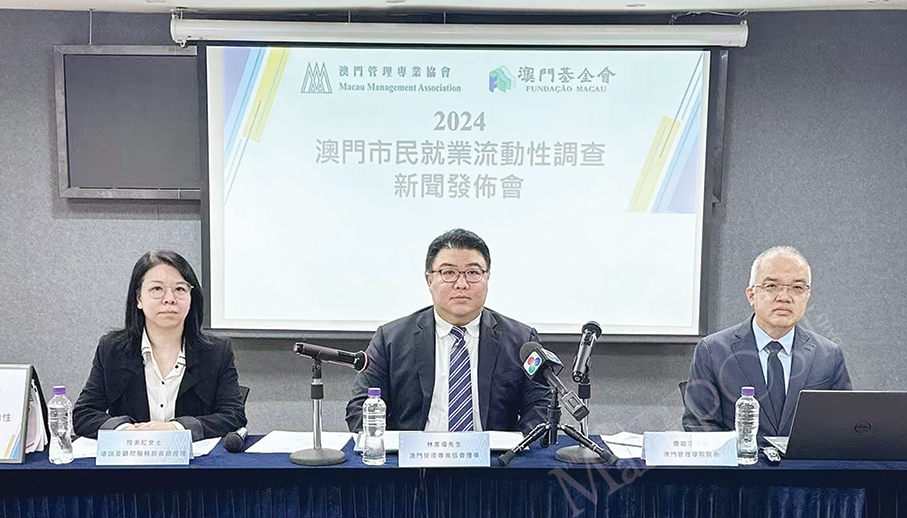
Representatives from the Macau Management Association (MMA) and Macau Institute of Management (MIM) President Samuel Tong Kai Chung (right) look on during yesterday’s press conference about their recent survey, on the MMA premises in Zape. – Photo: MMA