

Chi Lam Chuen (茨林村) residents told the Post yesterday that workers suddenly fenced in a vacant plot of land in their ancient village next to an old house at 5 Pátio do Espinho* (茨林圍 called Chi Lam Vai in Cantonese) at around 10 a.m. yesterday, obstructing access to one of the originally walled village's only two main entrances.
The house includes a café dedicated to Na Tcha, a Taoist tutelary deity. One of the peninsula’s two Na Tcha (known in Putonghua Pinyin as Nezha) temples is located nearby.
According to an article on the Municipal Affairs Bureau’s (IAM) official website, Chi Lam Chuen (“Potato Field Village”) is Macau's last surviving 400-year-old walled village that once housed Japanese Catholics involved in the construction of the Ruins of St. Paul's in the early 17th century and their descendants, has been officially designated as a protected heritage site and incorporated into the St. Paul's Ruins scenic area by the government.
As a living witness to Macau's history and a symbolic landmark, the village has recently benefited from the surging popularity of Na Tcha, in the wake of the immense commercial and cultural success of the Chinese mainland’s blockbuster “Ne Zha 2”. The Na Zha Temple next to the Ruins of St. Paul's has attracted a wave of pilgrims and tourists, as well as locals, boosting the community economy.
Nezha (哪吒), aka Nezha the Crown Prince (哪吒太子) is a protection deity in Taoism, Buddhism, and Chinese folk religion. Nezha, a famous figure in Chinese mythology, is a divine hero whose origins are rooted in ancient Chinese folklore and religious traditions. According to the mythological narrative, Nezha was born during the Shang Dynasty (商朝, around 1600–1046 BCE), as his story is closely tied to the Investiture of the Gods (封神演义), a Ming Dynasty (1368-1644) novel set in that era.
Villagers told the Post yesterday afternoon that the suddenly fenced-in plot was originally private land, but had effectively become a communal gathering space due to prolonged disuse by its owners, while also serving as a critical fire escape route for the small village.
The villagers said that in mid-May, the relevant parties had issued both verbal notices and posted public announcements stating that the plot’s landowner would erect fencing around the vacant plot. The notices demanded the removal of all personal belongings from the site, warning that any remaining items would be disposed of at the owners' risk.
During yesterday afternoon’s on-site visit by the Post, after the fencing-in of the plot, the remaining accessible space requires pedestrians to use a narrow raised ledge between the fence and the pavement. The villagers expressed concern that with Macau entering the typhoon season and due to Chi Lam Chuen’s ageing housing structures with unstable foundations, the situation could potentially lead to casualties during a typhoon.
The villagers also highlighted their safety concerns due to inadequate street lighting in the area and the elevated terrain (1-2 metres above ground level), creating potential hazards for pedestrians. They urged the government to negotiate with the owner of the plot to restore at least limited access to what had been for a long time a “community space”.
The Post published an editorial about “Ne Zha 2” on March 3, headlined Editorial: Ne Zha – China’s soft power answer to Mickey Mouse https://www.macaupostdaily.com/news/24225
*Literally translated, the Portuguese name means “Courtyard of the Thorn”
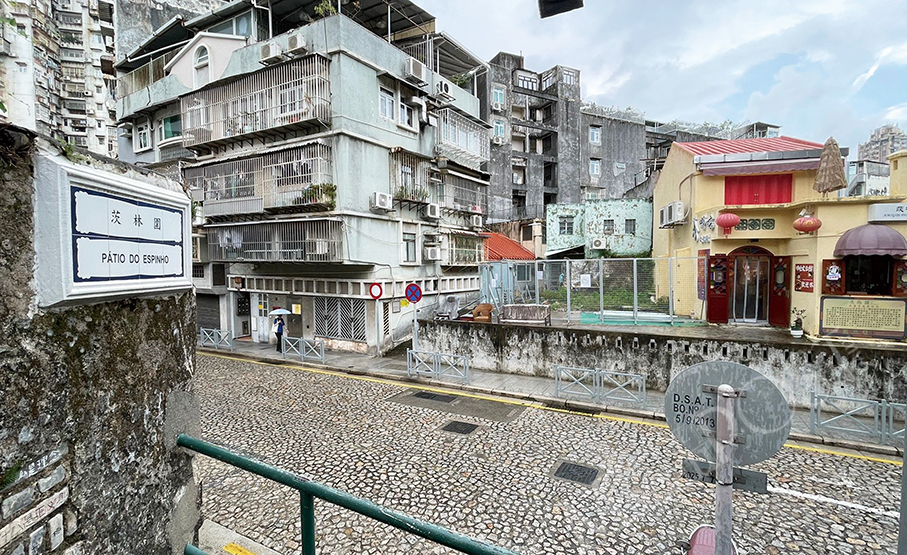
This photo taken yesterday afternoon shows the suddenly fenced-in plot of land next to a café dedicated to Na Tcha, one of China’s most popular deities, at 5 Pátio do Espinho in Chi Lam Village behind the UNESCO World Heritage-listed Ruins of St Paul’s. – Photo: Armindo Neves