

Interview by Rui Pastorin
Domestic violence is an issue that knows no age, race or gender. A spouse might be battered emotionally, psychologically and physically over the most trivial matter, just as easily as a young child or an elderly member of a family can be subjected to the same thing. At the end of it all, abusers stand proud over victims they made to feel voiceless and powerless. And the cycle continues.
In the context of Macau, it is a situation that still happens. People might be shocked to hear about some of the worst cases that end up making their way onto the news and social media, with one of the most recent about a 35-year-old construction worker who subjected his wife to violence and threatened her with a cleaver.
The city continues its joint efforts towards addressing such cases, with measures in place to determine, assess and prevent domestic violence, as well as offer assistance to those involved. Since the implementation of the Domestic Violence Law in 2016, incidents involving children have declined significantly, according to Social Welfare Bureau (IAS) Director Wilson Hon Wai said in an interview with the local media in July, during which he also pointed out that the number of domestic dispute cases have remained stable while public awareness has increased.
Caritas Macau Secretary-General Paul Pun Chi Meng pointed out during an interview with the Post at the Catholic non-profit’s office on Tuesday afternoon that various sectors of civil society, from the government to non-governmental organisations (NGOs), continue to work together, while the Social Welfare Bureau’s 24-hour helpline for victims of domestic violence is an important channel set up for victims and those suspecting abuse.
Pun said that Caritas Macau participates as one of the organisations involved in the joint efforts, with the bureau referring cases to them. “Our role is second assessment”, he said, learning the needs of a family and those involved, exploring the issues and “severe situations” that often haven’t been talked about.
Among the assistance they provide, at least for those who already have a place or shelter to stay, are life planning, family education and parent-child activities, financial and emotional assistance for children, and, if possible, legal assistance by finding volunteer lawyers.
Pun elaborated that last year, Caritas Macau’s centres related to family and youth services had received a total of 10 cases referred by the bureau, among which were two related to child abuse and three related to family domestic violence.
Pun underscored the IAS hotline’s importance as the main channel in assisting victims and assessing situations, but also added that people are also welcome to call the Catholic non-profit’s 24-hour “Life Hope” hotline. Despite not being specifically for domestic violence, “the hotline also listens to them”, Pun said. He added that from January to the end of August, they received 12 calls related to domestic violence.
Everyone has a voice
Domestic violence can come in the form of physical, emotional, psychological, sexual and financial abuse or even stalking, as noted by UNESCO on its website. It is a situation that is complex and is not always easy to spot. And for those who are seeing it happen or are experiencing it, Pun emphasised the importance of speaking up.
Some people might choose not to say anything because they believe that the abuse won’t happen again or that saying something could cause even bigger problems such as splitting up one’s family or sending an abuser to prison. However, by maintaining silence, Pun said that this will only exacerbate the issue, also highlighting that victims should not believe that an abuser will simply stop. Therefore, it’s important to “try to think differently” and bring their situations to light, adding: “If the situation is not handled, the case will get worse”.
Pun highlighted that more can always be done to tackle the situation and among those that he hopes to see in Macau are pre-marriage counselling (including related seminars and workshops) to help prepare couples emotionally and for possible marital challenges, and teach them to better communicate with each other; increasing training for couples on how to care for newborns to prevent abuse; and financial management training.
With negative comments and emotions as well as a lack of communication being things that contribute to abuse, he also highlighted the importance of emotional management training for families, benefiting not only couples but even children. Being able to openly talk about problems is also helpful, Pun highlighted, adding that in Chinese culture, it is commonly thought that family matters should only be kept within themselves. “I think nowadays we should change this [outdated] mindset”, he pointed out, also noting how opening up to professionals could be helpful.
Lastly, continuous research on domestic violence cases, why it happens, the reasons behind why it becomes hard to tell others, and how members of society such as doctors can identify signs of abuse as well as how to determine whether domestic violence is happening needs to continue.
“There are hidden cases in every society. Therefore, we have to encourage the public to know the number” – the IAS 24-hour domestic violence helpline: 2823 3030, Pun concluded.
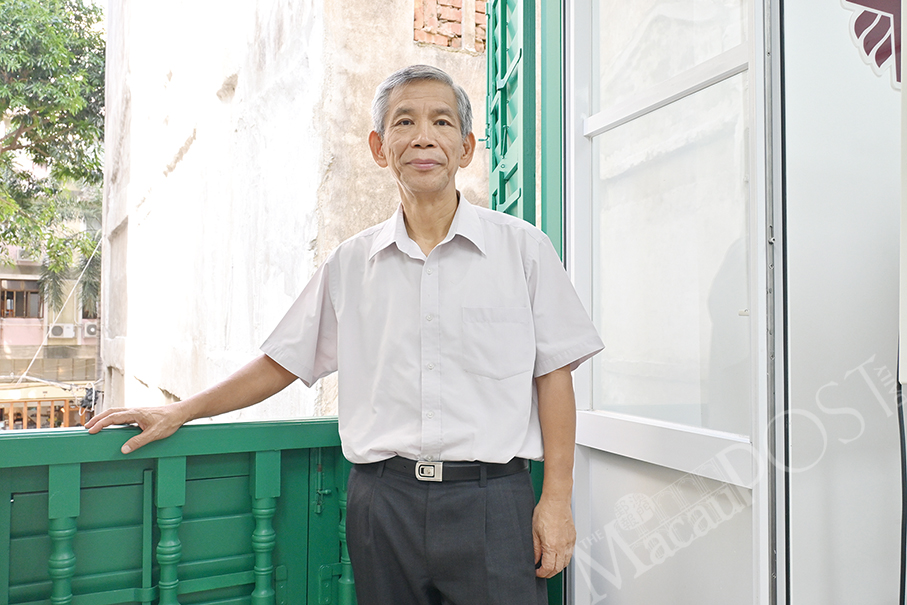
Caritas Macau Secretary-General Paul Pun Chi Meng poses after Tuesday’s interview at the local charitable organisation’s head office in Largo de Santo Agostinho. – Photo: Rui Pastorin