

A total of 14 candidates fielded by six electoral groups are vying for the 12 seats at stake in the 2025 indirect Legislative Assembly (AL) election on Sunday, as two indirect election candidacy groups comprising four candidates are competing for the labour sector’s two seats, while only one candidacy group is running for each of the other four sectors.
The legislature’s 12 indirectly-elected seats comprise four seats representing the city’s industrial, commercial and financial sector, three seats from the professional sector, two seats from the labour sector, two seats from the cultural and sports sector, and one seat from the social services and educational sector.
The labour sector is the only sector where more than one group is running this time.
The number of candidates fielded by each indirect election group must be the same as the respective sector’s number of seats.
Consequently, while the four candidates from the two groups for the labour sector are competing for the sector’s two indirectly-elected seats, all candidates of the other four sectors’ electoral groups are slated to be elected uncontested on Sunday.
In the 2021 indirect election, only one candidacy group ran for each of all five sectors, meaning that all of the then 12 candidates were elected unopposed.
For the 2025 indirect election of the four seats in the industrial, commercial and financial sector, the Union of Macau Business Interests list has fielded two of its sitting lawmakers as its candidates, while Kou Hoi In and Wang Sai Man did not seek re-election this time.
Kou, 72, who is currently the legislature’s president, was the group’s first-ranked candidate four years ago, while Wang was its fourth-ranked candidate.
This will also mean that the legislature will have a new president in the upcoming new four-year term.
The Union of Macau Business Interests group has fielded José Chui Sai Peng, 65, and Ip Sio Kai, 64, who were the second and third-ranked candidates in the indirect election four years ago, as its first and second-ranked candidates for the 2025 indirect election, while it has fielded incumbent directly-elected lawmaker Si Ka Lon, 47, as its third-ranked candidate.
The group has fielded local businessman Kevin Ho King Lun, 49, as its fourth-ranked candidate.
For the 2025 indirect election of the professional sector’s three seats, the three sitting lawmakers, Chui Sai Cheong, Vong Hin Fai and Chan Iek Lap, who were the three candidates of the Union of Macau Professionals’ Interests group in the indirect election four years ago, did not seek re-election.
Chui Sai Cheong is currently the legislature’s vice-president.
Instead, the Union of Macau Professionals’ Interests group has fielded incumbent appointed lawmaker Iau Teng Pio, 61, as its first-ranked candidate for the 2025 indirect election, while it has fielded newcomers Vong Hou Piu, 62, and Wong Chon Kit, 47, as its second and third-ranked candidates.
Iau is an associate professor in the public University of Macau’s (UM) Faculty of Law. He is also one of the faculty’s two associate deans.
Vong is an accountant by profession, while Wong is a dentist whose father was a well-known journalist.
The two groups running in the 2025 indirect election of the labour sector’s two seats comprise the Joint Candidacy Committee of Employees’ Associations and the Union of Workers’ Associations.
The Joint Candidacy Committee of Employees’ Associations group ran in the indirect election four years ago, while the Union of Workers’ Associations group is running in the indirect legislative election for the first time.
While there are two groups competing for the labour sector’s two seats, all four candidates are senior board members of the influential Macau Federation of Trade Unions (commonly known as Gung Luen in Cantonese).
The Joint Candidacy Committee of Employees’ Associations group has fielded incumbent lawmaker Lam Lon Wai, 49, for the 2025 indirect election, but sitting legislator Lei Chan U, who was the group’s second-ranked candidate four years ago, did not seek re-election this time. Lei is also a Gung Luen senior board member.
Instead, the group has fielded Kong Ioi Fai, 52, as the second-ranked candidate this time.
The new Union of Workers’ Associations group has fielded Leong Pou U, 51, and Kelvin Choi Kam Fu, 47, as its first and second-ranked candidates.
Lam, Kong, and Leong are currently three of the Gung Luen vice-chairmen, while Choi is currently one of the Gung Luen vice-presidents.
Lam is one of the current three vice-principals of Lou Hau High School, which is run by the Macau Federation of Trade Unions.
For the 2025 indirect election of the cultural and sports sector’s two seats, the Rising Sun Cultural and Sports Union group has fielded sitting lawmaker Angela Leong On Kei, 64, as its first-ranked candidate, while restaurateur Andrew Chan Chak Mo did not seek re-election this time.
Four years ago, Andrew Chan was the group’s first-ranked candidate, while Angela Leong was the second-ranked candidate at that time.
The group has instead fielded current appointed lawmaker Ma Chi Seng, 47, as its second-ranked candidate.
For the 2025 indirect election of the social services and educational sector’s only seat, the Social Service and Education Promotion Association group has fielded sitting lawmaker Alan Ho Ion Sang, 63, as its candidate.
Ho, who had been a directly-elected lawmaker since 2009, became an indirectly-elected legislator representing the social services and educational sector in the indirect election four years ago.
Ho is currently one of the vice-chairmen of the influential Macau General Union of Neighbourhood Associations (commonly known as Kai Fong in Cantonese).
In addition to this time, the number of candidates also exceeded the number of seats at stake in the 2017 indirect election since 2001 when the Macau Special Administration Region (MSAR) held its first indirect legislative election.
In the 2017 indirect election, two indirect election candidacy groups comprising six candidates were competing for the professional sector’s three seats.
Proportional representation system
Macau’s legislative elections are based on the proportional representation system. There are no political parties in Macau. Customarily, community organisations set up ad hoc candidacy groups in the run-up to the elections that are held every four years. Voters cast their ballots for groups, not individual candidates.
Key features of Macau’s proportional representation system
1. One single constituency
Macau treats the entire territory as one single constituency for its direct elections. This means every voter in Macau votes from the same list of candidate groups.
2. Closed list system
Political groups (parties or associations) submit closed lists of candidates. Voters cast their vote for one entire group; they cannot change the order of candidates on the list or select individuals from different lists. The order of candidates on each list is fixed by the group itself.
3. Method for seat allocation
This is the mathematical formula used to distribute the 14 seats among the candidacy groups, based on the “highest averages” method designed to favour larger groups. Here’s how it works:
Step 1: Each group receives a No. of votes.
Step 2: The total votes for each group are divided by a series of divisors (1, 2, 4, 8, 16, etc.).
Step 3: The resulting quotients from all groups are ranked from highest to lowest.
Step 4: The 14 highest quotients each win a seat for the group that produced that quotient.
The direct and indirect elections will be held from 9 a.m. to 9 p.m. on Sunday. Public transport (public buses and LRT) will be free of charge. Provisional election results are expected for early Monday at the earliest.
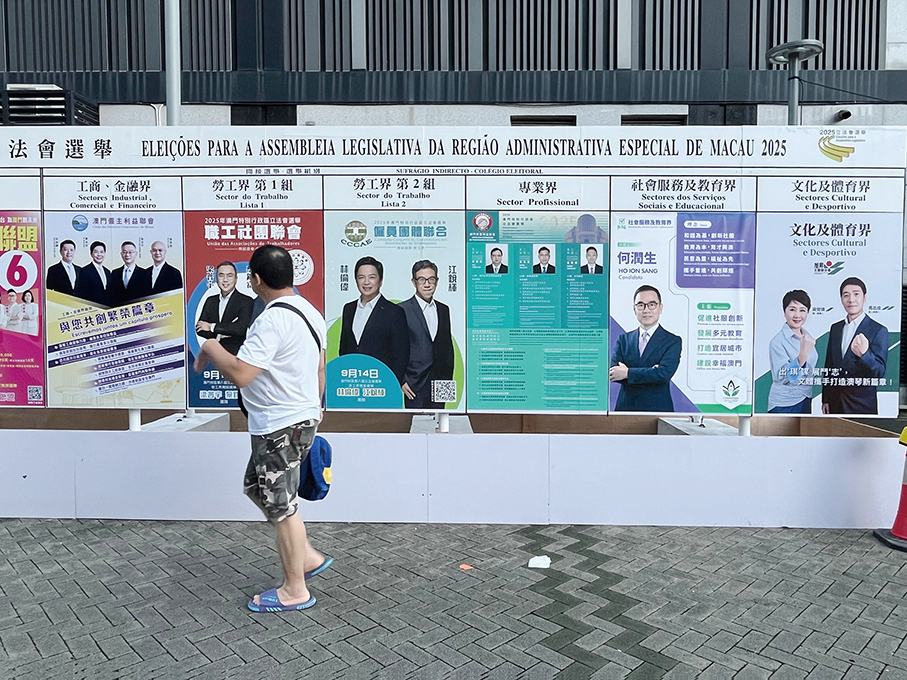
A man looks at indirect legislative election groups’ campaign posters on a board near a recreational area in Lam Mau Tong district yesterday. – Photo: Maria Cheang Ut Meng