

Macau’s 20 casinos generated gross gaming revenue (GGR) of 19.89 billion patacas (US$2.46 billion) last month, marking a year-on-year increase of 5.5 percent, the Gaming Inspection and Coordination Bureau (DICJ) announced today.
Month-on-month, however, GGR fell by 12.0 percent, from March’s 22.61 billion patacas.
April produced the local casino sector’s lowest monthly GGR in the first four months of the year and its lowest year-on-year growth rate, after February’s 4.5 percent.
In the first four months, GGR rose year-on-year by 12.1 percent to 85.7 billion patacas.
Macau’s government-concessioned gaming industry is operated by six competing integrated resort (IR) operators: Sands, Galaxy, SJM, Melco, Wynn, and MGM. Under their concession agreements with the government, these operators are required to enhance their non-gaming attractions and support the promotion of Macau’s cultural heritage and old-quarter renewal projects. The operators pay 35 percent of their GGR as a direct gaming tax to the government, along with an additional 5.0 percent in levies to fund various public causes.
As of the end of the first quarters, the six operators ran a total of 20 casinos, a 52.4 percent decrease from the peak of 42 casinos in 2021. This decline is primarily due to a government-ordered consolidation of the gaming industry, which included an official ban on “satellite casinos” operated by third-party enterprises in collaboration with gaming concessionaires.
During the gaming industry’s three-year consolidation process, which officially ended on December 31, 2025, the gaming tables and slot machines from shuttered satellite casinos, along with their local employees, were transferred to casinos directly run by the gaming concessionaires.
Currently, SJM and Sands each own five casinos, Galaxy and Melco operate three each, while Wynn and MGM run two each.
Baccarat generates 85.2 pct of GGR in Q1
According to the latest available DICJ statistics, baccarat accounted for 85.2 percent of local casinos' GGR across their 16 games of chance at the end of this year’s first quarter. In comparison, roulette, Europe’s classic game of chance, generated a mere 0.49 percent of GGR.
At the end of last year, Macau’s casinos operated 6,000 gaming tables and 12,000 gaming machines, according to the bureau.
Macau’s officially concessioned casino industry got off the ground in 1849.
According to the latest available Statistics and Census Bureau (DSEC) data, the number of persons engaged in the gaming sector amounted to 53,272 at the end of last year, accounting for 10.7 percent of Macau’s total labour force of 496,600 around that time (Dec 2025-Feb 2026).
In December, according to DSEC figures, the average earnings (excluding irregular remuneration) of the gaming sector’s full-time employees stood at 28,020 patacas.
GDP rises 7.1 pct in Q1
Meanwhile, according to preliminary data released by the Statistics and Census Bureau (DSEC) yesterday, Macau’s GDP rose by 7.1 percent year-on-year in real terms in the first quarter, reaching 108.1 billion patacas. A DSEC statement said the growth was mainly due to a “notable” 13.9 percent increase in exports of services thanks to surging visitor arrivals during the Chinese New Year holidays and a raft of festive events.
Hotel guests rise 2.6 pct to 3.67 million in Q1
According to a separate statement released by the bureau yesterday, Macau’s number of hotel guests grew by 2.6 percent year-on-year to 3.67 million in the first quarter. Guests from the Chinese mainland (2.74 million) and the Hong Kong Special Administrative Region (390,000) rose by 0.6 percent and 4.3 percent respectively. Foreign guests increased by 16.0 percent to 338,000, reaching 9.2 percent of the total number of guests in this year’s first three months. South Koreans (106,000) continued to top Macau’s list of international hotel guests.
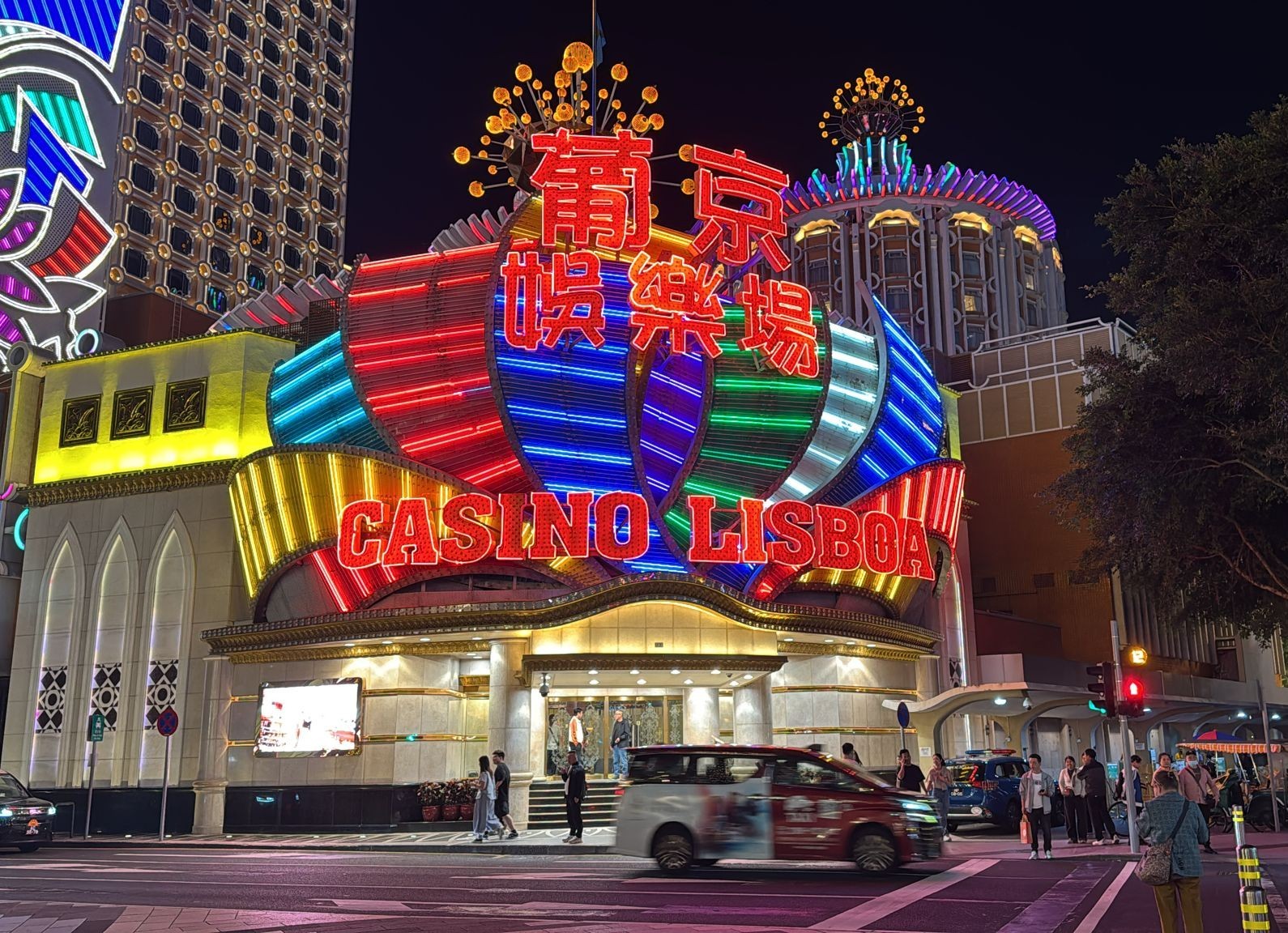
Caption: A taxi drives past the main entrance of Hotel Lisboa, Macau’s oldest existing casino, last night. The casino-hotel on Praça Ferreira do Amaral
opened in February 1970. - Photo: Carl Leong