

The Macau Health Bureau (SSM) announced yesterday that from today it will strengthen its health monitoring measures for those arriving in Macau from various African countries in response to the World Health Organisation’s (WHO) latest assessments of the potentially deadly Ebola* virus disease.
An SSM statement yesterday noted that during a recent joint online press briefing, the Africa Centres for Disease Control and Prevention (Africa CDC) and the WHO warned that 10 African countries are at high risk of the latest Ebola outbreak in the Democratic Republic of the Congo (DRC) and Uganda. The 10 high-risk countries are Angola, Burundi, the Central African Republic (CAR), Ethiopia, Kenya, the Republic of the Congo (ROC), Rwanda, South Sudan, Tanzania, and Zambia.
The SSM statement said that in response to the ongoing Ebola outbreak in the DRC and Uganda, and remarks made by the Africa CDC and the WHO during their joint press briefing, the Macau Health Bureau decided to strengthen its measures to tackle the Ebola threat, with the aim of further reducing the risk of Macau recording imported cases.
The statement also underlined that the Macau Health Bureau also made the decision after referencing the Chinese Centre for Disease Control and Prevention’s (China CDC) latest guidelines for the prevention and control of the Ebola virus disease.
The strengthened measures will start at 9 a.m. today, the statement said.
According to the statement, health inspection personnel at all major border checkpoints will reinforce health enquiries and risk assessments for individuals who have visited the relevant countries within the last 21 days or who hold passports from these countries, comprising the DRC and Uganda hit by Ebola outbreaks, as well as the 10 newly classified high-risk African countries.
If a person who has visited any of the 12 African countries presents with symptoms suggestive of the Ebola virus disease, they will be immediately transferred to the public Conde de São Januário Hospital Centre for further assessment and examination, the statement said, adding that those without symptoms will be subject to health monitoring and management by the Macau Health Bureau.
The statement said that given that the incubation period for the Ebola virus disease can be up to 21 days, individuals arriving in Macau who have visited any of the 12 African countries are now required to undergo self-health management for a period of 21 days from the date of entry, where the Health Bureau will conduct health monitoring and follow-up measures on the individuals concerned throughout the 21-day period.
The individuals concerned, the statement said, should self-monitor their health condition daily during the 21-day period. If they come down with symptoms such as fever, fatigue, headache, sore throat, vomiting, diarrhoea, or unexplained bleeding, they should seek medical treatment immediately, the statement said.
If they need to go to a medical institution for diagnosis and treatment, they should avoid using public transport, take personal protective measures, avoid physical contact with others, and inform the healthcare workers of their travel history and contact history, the statement said.
The Macau Health Bureau’s latest initiatives to respond to the Ebola threat came after it issued a warning early last week urging residents and private medical institutions to stay vigilant against the Ebola virus disease, after the WHO declared the ongoing Ebola outbreak in the DRC and Uganda a Public Health Emergency of International Concern.
*Ebola is a severe viral illness which can lead to high fever, internal bleeding, and organ failure, and it can be fatal. Ebola spreads when bodily fluids (such as blood, vomit, diarrhoea, and sweat) of an infected person come into direct contact with another person’s broken skin or eyes, nose, or mouth. Early symptoms usually begin suddenly and can include fever, severe weakness, muscle pain, headache, and sore throat, followed by vomiting, diarrhoea, rash, and sometimes bleeding. Because symptoms can resemble other illnesses at first, rapid diagnosis and strict infection-control are crucial. There’s no single cure, but treatment focuses on supportive care and targeted therapies. – Poe
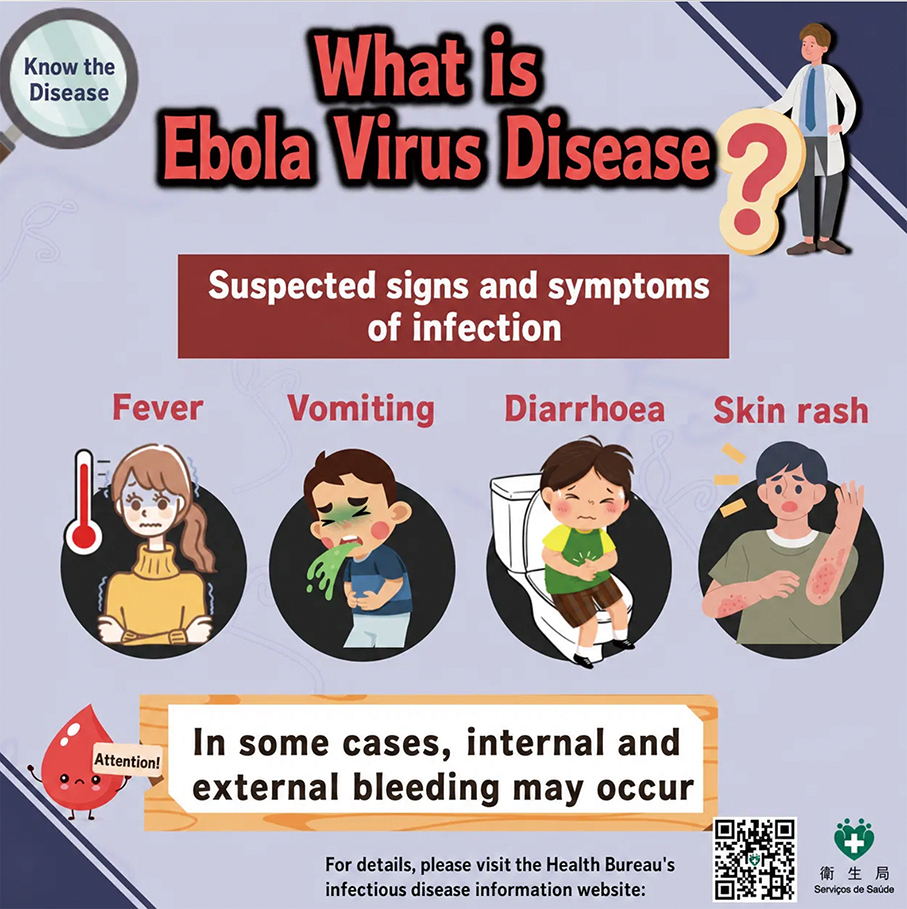
The poster released by the Health Bureau (SSM) yesterday shows information on the Ebola virus disease. The AI-translated English text was arranged by the Post.