

Foreign Ministry Commissioner Liu Xianfa briefed Macau’s English- and Portuguese-language media, diplomats accredited in Macau, foreign delegates to the Forum for Economic and Trade Cooperation between China and Portuguese-speaking Countries (Forum Macao), local academics, and representatives of chambers of commerce based in Macau about the nation’s “two sessions” that were held in Beijing earlier this month.
The term ”two sessions” denotes the concurrently held annual sessions of the National People’s Congress (NPC) and the National Committee of the Chinese People’s Political Consultative Conference (CPPCC). Liu, a former assistant foreign minister, is a member of the CPPCC National Committee.
In his 1 ½ hour presentation at the Office of the Commissioner of the Ministry of Foreign Affairs in Zape, Liu, who holds a doctorate in management science, underlined the achievements of this year’s “two sessions”, detailed the nation’s “whole-process people’s democracy in practice”, pointed out the country’s “institutional strengths” and called for “joining hands to achieve Macau’s brighter future”.
On the economic front, Liu, who worked as a senior executive in China’s petrochemical industry and as a high-ranking official in the central authorities’ economic, trade, resource conservation and environmental protection departments before joining the diplomatic service, underlined the fact that China last year was the No.1 contributor to global growth, accounting for 30 percent of the world’s economic growth. He also pointed out that 62 of the world’s 153 lighthouse factories* are based in China.
Liu also introduced his audience to the “Six Little Dragons” – half a dozen enterprises consisting of Game Science, DeepSeek, Unitree Robotics, DEEP Robotics, BrainCo and Manycore Tech – “all ‘tech upstarts’ that have risen to prominence in Hangzhou over the past two years and hold significant influence with their respective industries”.
During his presentation in highly proficient English, Liu also stressed the important guidance that President Xi Jinping gave Macau and Hong Kong during his inspection visit to Macau last December and also his pivotal comments while attending several meetings during this month’s “two sessions” in Beijing, such as when reminding NPC deputies that “technological innovation and industrial innovation constitute the fundamental pathways for developing new quality productive forces.”
Liu also introduced his audience to the new concept of “embodied AI: artificial intelligence equipped with a physical body, which allows it to better interact with the surroundings, often through sensors and robotic arms.” He stressed that “experts believe that a number of humanoid robot models will enter mass production this year in China, marking a significant milestone in the application of AI technology”.
The presentation was followed by an informal exchange of views among the guests and foreign ministry officials, including Liu, during an afternoon tea gathering in the building.
*Lighthouse Factories are advanced manufacturing facilities recognised for their cutting-edge use of technology, automation, and innovation. They serve as global benchmarks for efficiency, productivity, and sustainability in industrial production. These factories are often part of the Fourth Industrial Revolution (Industry 4.0), leveraging technologies like artificial intelligence (AI), the Internet of Things (IoT), robotics, big data analytics, and digital twins to optimise operations. – DeepSeek
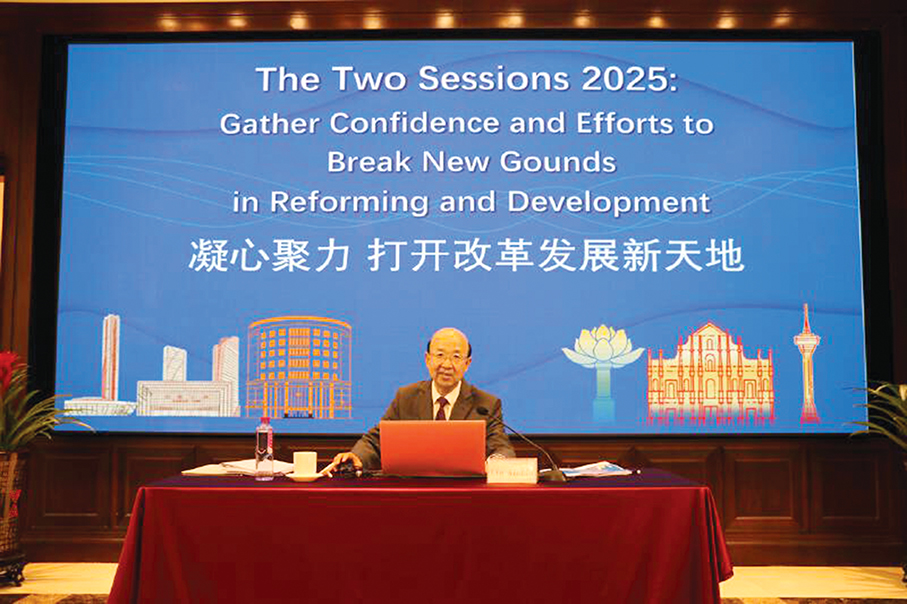
Foreign Ministry Commissioner Liu Xianfa speaks during yesterday afternoon’s presentation at the Commission about the achievements of the nation’s “two sessions” in Beijing. – Photo courtesy of TDM
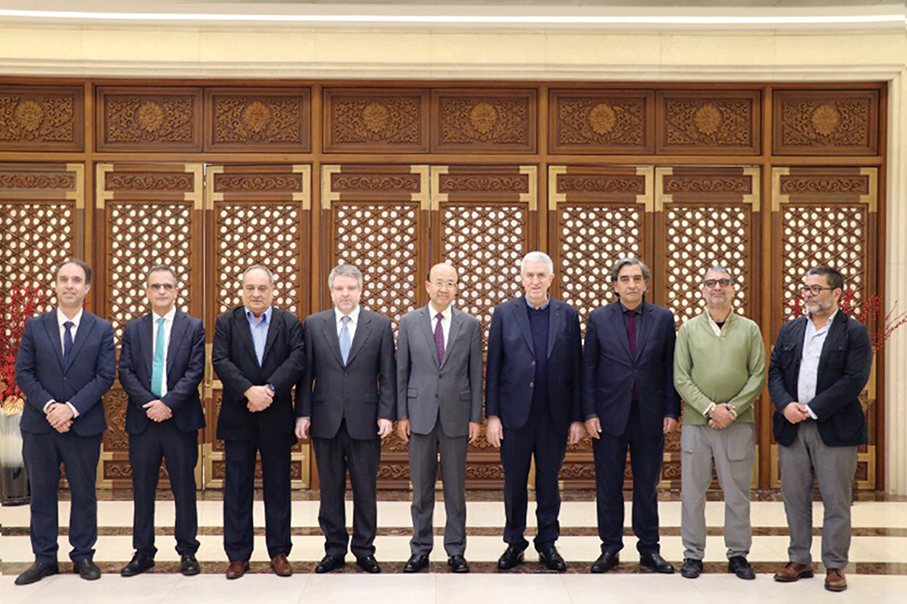
Commissioner Liu Xianfa (centre) poses at the Commission with representatives of Macau’s English- and Portuguese-language media before yesterday’s presentation about the achievements of the nation’s “two sessions”. – Photo courtesy of TDM