

The University of Macau (UM) launched its 39th Portuguese Language Summer Programme last Thursday, drawing over 400 participants from around the globe for three weeks of immersive language learning and cultural exchange.
The summer programme has attracted 406 participants from places including the Chinese mainland, Macau, Hong Kong, China’s Taiwan region, Australia, and Timor-Leste (East Timor). According to a statement provided by the public university yesterday, the three-week programme offers a combination of language instruction and cultural experiences designed to deepen participants’ understanding of Portuguese-speaking countries (PSCs).
The programme, launched in 1986, is the university’s longest-running educational initiative, the statement noted. According to the statement, UM Vice Rector Rui Martins highlighted in a speech the importance of embracing the beauty of the Portuguese language while encouraging students to fully engage in the immersive campus experience. Interactive teaching, with most classes conducted in Portuguese, and aspects of history, society, politics, and economics related to Macau and the wider Portuguese-speaking world, are also featured in the programme.
The statement pointed out that cultural activities such as capoeira* and folkdance workshops have also been added into the curriculum to enhance learning through art and movement. For more advanced students, the programme includes in-depth modules on contemporary Portugal and the history of PSCs.
The statement noted the programme’s goal of fostering global exchange and building connections between participants. By promoting linguistic and cultural literacy, UM aims to highlight the increasing relevance of the Portuguese language on the world stage, the statement said.
The world’s nine PSCs comprise a total population of 290 million.
*Capoeira is a Brazilian martial art that combines elements of dance, acrobatics, and music. It originated in the 16th century among African slaves in Brazil and is characterised by fluid, dance-like movements, kicks, and spins. – Source: Poe
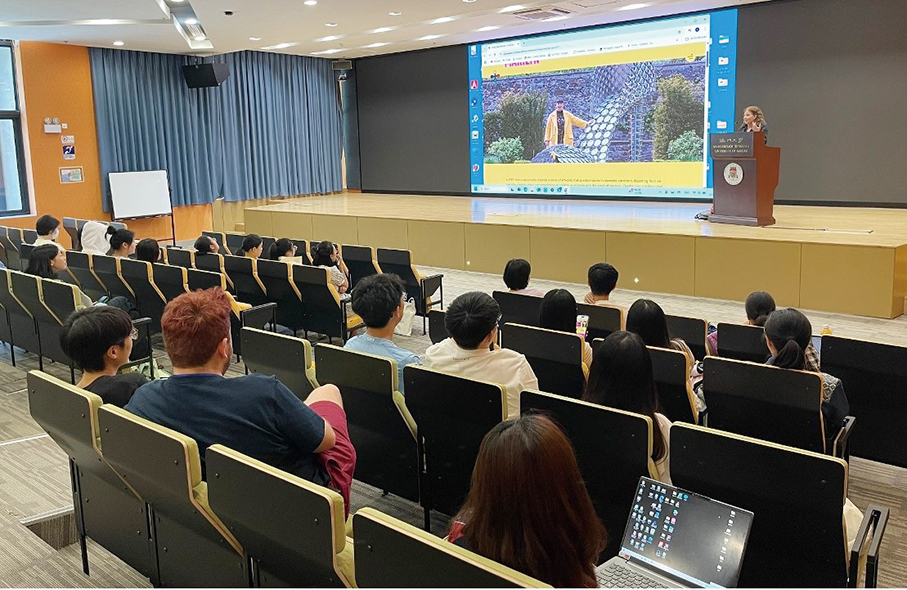
This undated handout photo shows participants attending a session of the ongoing Portuguese Language Summer Programme at the public University of Macau (UM) in Hengqin. – Photo: UM