

There are no more operations of the 100 “blue” radio taxis from today as their licences expired last night, while the 200 “red” radio taxis continue to be in service.
The Transport Bureau (DSAT) issued a statement on the matter yesterday.
The government granted two concessions for the city’s radio taxi services, which were granted to the same company, Macau Radio Taxi Services Limited, at two different times. The first concession, with 100 radio taxis (blue), commenced on April 1, 2017 and was scheduled to expire on September 30 this year, while the second concession, with 200 radio taxis (red), began on December 1, 2019 and is now scheduled to end on May 31, 2028.
The “blue” taxis, unlike their “red” counterparts, had a calling fee of 5 patacas.
The company’s taxis are not allowed to pick up those hailing a cab in the street. To use the company’s ride-hailing service, prospective passengers can phone its call centre or use its own mobile ride-hailing app.
The company’s radio taxis are officially known as “special taxis”.
Common taxis – as opposed to special radio taxis – are colloquially known as “black taxis” (“hak dik” in Cantonese), as the colour of common taxis is black.
Yesterday’s statement noted that after the expiration of the “blue” radio taxi agreement, there are currently still over 1,400 taxis in service in the city in total, comprising common taxis as well as the 200 “red” radio taxis.
According to data on the bureau’s website, at the end of the second quarter, there were 1,583 taxis in service in the city, comprising 1,283 “black” taxis and 300 “special” taxis.
Yesterday’s statement also said that the Macau Radio Taxi Services Limited has arranged for about 70 percent of its “blue” taxi drivers to work for its fleet of “red” taxis.
Before the expiration of the “blue” radio taxi agreement, according to the statement, about 200 drivers worked for the company’s fleet of “blue” taxis.
The statement also said that some of the remaining 30 percent of “blue” taxi drivers want to continue to work as cabbies, because of which the bureau is asking companies operating “black” taxis in the city to provide their respective job vacancy information to them.
In addition to being allowed to pick up passengers while travelling around the city, “black” taxis are also legally allowed to provide a radio taxi service.
According to the current law regulating the city’s taxi sector, which took effect in June 2019, only companies are allowed to bid for a licence to operate “black” taxis.
Yesterday’s statement also noted that with the aim of increasing the number of “black” taxis in the city more rapidly, the government has decided to grant two more company licences to operate common taxis without launching a public tender, enabling 100 new taxis to hit the road by the second quarter of next year.
Following a public tender process, the government granted 10 company licences last year to operate common taxis, valid for eight years, with each company to operate 50 vehicles. The 500 new common taxis have gradually come into service since late last year.
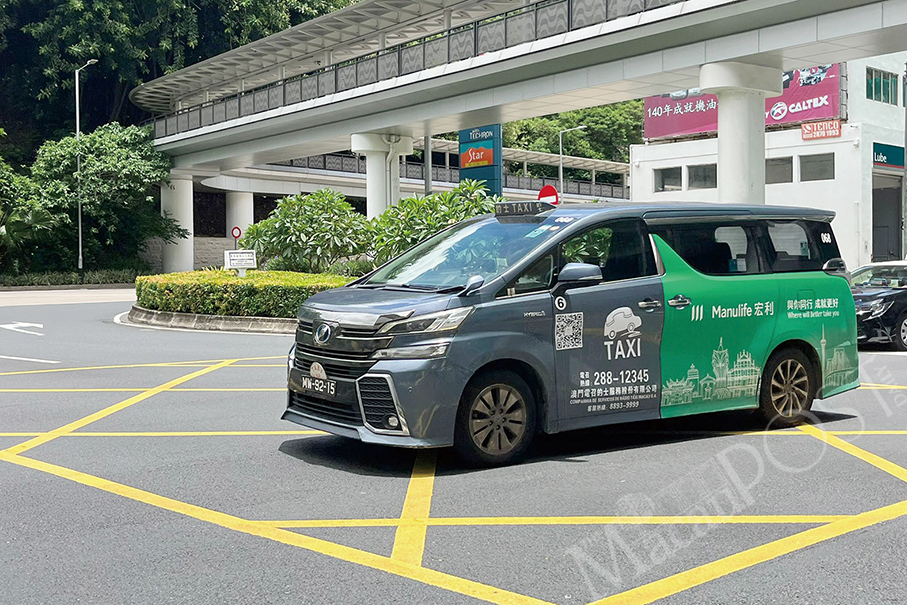
This file photo taken in June shows a “blue” radio taxi travelling along Avenida do Dr. Rodrigo Rodrigues in Zape. – Photo: Maria Cheang Ut Meng