

Interview by William Chan
The “Red Market Art and Cultural Fest 2025-2026,” a two-year programme spearheaded by local art group MyLand Culture launched its opening ceremony at the Red Market, officially known as Almirante Lacerda Market, on November 15, coinciding with the opening of the “Echoes of the Red Market” exhibition.
Its curators and artists talked to the Post in an exclusive interview at the traditional wet market on Monday.
“The festival’s programme is designed to revitalise community energy, attract foot traffic, stimulate economic activities, and foster collaborative learning,” Pal Lok Chok, president of MyLand Culture and Director of the Fest, noted. “The core aim is to explore how traditional markets can preserve local culture and folk wisdom amid evolving times, promoting creative placemaking with all Red Market stakeholders.”
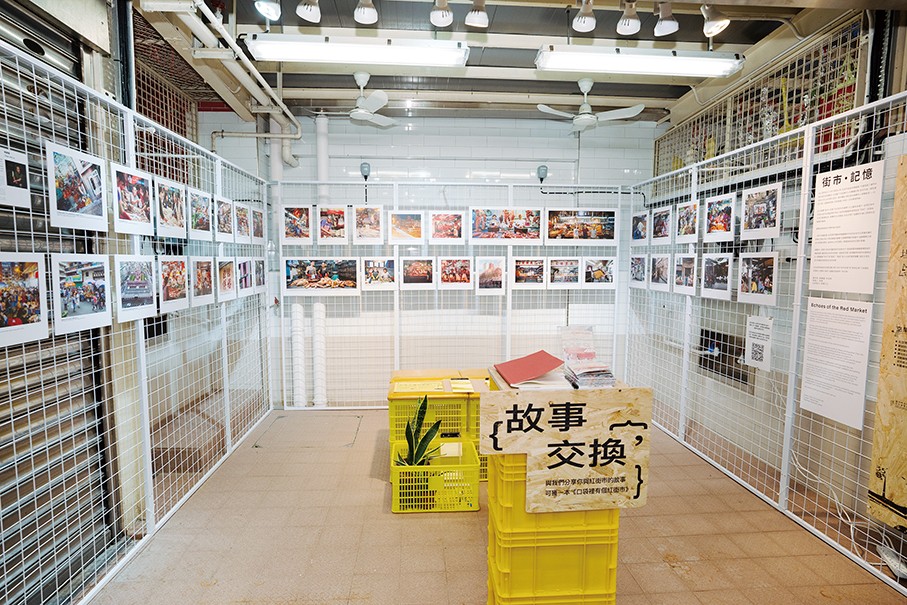
“The ‘Echoes of the Red Market’ exhibition, displayed within the market itself, is a powerful testament to this vision,” curator Chang Chan explained, adding that that the exhibition is divided into a photography collection and an art installation. “Through photographs of fleeting moments in the Red Market over the years and an installation which recreates a kitchen space, the exhibition invites visitors to explore urban memories and interpersonal connections within community public spaces.”
Chan Hin Io and the art of connection
Veteran photographer Chan Hin Io, whose work forms the first half of the exhibition, describes his practice as “rooted in the community.” His decades-long project of documenting Macau’s urban development and its people as a labour of love, built on genuine relationships with the market’s vendors.
“I will often meet with the neighbours, chat with them,” Chan shared. “This is a necessary part of my work as a community-based photographer. The information and conversations we have are a great help to my photography.”
Chan’s collection spans decades, with some of the earliest photos dating back to the 2000s, capturing the now-vanished landscape of the surrounding area, such as the old Tou Fa Kong (“桃花崗”). His most striking pieces are large-format panoramic images of the market’s interior, which he revealed were created using a multi-shot stitching method with a specialised lens.
“I use three separate shots stitched together,” he explained, noting that the technique, which he believes is unique to his work, allowed him to capture the market’s vertical lines and vast scale without distortion. This meticulous approach is a fitting parallel to the structured chaos of the market itself.
The true value of his work, however, lies in its emotional resonance. “The people in the photos are often here at the market,” Chan said. “They can see the scenes of their past work, which creates a sense of familiarity and brings back memories of that time.”
Situ Jian and the domestic echo
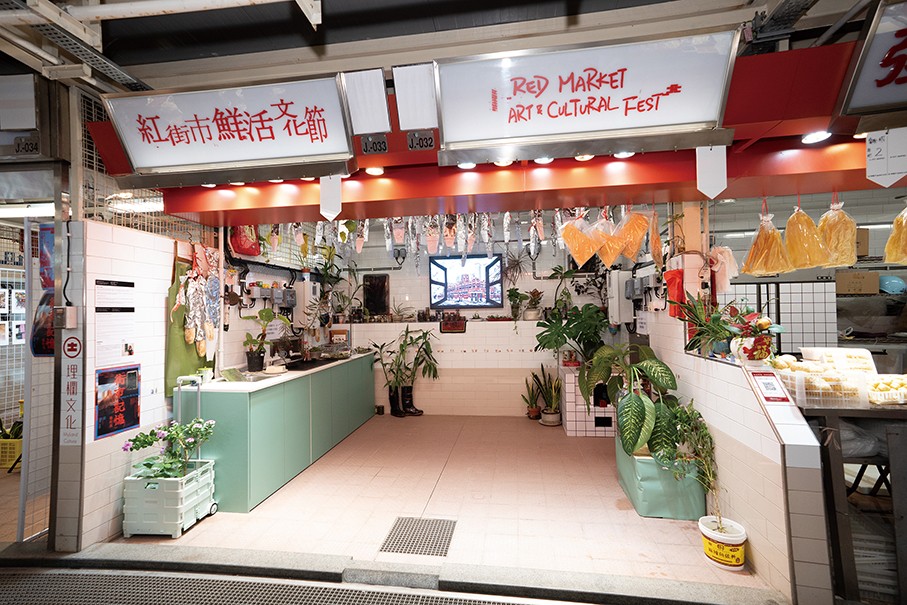
The second half of the exhibition, Situ Jian’s installation, offers a deeply personal counterpoint to Chan’s documentary style. Titled “Kitchen Memory,” the work transforms one of the market stalls into a domestic kitchen space, symbolising the market’s role as a bridge between the public sphere and private homes.
Situ, an artist who has recently embraced installation and mixed media, explained her shift from traditional painting: “I started thinking about why I couldn’t paint anymore after having children. It wasn’t just time; it was the reality of keeping my art materials separate from the food preparation.” This conflict between the artist’s life and the demands of a mother and homemaker became the central theme.
Her installation is a collage of domestic life, featuring real kitchen objects that she used for paintings from her home – a chopping board, old jars – interspersed with artistic elements. The jars, for instance, are filled with “memories” like stationery and dried food, mimicking the vendors’ own cluttered stalls. She even included a small, wilting plant, a nod to her interest in “marginal objects” in the city, such as stray animals and housewives.
Situ’s work is a deliberate attempt to connect with the market community. She uses elements familiar to the vendors, such as aprons, rubber gloves, and even a mock-up of salted fish made from tin foil, to create a sense of belonging.
“I really want the neighbours and the stall owners to like it,” she said. “They are here every day. If they find it jarring, it would be a failure.” The response has been overwhelmingly positive, with vendors recognising the familiar elements and the installation’s depiction of the market building itself.
“The exhibition space changes every day. People add things, and the plants might wilt, so it’s a living, breathing installation,” she said. This constant flux perfectly mirrors the organic, ever-changing environment of the Red Market, ensuring that the “echoes” resonate not just with the past, but with the present moment.
The exhibition is on view until December 14 at Stalls J-032 to J-035 on the ground floor. It is open from 10 a.m. to 5 p.m., with a break between 1 p.m. and 2 p.m. Lok also drew attention to the hand-illustrated market zine*, “A Pocketful of Red Market,” created by the illustrator Yang Sio Maan. Visitors can either spend 50 patacas at the market or share a personal market story to redeem the zine. Looking ahead, the initiative will continue to offer a variety of activities, including market workshops, artist residency programmes, and art exhibitions.
*The word is a direct shortening of the word “magazine” or “fanzine.” It emerged from the science fiction fan communities of the 1930s and 40s (“fanzines”) and was later cemented by the punk and feminist movements of the 1970s-90s, which used zines as a vital communication tool.
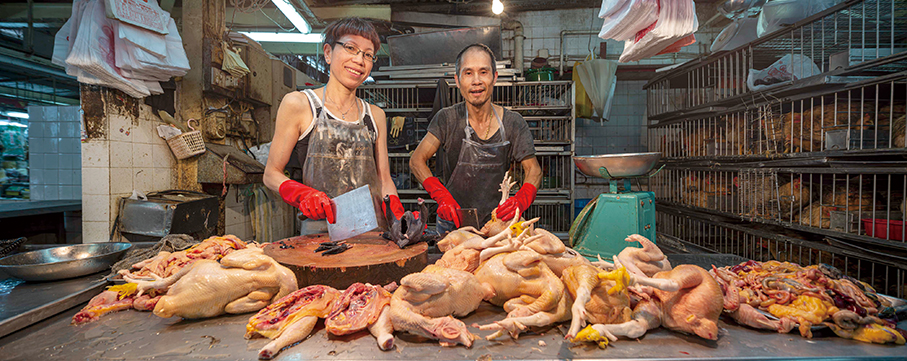
This photograph, captured by Chan in 2012 using a multi-shot stitching technique, depicts a couple selling chicken at the Red Market.
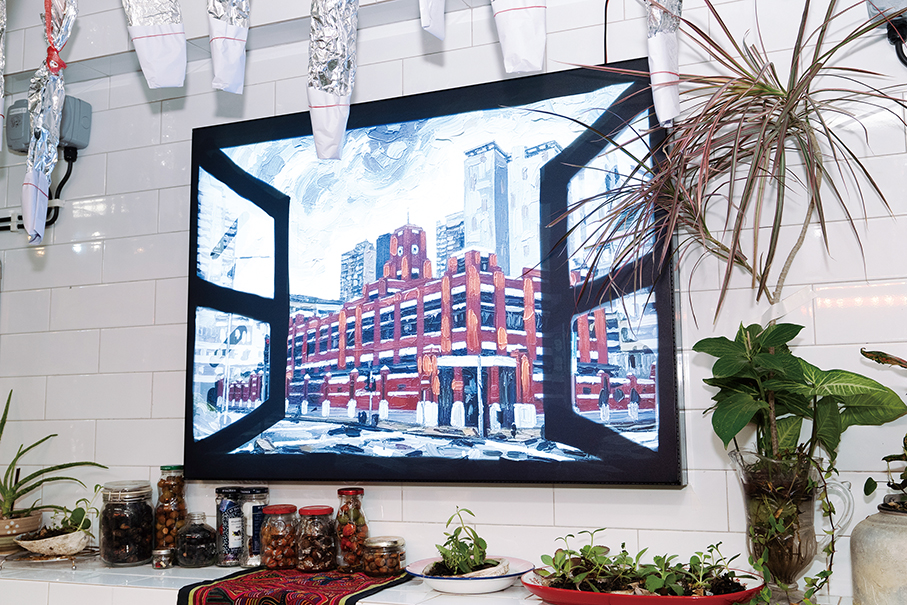
Using a photo of the renovated Red Market as its source, Situ used an artificial intelligence program to create an image in the style of an oil painting, as part of her installation. – Photos provided by MyLand Culture

(From left to right) “Echoes of the Red Market” curator Chang Chan, installation artist Situ Jian, photographer Chan Hin Io and President of MyLand Culture Pal Lok Chok pose in front of the exhibition area at the Red Market. – Photo: William Chan