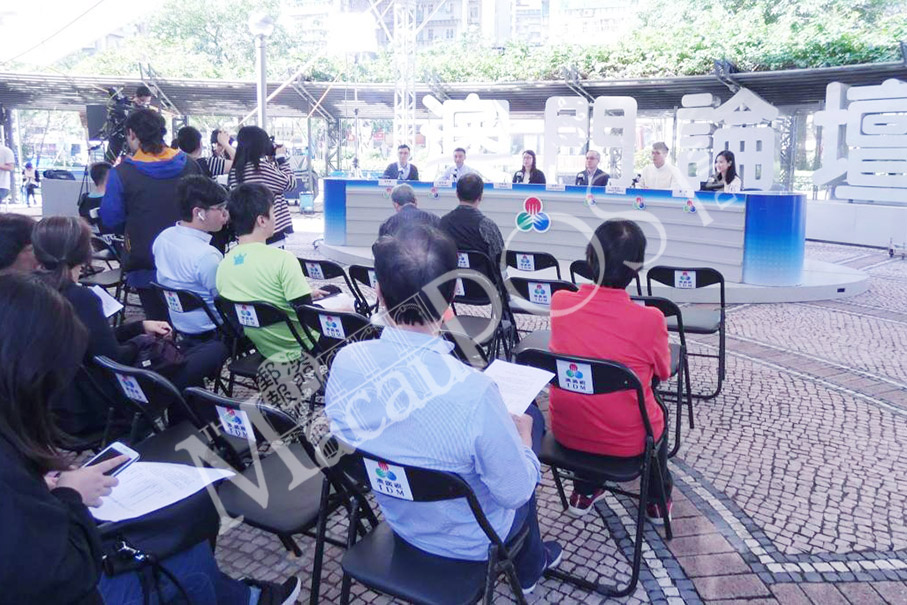


The 2025 International Forum on Mutual Learning Among Civilisations started yesterday in Cotai, striving to foster global dialogue and cooperation between East and West.
Leading scholars from various countries and regions discussed civilisational inclusiveness, cultural innovation, heritage preservation and cross-cultural cooperation, aiming to contribute to the ongoing discussions on the theme of “Mutual Learning Among Civilisations.”
The two-day forum, held at integrated resort Galaxy Macau, Cotai, is co-organised by the local government and the Cultural Affairs Bureau (IC). The forum gathered international scholars and experts to discuss “civilisation mutual learning and inheritance development”.
Germany’s Alfred Hornung, a member of the prestigious Academia Europaea and research professor and director of the Obama Institute at Johannes Gutenberg University Mainz, gave a power-point presentation on the Silk Road and its influence on global civilisation.
The Academia Europaea is a pan-European Academy of humanities, letters, law, and sciences, founded in 1988.
His presentation was titled “From the Silk Road to BRI and GCI”, saying that Macau’s Chinese–Portuguese history made it “the ideal location to experience and learn about communication between civilisations in East and West”.
BRI stands for China’s Belt and Road Initiative and GCI is the abbreviation for its Global Civilisation Initiative.
Hornung underlined that Macau was “the place where the first Western university in China was founded in the 16th century”, noting that this remained little known in the West.
Macau’s St. Paul’s College was founded in 1594 and continued as a Jesuit-run institution of higher learning until 1762.
Hornung traced the Silk Road back to the Han Dynasty some two millennia ago, describing it as “the perfect example” of how early Chinese exploration created land and maritime routes linking different peoples and cultures, citing archaeological and historical records, including Roman glassware unearthed in China and diplomatic exchanges between Rome and Han China, to show that early encounters already operated on “multiple levels of relations”.
Moving into the medieval period, Hornung referenced Marco Polo’s China travel in the late 13th century and writings as a turning point that provided Western societies with first-hand knowledge of China, arguing that these accounts inspired further intercultural engagement and reinforced the Silk Road’s role as a conduit not only for goods, but also for ideas, art and belief systems.
“Silk,” he said, became “the central main means of communication on a cultural, artistic, and economic level”, and even functioned as a form of currency between different nations.
Hornung linked this historical remarks to contemporary policy, saying it was “part of Xi Jinping’s insight and foresight” to recognise the Silk Road’s intercultural function when formulating the Belt and Road Initiative.
Quoting President Xi’s 2013 speech in Kazakhstan, Hornung cited the emphasis on “unity and mutual trust, equality and mutual benefit, inclusiveness and mutual learning” as values inherited from the ancient route. He further argued that in the modern era, blockchain technology has assumed a role comparable to silk, acting as a trusted medium for transnational exchange.
While the commodity has changed, Hornung said that the underlying principle of connectivity remained. From there, he described GCI as a natural extension of this historical trajectory, especially at a time when “many of the traditional assumptions about the peaceful cooperation of peoples and nations started to erode,” he said.
Hornung placed emphasis on Confucius as a symbolic figure for intercivilisational dialogue. He said the 1687 Latin translation of Confucian texts in Paris marked “the beginning of a mutual civilisation and exchange”, influencing European thinkers such as Gottfried Wilhelm Leibniz (1646-1716) and later shaping intellectual currents in the United States. He pointed to Confucius’ depiction on the US Supreme Court building as evidence of his transnational significance, adding that Confucius could be seen as “China’s great gift to the world”.
Meanwhile, Li Guoqiang, a member of the Academic Division of the Chinese Academy of Social Sciences (CASS) and vice president of the Chinese Academy of History, said in his speech that facts show that the history of mutual learning among world civilisations has a long-standing and extensive tradition, almost accompanying the development of human society from its inception.
Qian Chengdan, Boya chair professor of Peking University, noted that Macau is a convergence point of Chinese and Western cultures with a profound historical heritage, serving as an important bridge for communication between Chinese and Western cultures.
Moreover, the dean of the School of Public Policy, Chinese University of Hong Kong, Shenzhen campus, and director of the Institute for International Affairs in Qianhai, Zheng Yongnian pointing out in his speech that Europe today lacks innovation, is overly ideological, holds exclusionary attitudes towards China, and lacks independent thinking.
The director of the Liangzhu Museum (Liangzhu Research Institute), Xu Tianjin noted in his speech that the UNESCO-listed “Historic Centre of Macau” primarily consists of buildings and neighbourhoods, while Liangzhu encompasses various relics, including ancient city sites, buildings, workshops, astronomical observation sites, and tombs, each with its own style.
The archaeological ruins of Liangzhu City are a cluster of Neolithic sites located in the Liangzhu Subdistrict and Pingyao Town of Yuhang, Hangzhou. Initially excavated in 1936, the ruins were recognised to belong to a previously unknown civilisation, termed Liangzhu culture, in 1959. The site was confirmed as an ancient city after the discovery of its city walls in 2006. It was designated a UNESCO World Heritage Site in 2019.
Wu Zhiliang, vice chairman of the National Committee of the Chinese People’s Political Consultative Conference on Culture, History and Learning, and chairman of the Administrative Committee of the Macao Foundation (FM), said that Macau, with over 400 years of history as a place where Chinese and Western civilisations have coexisted, should not merely serve as a “civilisational laboratory” of history, but rather should evolve into a proactive “civilisational transformer” that actively shapes the future, offering solutions rooted in Chinese wisdom to address the challenges facing human civilisation.
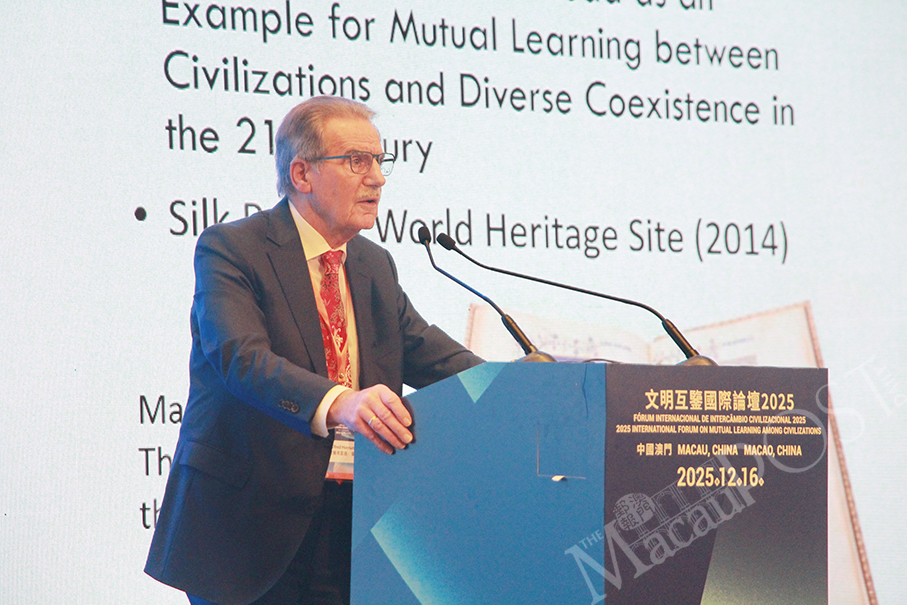
Alfred Hornung, member of the prestigious Academia Europaea and research professor and director of the Obama Institute at Johannes Gutenberg University Mainz, presents his “From the Silk Road to BRI and GCI” lecture during the first “2025 International Forum on Mutual Learning Among Civilizations” forum at integrated resort Galaxy Macau in Cotai yesterday. The two-day event ends today. – Photo: Khalel Vallo