

President Xi Jinping mentioned Macau – and Hong Kong, for that matter – twice in his 2026 New Year address.
Xi pointed out in his message broadcast nationwide on New Year’s Eve that “not long ago, I attended the opening ceremony of the National Games, and I was glad to see Guangdong, Hong Kong and Macau coming together in unity and acting in unison”.
I may add that Macau won a record three gold and two bronze medals, all in karate events, at the National Games in November. Moreover, it garnered a record 146 medals at the 12th National Games for Persons with Disabilities and the 9th National Special Olympic Games last month. Not only Macau but the whole country can justifiably take great pride in the astonishing medal haul by our athletes – whatever their physical and intellectual condition.
Xi also stressed that “we should unswervingly implement the policy of ‘One Country, Two Systems’, and support Hong Kong and Macau in better integrating into the overall development of our country and maintaining long-term prosperity and stability”.
His call for supporting Macau and also Hong Kong in better integrating into the nation’s overall development is of utmost importance, and it is also very timely appeal.
Xi’s speeches, which I have been editing for publication in our newspaper for over a decade, including his New Year addresses, are very well written and, I may add, professionally translated into English and, I have been told, into other foreign languages.
That’s why all of us in Macau should always pay close attention to Xi’s speeches – and, therefore, our newspaper customarily publishes their full-text versions in print and/or on our website (depending on their length).
The concept of “integration” - the harmonious combination of parts into a functional whole - is a profound theme in starkly different cultures all over the world. Integration within the ambit of political and socio-economic development, i.e., the process of bringing together various political, social, and economic elements within a society to create a cohesive and functioning whole, is a sine qua non to ensure human progress.
“The whole is greater than the sum of its parts,” Greek polymath Aristotle said wisely some 2,300 years ago. In other words, when parts are truly integrated, they create emergent properties, synergies, and value that the separate parts do not possess.
That’s how we ought to consider the obvious benefits of “better integration” between Macau and the rest of the nation.
In Confucianism, a similar concept is expressed through the idea of “harmony”, which stresses the importance of working together and achieving balance, suggesting that a well-functioning society or family is greater than the individual contributions of its members.
In Taoism, “effortless action” reflects the idea that a harmonious whole emerges when individuals act in accordance with the natural flow of life, again leading to outcomes that transcend individual efforts.
Both schools of thought highlight the significance of unity and interconnectedness, resonating with the idea that “the whole is greater than the sum of its parts.”
China’s economic miracle, which started with Deng Xiaoping’s famed “reform and opening up” drive in 1978, is, in my view, the gradually accomplished integration of Marxist theory with market-orientated policies, an approach that, thanks to Xi in particular, has produced the world’s most successful poverty reduction programme that has benefitted about 800 million Chinese – a mind-boggling figure – and, ultimately, it has created one of humanity’s most thriving economies.
I was able to confirm the great poverty alleviation and economic development success during my annual Winter Solstice/Christmas holidays when I travelled by high-speed train from Zhuhai to Shanghai and back late last month. The 9½ hour, comfortable train ride enabled me to admire the well-developed countryside – including neatly cultivated fields and ponds as well as farmers’ nicely designed houses. I did a similar cross-country train ride in the mid-1980s between Hong Kong and Beijing. At that time, the reform drive was still in its initial state so that the countryside looked rather different to what it is now.
As a student of Political Economy in Munich in the early 1970s I learnt what nowadays seems to be a truism, namely that railways have been facilitators of industrial growth and socio-economic progress since the late 19th century. That’s why it’s all the more surprising that there are still countries that continue to neglect the modernisation, even the sheer development, of their railway networks, such as India and the United States.
While in Shanghai, I also noticed how well mass transport and the metropolis’s old quarters have been upgraded and spruced up. Macau, as the public transport woes during the New Year holiday last week have regrettably shown us once again, could learn a lot on both development fronts from cities in the Chinese mainland (such as, for instance, Hangzhou, which I visited also last year).
On New Year’s Eve I was ashamed seeing bus after bus passing through our city’s main thoroughfare, Avenida de Almeida Ribeiro, with passengers – mostly but not only tourists – crammed in like sardines – and this in a city so eager to present itself as a World Centre of Tourism and Leisure – a goal set by the Central People’s Government after all. Macau’s record 40.06 million visitor arrivals last year should have deserved better integrated public transport services.
That’s why Macau needs Beijing’s enduring support, as Xi rightly pointed out, to be able to “better integrate” into the overall development of the country. Indubitably, Macau requires the Chinese mainland’s continued development support.
Let’s be realistically ambitious: Macau needs to further speed up the development of its still rudimentary mass-transport system – the government-owned Light Rapid Transport (LRT). The government should also look at the feasibility of licensing a DiDi-like ride-hailing system. While it is socio-economically understandable to protect the interests of local taxi owners and drivers, but as one of the world’s most visited tourist destinations, burying one’s head in the sand as far as ride-hailing services are concerned – which are common virtually in all other tourist destinations in Asia and elsewhere – would be impudent.
I spent New Year’s Eve and New Year’s Day in the Guangdong-Macau In-Depth Cooperation Zone in Hengqin – a pleasant experience on the public transport, hotel accommodation and, last but not least, gastronomic front. Why Hengqin’s progress is clearly noticeable (I visited the island infrequently back in the 1980s when it was little more than a short-trip destination for Macau people to savour freshly harvested oysters), it is obvious that the cross-boundary project is a long-term effort.
I hope that the zone will be in full swing by 2049 when the People’s Republic of China (PRC) will celebrate the centenary of its founding by the Communist Party of China (CPC). In that year, according to the central authorities’ vision, both national rejuvenation – the realisation of a prosperous, strong, and culturally advanced nation that plays a leading role on the world stage – and comprehensive national strength – the alignment of economic, political, cultural, and military dimensions for global influence – will have been achieved.
And what about Macau in 2049? Well, I am sure that the central authorities will find a solution that will be commensurate with the city’s special past and presence. Of course, contrary to what I have been hearing from commentators for years, in that year the Macau SAR Basic Law will not “expire” for the simple reason that is a national law underpinned by Article 31 of the Constitution of the PRC: “The state may establish special administrative regions when necessary. The systems instituted in special administrative regions shall, in light of specific circumstances, be prescribed by laws enacted by the National People’s Congress.”
What, I believe, will happen is that while the Basic Law will merely be amended, namely its Article 5 stating, since its promulgation in 1993 by late president Jiang Zemin that “the socialist system and policies shall not be practised in the Macau Special Administrative Region, and the previous capitalist system and way of life shall remain unchanged for 50 years”.
Post-2049, Article 5 could simply be reformulated by stating that the capitalist system and way of life shall remain unchanged “for the time being” or “for the present”. Besides, Xi and the nation’s previous leaders have repeatedly reassured Macau citizens – and their counterparts in Hong Kong for that matter – that they can be at ease about their post-2049 future (post-2047 in the case of Hong Kong).
Perhaps, and I am thinking allowed, Macau’s amended Basic Law at that time could also include specific articles on the Macau-Hengqin and Macau-Greater Bay (GBA) integration systems at that time. Both are interconnected anyway.
As a long-time Macau resident, I am confident that our city’s special identity and centuries-old East-meets-West “personality” are strong enough to be capable of playing a meaningful role beyond 2049, irrespective of the development stage that the ongoing GBA integration will have reached at that time.
Incidentally, as someone from a country that between 1949 and 1990 was divided into two hostile entities, I hope that by 2049 China will be reunified so that Taiwan will cease to be an anti-China pawn of foreign powers.
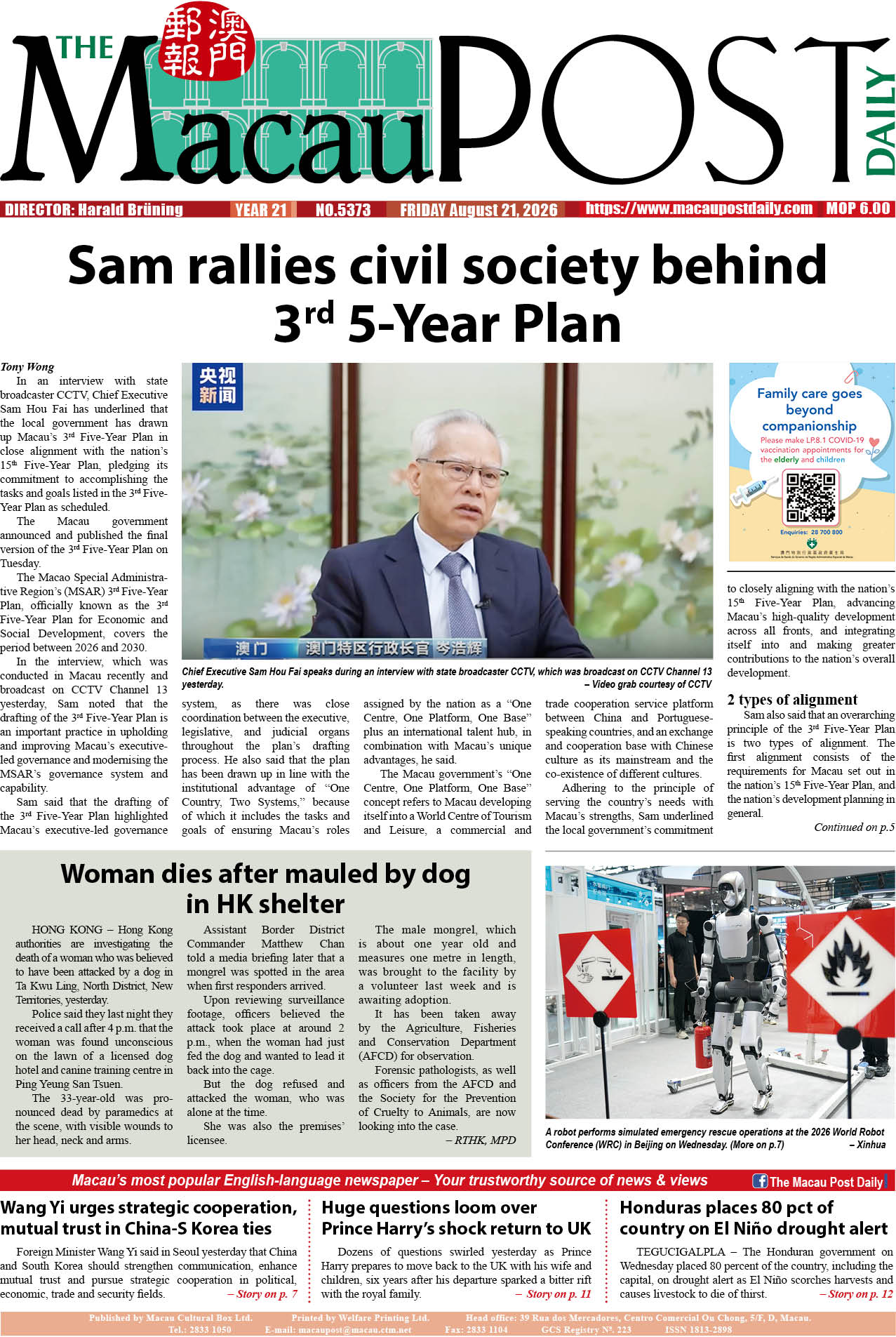
Chief Executive Sam Hou Fai reacted to Xi’s speech by saying in a statement on New Year’s Day that the president’s remarks on Macau “conveyed his care and concern” for our city and that the local government deeply appreciates the president’s concern for Macau, “always remembering this and putting it into action”.
Sam also pledged that his government will continue to focus on the local economy’s appropriate diversification and that it will further improve people’s livelihoods, “actively align with the national 15th Five-Year Plan, and scientifically formulate and implement [Macau’s] 3rd Five-Year Plan.”
Macau’s other principal officials also released statements in support of Xi’s speech, pledging to heed his directives and advice.
The chief executive, who on December 20 completed the first of his five-year term at the helm of the MSAR, promised to the consolidation of a “law-based, vibrant, cultural, and blissful Macau.”
Sam can take heart in the praise he received on New Year’s Eve from the central authorities in charge of Hong Kong and Macau affairs that both SARs in the past year “lived up to expectations and achieved outstanding results” and, thereby, are capable of “seizing opportunities to set sail again”.
I would like to use this opportunity to wish all our readers a prosperous 2026 and Year of the Horse. Let’s hope it’s a horse that is galloping quickly but safely towards further development, stability, security and contentment for all of us in Macau – the nation’s cherished “pearl in the hand”, as the central authorities’ frontman for Hong Kong and Macau affairs, Xia Baolong, has described our beloved city.
– Harald Brüning