

The government is proposing to raise the number of days for statutory paid maternity leave in the private sector to 90 days from the current 70 days.
The government is also proposing to raise the number of days for private-sector employees’ statutory minimum paid annual leave. Currently, the number is six days for all private-sector employees with a minimum of one-year employment, regardless of their length of service. The government is proposing to establish a system where the number of days for employees’ statutory paid annual leave will increase with their length of service, but with a maximum of 12 days.
The Labour Affairs Bureau (DSAL) has launched a 45-day public consultation on proposed amendments to the Labour Relations Law, which was announced during a press conference at its headquarters in Areia Preta district on Friday.
The Labour Relations Law regulates the private sector’s employment. The public sector has its own employment regulations that are much more generous than those of its private counterpart.
The public consultation, which started on Saturday, is running until March 16, during which three sessions for members of the general public will be held.
The public consultation document, available in Chinese and Portuguese, can be downloaded from the consultation’s dedicated website (https://www3.dsal.gov.mo/survey/labourlaw/).
When the Labour Relations Law came into force in 2009, the number of days for statutory paid maternity leave was 56 days. The number was raised to the current 70 days on May 26, 2020 when the law’s amended, current version took effect.
Private-sector employees with a minimum of one-year employment, regardless of local and non-resident workers (NRWs), are entitled to statutory paid maternity leave. The Labour Relations Law’s current version requires 63 days out of the 70 days of statutory paid maternity leave to be used immediately after the baby’s birth, while the mother can choose to take the remaining seven days before or after the birth.
The consultation document proposes to raise the number of days for statutory paid maternity leave to 90 days from the current 70 days. The document proposes to require 60 days out of the proposed 90 days of statutory paid maternity leave to be used immediately after the baby’s birth, while the mother can choose to take the remaining 30 days before or after the birth.
After the Labour Relations Law’s current version took effect on May 26, 2020, the government ran a three-year transition period during which the respective employers were only required to pay at least 56 days out of the 70 days of statutory paid maternity leave, while the remaining up to 14 days was paid by the government.
After the three-year transition period ended on May 25, 2023, the government once again launched a scheme, on a provisional basis, subsidising eligible employers’ payments of 14 days of maternity leave. Under the scheme, which is now running until December 31 this year, eligible employers must pay mothers the whole 70-day maternity period first before filing an application to the Labour Affairs Bureau to receive a subsidy of 14 days of maternity leave.
The current subsidy only applies to local female employees, because of which the employer of a mother who is a non-resident worker (NRW) still needs to pay the whole 70-day maternity period.
In its public consultation document, the government is proposing that it will continue to subsidise eligible employers’ payments of maternity leave after the number of days for statutory paid maternity leave is raised to 90 days. The document proposes that eligible employers can apply for a subsidy of up to 20 days of maternity leave.
Concerning the number of days for private-sector employees’ statutory minimum paid annual leave, the government is proposing that employees with up to two years of service for the same employers will continue to be entitled to six days of paid annual leave, with those with their length of service ranging between two and four years to be entitled to seven days of paid annual leave; those working for the same employers between four and six years to be entitled to eight days of leave; those working between six and eight years to be entitled to nine days of leave; those working between 8 and 10 years to be entitled to 10 days of leave; those working between 10 and 12 years to be entitled to 11 days of leave; and those working for the same employers for at least 12 years to be entitled to 12 days of paid annual leave.
The government does not propose to increase paternity leave from its current five days.
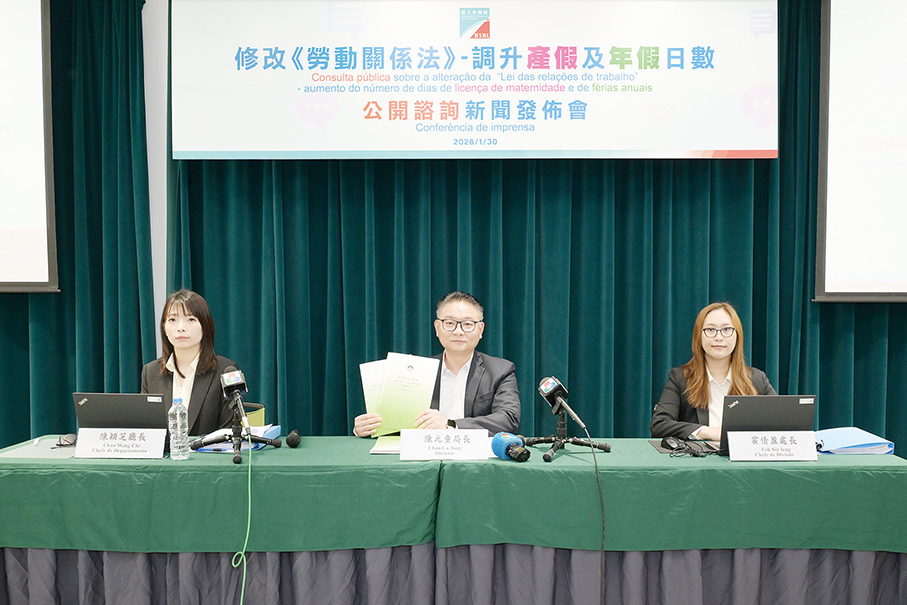
Labour Affairs Bureau (DSAL) Director Chan Un Tong (centre) shows journalists the public consultation document during Friday’s press conference, as Chan Weng Chi (left), who heads the bureau’s Research and Information Technology Department, and Fok Sin Ieng, who heads the bureau’s Law and Research Division, look on. – Photo: GCS