

Integrated resort operator MGM opens the National Art Funds-backed “Talent Training on the Cultural and Creative Design of Maritime Silk Road” exhibition in Barra district to the public today, showcasing 30 original works created by trainees after nearly a year of study and field research.
The exhibition, part of the “2025 National Arts Fund” arts talent sponsorship programme, was formally inaugurated in Barra yesterday, at the site of a former abattoir.
The talent training programme ran for nearly a year and used the Poly MGM Museum as its study base, with support from the Beijing Palace Museum and Beijing Institute of Fashion Technology (BIFT), according to a statement by MGM yesterday.
The programme covered five key Maritime Silk Road cities and combined cultural theory, professional field visits and design practice, aiming to cultivate new creative talent.
Addressing the opening ceremony, MGM China Holdings Limited Chairperson & Executive Director Pansy Ho Chiu-king said that the trainees had transformed history and culture into works with contemporary aesthetics and cultural confidence, adding that the programme helped connect “traditional foundation” with “modern expression,” which she described as a key to achieving competitiveness by the cultural and creative industry.
The exhibition is divided into six sections – “Setting Sail,” “Exploration,” “Integration,” “Growth,” “Passing the Torch” and “Tides” – and features 30 original works including cultural creative products, fashion design, paintings, sculptures, and multimedia installations.
Speaking to the media before the opening ceremony, Wang Yu Ding, an artist from the Chinese mainland, said that she used 12 colours to represent the Maritime Silk Road in a “warm and steady” way. “The most difficult part of the design is to combine all the colours to create the design,” she said, adding she hopes the exhibition can show the value of contemporary design to audiences worldwide. Wang also noted that Macau invited local designers to provide professional feedback, which helped explore cross-border collaboration and business transformation.
Another artist, Leong Man Teng, said her work used composite material and drew inspiration from museum visits during the programme, including a Macau station experience at the Poly MGM Museum. She said she incorporated elements of a “green flower pool” into her work after being inspired by exhibits seen in museums such as the National Museum of China in Beijing and the Guangdong Provincial Museum in Guangzhou. Leong added the fact that project combined theory and creation helped deepen her thinking and supported her artistic development.
Meanwhile, in order to strengthen academic exchange, the Poly MGM Museum also hosted a symposium titled “Silk Roads Beyond Borders: Where Creativity Converges, Culture Reimagined” yesterday afternoon, with speakers including Dunhuang Academy researcher Lou Jie and BIFT professor Chu Yan.
Lou shared insights from a broader historical perspective, highlighting the cultural value of Dunhuang art and its role in East-West exchanges. She also drew parallels between Dunhuang* and Macau, saying both have served as key bridges for cultural interaction. Lou noted that Macau plays an important role in connecting ancient and modern Silk Road civilisations, especially in promoting dialogue between Chinese and Western cultures.
Meanwhile, Chu discussed how Silk Road aesthetics can be reinterpreted through contemporary design. Chu stressed that Silk Road aesthetics is not a one-way transmission, but an evolving process of mutual influence and integration. She encouraged participants to explore the “universal values” within traditional Chinese culture and transform them into creative inspiration, adding that Eastern aesthetics have the potential to become a driving force in global fashion innovation.
The exhibition runs until March 8 and is open to the public for free.
Stay tuned for more photos and details of the free-admission exhibition in an upcoming Page 4.
*Dunhuang (敦煌) refers to a historical region and a city located in Gansu province, well-known for its rich cultural and artistic heritage. Dunhuang is a UNESCO World Heritage site, attracting tourists, historians, and scholars interested in its rich history and artistic achievements. The city is famous for the Mogao Caves (or Mogao Grottoes), a complex of Buddhist cave temples that house thousands of murals, sculptures, and manuscripts, illustrating the spread of Buddhism and showcasing ancient arts. Donhuang was a pivotal stop along the ancient Silk Road, serving as a hub for trade and cultural exchange between East and West. – Poe

MGM China Holdings Limited Chairperson & Executive Director Pansy Ho Chiu-king addresses yesterday’s opening ceremony of the “Talent Training on the Cultural and Creative Design of Maritime Silk Road” exhibition in Barra district. – Photos: Khalel Vallo
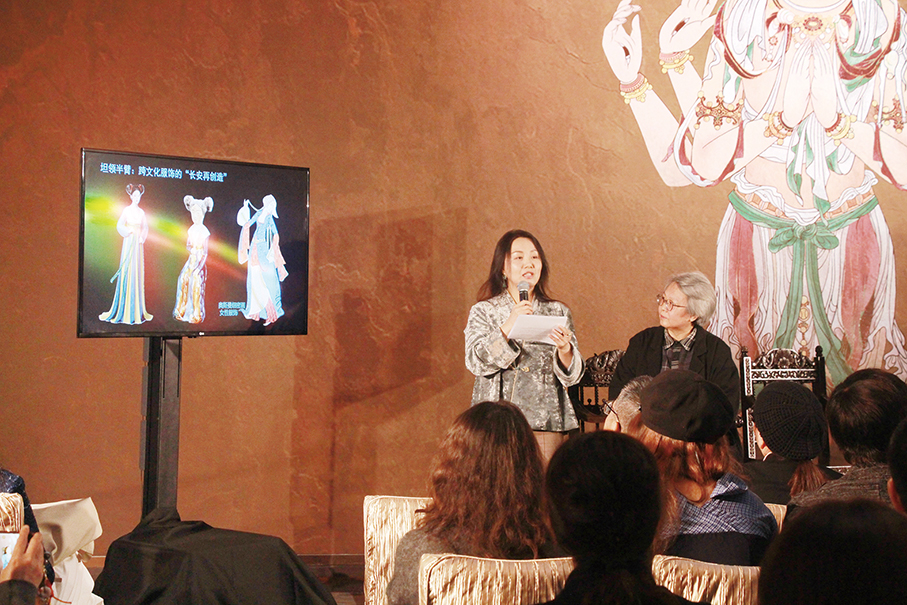
Beijing Institute of Fashion Technology (BIFT) Prof. Chu Yan (left) gives a presentation, alongside Dunhuang Academy researcher Lou Jie, during the “Silk Roads Beyond Borders: Where Creativity Converges, Culture Reimagined” symposium at the Poly MGM Museum yesterday afternoon.