


The Health Bureau (SSM) announced in a statement on Saturday a case of scrub typhus, the first recorded in Macau this year.
According to the bureau, the patient is a 31-year-old male resident. He first noticed a small black spot on his left thigh late last month, accompanied by a localised rash. On March 6, he developed fever, headache and muscle pain, followed by a full-body rash the next day.
The patient initially sought medical treatment at a local hospital but his symptoms did not improve, the statement said, adding that on March 12, he sought medical attention at the public Conde de São Januário Hospital, where doctors discovered a painless eschar* about the size of a soybean on his left thigh.
Based on his symptoms, clinical signs and treatment response, doctors made a clinical diagnosis of scrub typhus, the statement noted, adding that after treatment, the patient’s fever subsided and his condition stabilised. He is receiving hospital treatment.
According to the statement, health authorities said the case has been classified a an imported infection. The statement highlighted that the patient had travelled to Jiangmen City in Guangdong Province on February 24 and 25, where he went camping at a site with grassy surroundings and reported being bitten by insects, adding that no similar symptoms have been reported among people living with him, and he did not visit parks or rural areas while in Macau.
Scrub typhus, also known as tsutsugamushi disease, is an acute infectious disease caused by infection with the bacterium Orientia tsutsugamushi** transmitted through bites from infected chigger larvae. Rodents living in warm and humid environments with dense vegetation are common hosts. Symptoms typically include fever, headache, muscle pain and skin rash. A characteristic sign is a painless ulcer-like eschar at the bite site. If left untreated, severe complications such as pneumonia, encephalitis or myocarditis may occur, potentially leading to respiratory failure, shock or death.
The statement noted that the bureau urged residents who visit parks, grassy areas or rural environments to take preventive measures, including wearing protective clothing, applying insect repellent containing DEET (diethyltoluamide)***, taking a shower and changing clothes after leaving such areas.
Residents experiencing fever or related symptoms are advised to seek medical attention promptly.
* Eschar is a thick, dry, black or brown layer of dead tissue (necrosis) that forms over wounds, burns, or infections, often indicating severe skin damage. It acts as a protective barrier, but can hinder healing – DeepSeek
** Orientia tsutsugamushi is a mite-borne bacterium belonging to the family Rickettsiaceae and is responsible for a disease called scrub typhus in humans – DeepSeek
*** Diethyltoluamide (DEET) is the most common and effective active ingredient in insect repellents, designed to repel mosquitoes, ticks, fleas, and biting flies – DeepSeek
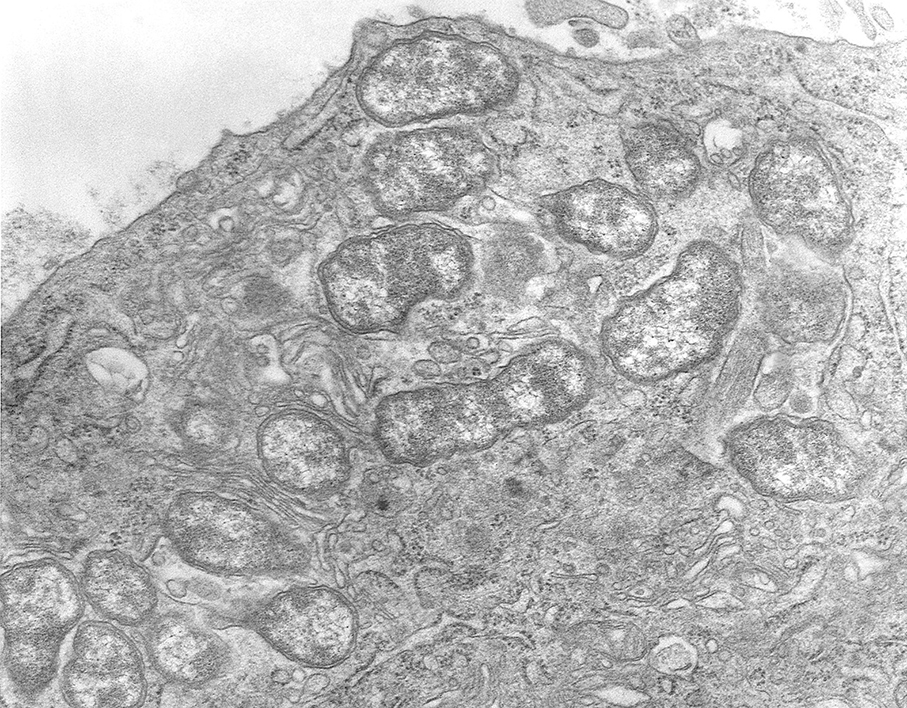
This photo courtesy of Wikimedia downloaded yesterday shows the scrub typhus.