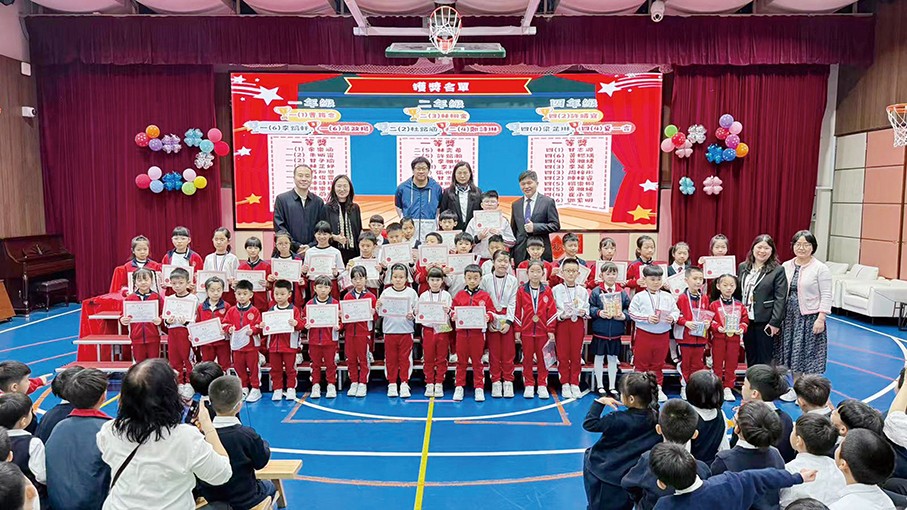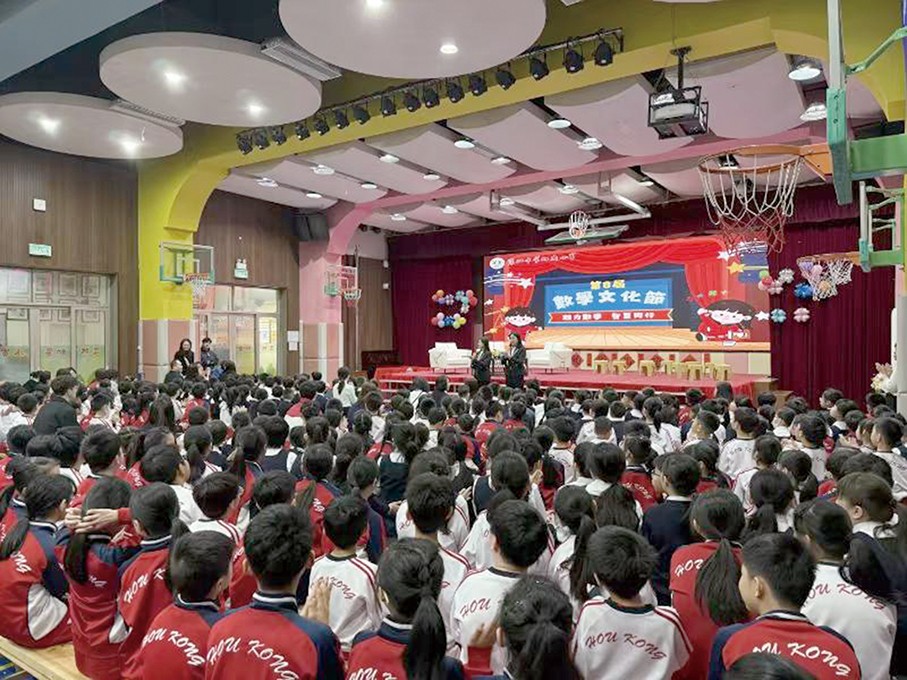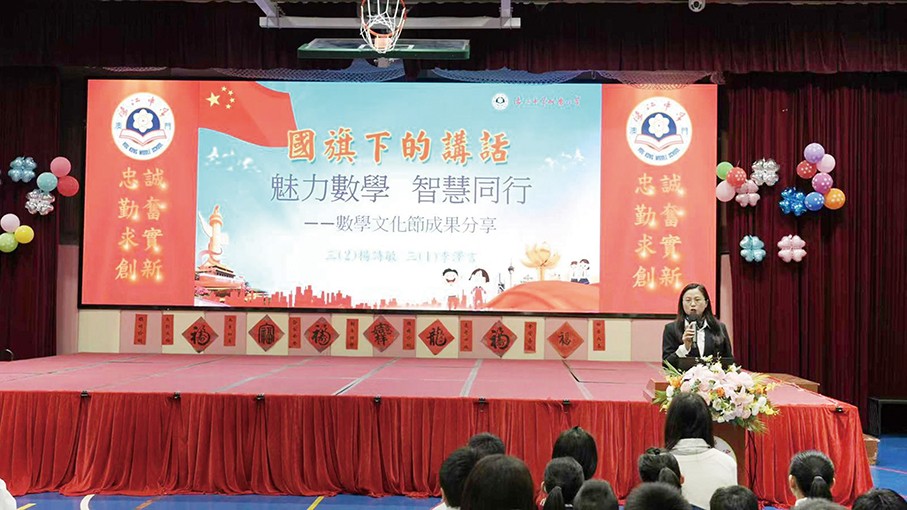


Macau’s renowned Hou Kong Middle School (Primary Section) hosted the last day of its Mathematical Cultural Week event yesterday, and Wang Shize, deputy director of the school, told the Post that the event aimed to develop students’ critical thinking and practical skills.
Wang said that centred on the concept of “Viewing the world through a mathematical lens,” nearly 20 mathematics competitions and activities were held in just over 10 days, with over a thousand students from the school participating. The activities aimed to enhance students’ logical and critical thinking, as well as practical application skills through games, problem-solving, and interdisciplinary practices, Wang said.
Nicholas Chao Man Fai, who heads the school’s Mathematics Panel, told the Post that the most challenging aspect of the preparations was to organise the participation of the entire student body, involving over 20 mathematics teachers who joined forces to design the activities, arrange the venues, and prepare all the materials.
Chao also said that some of the annual event’s most popular activities will be retained and refined, while those found dull or ineffective will be phased out, ensuring they align with the abilities and interests of students across different grade levels.
The activities featured unique projects such as “tangram”* puzzles for first graders, creative problem-solving for third graders, and comprehensive application for fifth graders, according to Chao.
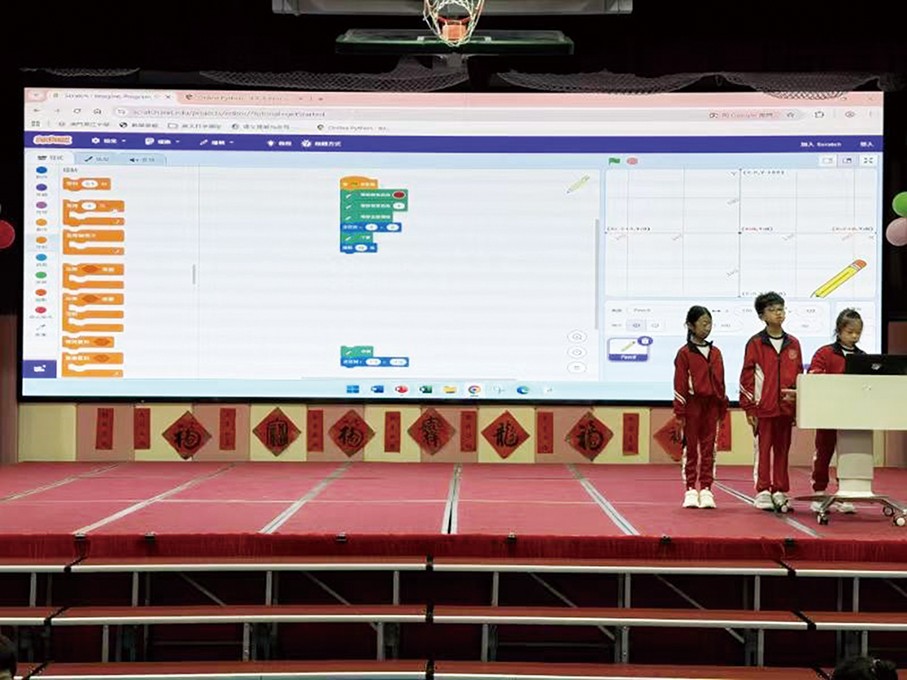
During the planning and development of the curriculum, ‘Maths Reading’ and ‘Maths Transformation’ were incorporated. Chao also said that using programming activities that integrate mathematics with information technology aims to lay a strong foundation for advanced robotics programming.
Wang pointed out that primary school mathematics education is not just about calculation; it is more importantly about cultivating students’ ability to questions, think, and modelling, preparing them for development in the AI era.
Wang noted that the primary section places strong emphasis on ensuring a smooth transition from primary to secondary education. During the primary years, students are encouraged to engage in group collaboration and active teacher–student interaction, gradually preparing them for the self-directed learning model used in secondary school. Wang added that the school will continue to deepen interdisciplinary integration in the future, exploring links between mathematics and other subjects such as general studies and physical education.
This will allow students to appreciate the practical value of mathematics in real-life contexts, Wang said.
University of Macau (UM) Faculty of Education Associate Professor Jiang Chunlian told the Post that the event added a new programming course aimed at cultivating students’ computational thinking. Through puzzle game and programming activities, students can develop their mathematical thinking and enhance their problem-solving skills, Jiang said.
Jiang chairs the Macao Mathematics EduCation Study Association.
She expressed the hope that learning mathematics will not only develop the intellect but also foster a resilient character in students when facing difficulties, preparing them for an uncertain future world.
Two parents, surnamed Lam and Ho both told the Post that their children’s interest in mathematics has greatly increased since participating in the activities, adding that they now actively practise speed calculation and challenge themselves with difficult problems.
Both thanked the school for thoughtfully designing the activities and competitions, allowing students to experience the joy of mathematics through games and no longer view it as a dull subject.
Seeing their children receive awards filled the parents with pride, Lam and Ho said, adding they hope that the school can provide more interactive and engaging activities to continuously stimulate their children’s enthusiasm for learning.
Several students who participated in the event told the Post of their experiences.
A third-grade student surnamed Lam, found that he got faster at playing with the Rubik’s snake with practice, and thanked his classmate, surnamed Ng, for teaching him certain techniques.
A fourth-grade student surnamed Hoi, learnt through playing with the Klotski puzzle not to rush things.
A fifth-grade student surnamed Ip, used programming to calculate his body mass index (BMI) and discovered that mathematics can be applied to real-life scenarios like facial recognition.
Two sixth-grade students surnamed Ho and U noted that solving the nine-linked rings puzzle requires mathematical thinking; one wrong move means having to start all over again, which they related to real-life situations like shopping and managing one’s finances.
Zhao Dandan, an outstanding teacher** from the Chinese mainland, spoke highly of the event. She told the Post that the school has incorporated puzzle toys into its curriculum, achieving a blend of fun and critical thinking. By downplaying individual competition and emphasising collective participation, Zhao said that the school protects students’ interest in learning. Zhao, who is from Shanghai, said she plans to take these curriculum design concepts back to the mainland to show the teachers there.
* A tangram (七巧板) is a dissection puzzle originating from China, consisting of seven flat pieces called tans that can be rearranged to form various shapes and figures. Each tan is typically a polygon, and the aim is to use all seven pieces to create a specific shape without any overlaps. Tangrams are used for educational purposes, promoting skills in geometry, spatial reasoning, and problem-solving. They can also serve as a fun recreational activity for all ages. – Poe
**In the Chinese mainland, recognition as an outstanding teacher may come through awards, promotions, or other formal acknowledgment by educational authorities or institutions. – Poe
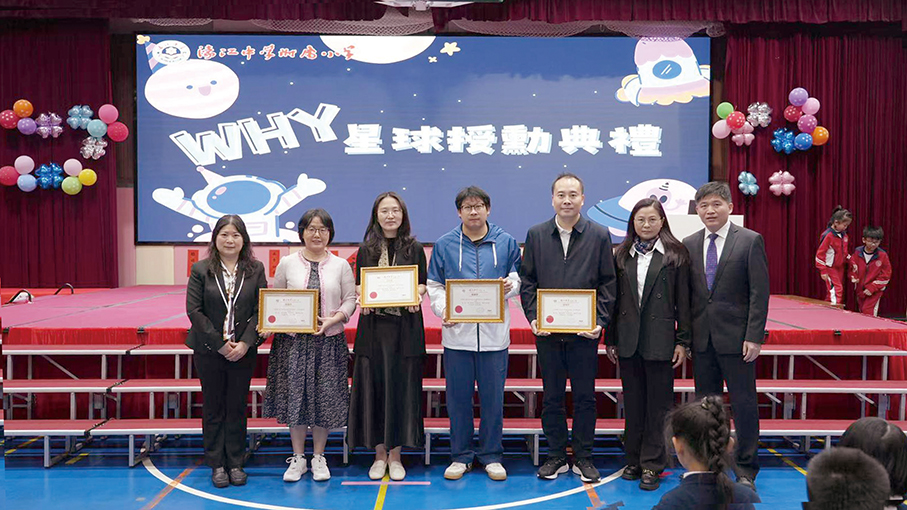
University of Macau (UM) Lui Che Woo College Associate Master Coffee Chao Kuok Fai (centre), the Chinese mainland’s outstanding teachers Zhao Dandan (third from left) and Lin Tong Shuo (third from right), UM Faculty of Education Associate Professor Jiang Chunlian (second from left), Hou Kong Middle School (Primary Section) Director Rebecca Choi Keng Man (second from right), and deputy directors Lei Ioi (left) and Wang Shize pose on stage during yesterday’s on-campus event on Rua de Afonso de Albuquerque. – Photos courtesy of Hou Kong Middle School