

Tony Wong in Hengqin
A one-day fact-finding tour of Hengqin was organised for Macau media workers last week where they visited three facilities concerning economic cooperation between Macau and Hengqin, and the three facilities’ representatives briefed the local journalists about their operations and latest developments.
The three facilities visited on Thursday last week comprised the Hengqin International Film Studio, the Service Centre for Economy and Trade between China and Portuguese/Spanish-speaking Countries, and the Cross-border E-commerce (Huafa) Innovation Industrial Park.
The first one was visited in the morning. After lunch, the media delegation visited the other two.
The tour, which the Post joined, aimed to enable Macau media workers to gain a better understanding of the latest achievements in the Macau-Hengqin integrated industrial development, and fresh opportunities for Macau to advance its appropriate economic diversification.
The 106-square-kilometre Hengqin island in Zhuhai City is officially known as Guangdong-Macao In-Depth Cooperation Zone in Hengqin, after the zone was inaugurated in September 2021. The adjacent island is three times the size of the Macau Special Administrative Region (MSAR).
The in-depth cooperation zone’s governance consists of a management committee and an executive committee.
The management committee is the zone’s top decision-making body run under a dual director system, jointly led by the governor of Guangdong Province and the chief executive of the MSAR. The zone’s executive committee, which is run under the management committee, is the body tasked with the zone’s daily functioning and execution of tasks.
There are nine bureaux administered under the zone’s executive committee.
Last week’s media trip was jointly organised by the Macau Government Information Bureau (GCS), the zone’s Administrative Affairs Bureau, and the Publicity, Culture and Sports Department of the Central People’s Government Liaison Office in the MSAR.
Hengqin Studio filming ‘micro-dramas’ for foreign markets
During the visit to the Hengqin International Film Studio, Leo Li Ming, a senior representative overseeing the film studio’s operation, briefed the journalists about the facility’s establishment, current operation and future development.
The Hengqin International Film Studio is located on a site, comprising 13 buildings, initially earmarked for a service hub for Hengqin’s financial industry, where six of the buildings have been converted into film studios.
The Hengqin Studio is the country’s first film studio dedicated to filming “micro-dramas” for foreign markets.
“Micro-dramas”, known as “duanju” in Chinese, is a type of short form web or television series that originated in China.
The current six indoor film studios, covering a total gross floor area of 17,000 square metres, in the Hengqin Studio feature a variety of Western-style film sets, including office, home, restaurant, hospital, police station, school, and church.
The six film studios comprise a total of 94 film sets.
The Hengqin Studio is operated and managed by COL (Guangdong Hengqin) International Film and Television Industry Development Company Limited, of which Li is the deputy general manager.
Five other buildings in the complex will be converted into film studios in the future, comprising 80 Chinese-style and Western-style film sets to be used for filming micro-dramas for both domestic and foreign markets, according to Li.
The five studios will cover a total gross floor area of 12,000 square metres.
The Hengqin Studio is committed to building itself into a full-chain, one-stop service platform for film shooting and production in the future, covering aspects such as equipment rental, costume, make-up, props, artiste management services, catering, accommodation, post-production, domestic and international distribution.
Li said that over the past three months, about 30 filming projects of different types have been carried out in the Hengqin Studio, including TV series, movies, ads, and micro-dramas.
Li underlined that one of the business objectives of the Hengqin Studio is to promote the integrated development of the film industry in Macau and Hengqin, adding that his company aims to attract those working in Macau’s film sector to film and do their production in the Hengqin Studio.
The China & Portuguese/Spanish-speaking Countries Service Centre is committed to supporting businesses from both sides
During the visit to the Service Centre for Economy and Trade between China and Portuguese/Spanish-speaking Countries, Ng In Cheong, vice-president of the service centre’s board, gave the visiting media workers a briefing. Ng is also a deputy director of the in-depth cooperation zone’s Legal Affairs Bureau. Before her posting to Hengqin by the Macau government in September last year, she was a department chief of the Macau Legal Affairs Bureau (DSAJ).
The Service Centre is a non-profit organisation jointly established by the MSAR government and the in-depth cooperation zone’s executive committee, under the guidance and support of the central government’s respective ministries and commissions, and the Guangdong government.
Ng noted that the planning and preparation for the Service Centre’s establishment was launched in April last year, before it started operating late last year.
She pointed out that the Forum for Economic and Trade Cooperation between China and Portuguese-speaking Countries, known as Forum Macao for short, is a country-to-country top-level decision-making initiative and platform, while the Service Centre in Hengqin aims to provide companies from both sides with a comprehensive set of services, providing support for companies from China keen to enter the markets in Portuguese- or Spanish-speaking countries, and vice versa.
Enterprises from China wishing to enter the Portuguese- or Spanish-speaking markets may encounter difficulties and technical problems in various aspects – and vice versa, and the Service Centre is committed to helping them tackle and resolve all the various problems throughout the whole process, Ng noted.
She noted that the zone’s executive committee bought a commercial complex in Hengqin comprising nine high-rises for the establishment and operation of the Service Centre.
The complex now comprises buildings used for offices and other facilities such as hotels and apartments.
The main office of the Service Centre in Hengqin is located on a floor of Block 8 of the complex.
Ng said that since its establishment, the Service Centre has got in touch with over 200 companies from China and Portuguese- or Spanish-speaking countries, about 80 of which have signed different types of business cooperation agreements.
Most of the companies that the Service Centre has helped are those from China wishing to enter the Portuguese or Spanish-speaking markets, Ng said, adding that the Service Centre is now aiming to strengthen its commitment to supporting companies from the other side wishing to enter the Chinese market.
Ng mentioned an example in which the Service Centre has recently helped a Brazilian company establish a presence in Hengqin.
She said that the Service Centre is aiming to become a national-level service centre next year.
Cross-border E-commerce Industrial Park
During the visit to the Cross-border E-commerce (Huafa) Innovation Industrial Park, Vic Lam In Kit, chief of the Tourism, MICE and Commerce Division of the in-depth cooperation zone’s Economic Development Bureau, briefed the media delegation about the park’s activities. Before his posting to Hengqin, he was a civil servant of the Macau Government Tourism Office (MGTO).
Lam said that about 200 companies have established a presence in the park, about 40 of which are Macau-invested companies and 70 percent of which are e-commerce or related businesses, with 1,600 staff currently working in the park.
Lam underlined that the about 200 companies include many leading enterprises from the Chinese mainland.
He said that the park has been able to make the achievements thanks to a new policy rolled out by the zone’s executive committee in 2024 aiming to strengthen support for the cross-border e-commerce industry.
He said that in the past, Chinese mainland e-commerce enterprises put stronger emphasis on expanding markets in Europe and North America, adding that new support measures to be launched in the near future can make it easier for them to expand markets in other regions such as Russia, the Middle East, and South America.
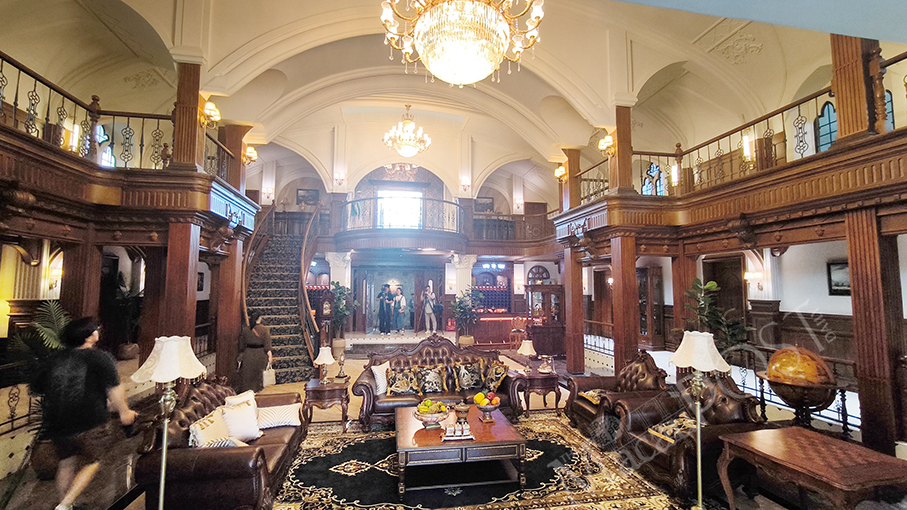
Journalists visit a film set in the Hengqin International Film Studio during last week’s tour. – Photos taken by Tony Wong
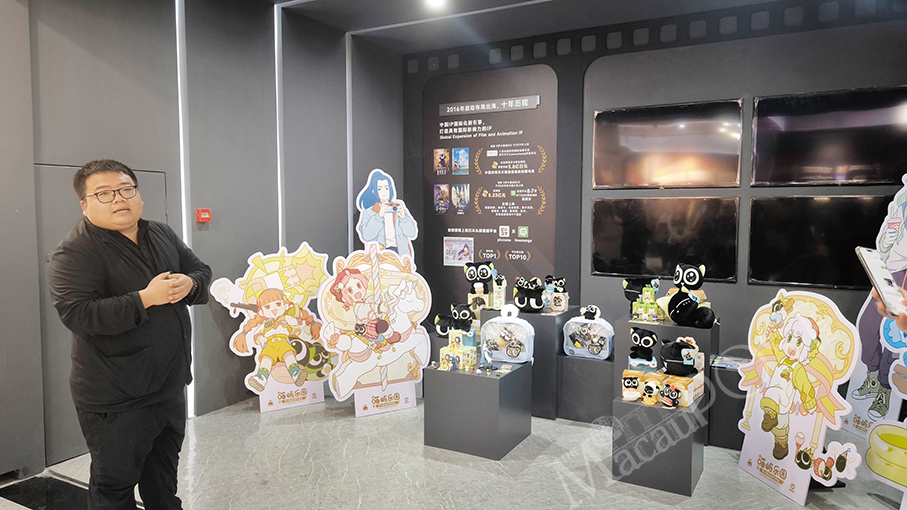
Leo Li Ming briefs journalists in the studio’s exhibition hall.
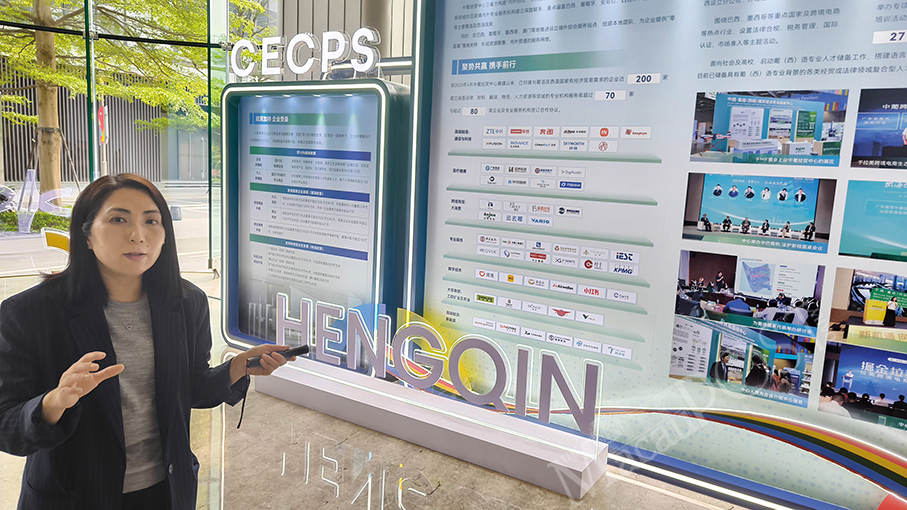
Ng In Cheong briefs journalists on the ground floor of Block 8 of the Service Centre for Economy and Trade between China and Portuguese/Spanish-speaking Countries complex last week.
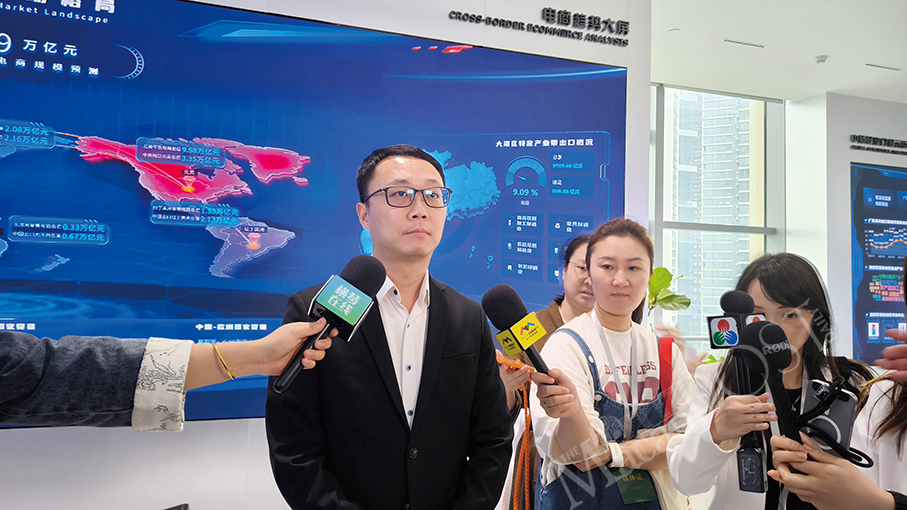
Vic Lam In Kit briefs journalists at the Cross-border E-commerce (Huafa) Innovation Industrial Park last week.
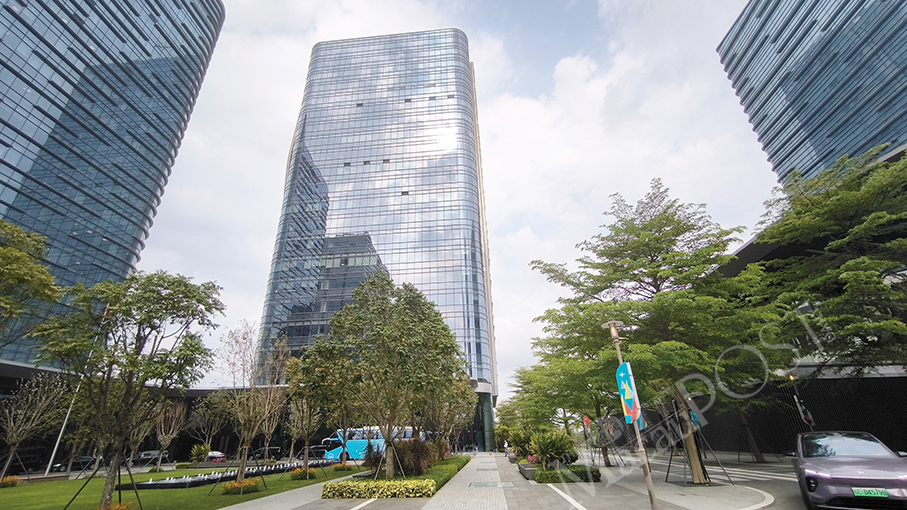
This photo taken last week shows Block 8 of the complex.
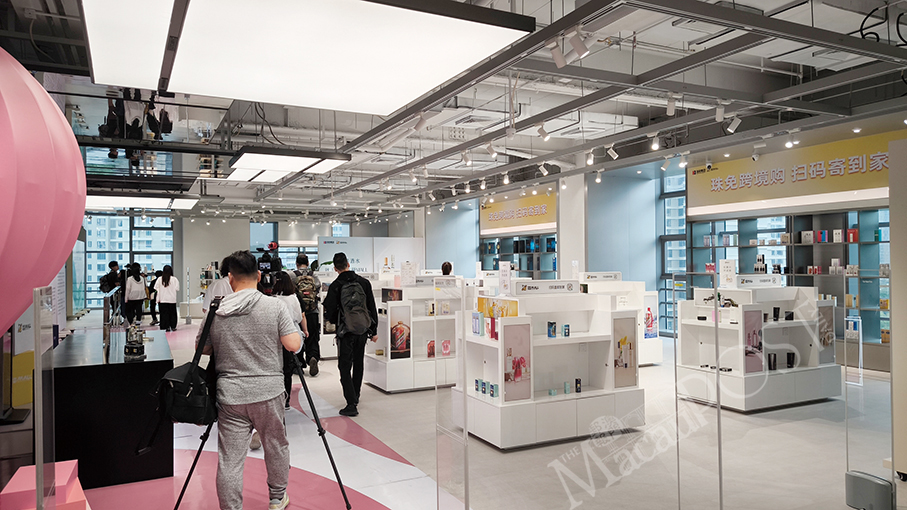
Journalists visit the park’s Global Product Selection Centre last week.