

A researcher from the public University of Macau (UM) has co-authored an article published in the scientific journal Nature, arguing that while artificial intelligence (AI) is boosting research productivity, it may also be eroding the traditional apprenticeship model that has long been central to scientific training, according to a statement by the public university on Thursday.
The article was co-written by Tony Zhang Huiquan, associate professor in the Department of Sociology at UM’s Faculty of Social Sciences (FSS), and a collaborator, said the statement, which did not identify the latter.
Drawing on their experience using agentic AI* tools such as OpenClaw, the authors examine the growing impact of AI on research and education, the statement added.
Published under the title “AI agents in research: when productivity comes at the cost of apprenticeship”, the article highlights concerns that junior researchers are increasingly being displaced from routine research tasks that traditionally served as key learning opportunities, the statement noted.
According to the statement, students develop research competence not only through formal instruction but also through hands-on practice under the guidance of experienced mentors. Activities such as troubleshooting errors, refining methods, calibrating instruments and making research decisions provide essential skills and judgment that cannot easily be learnt through theory alone, the statement noted, adding that the article argues that as AI systems assume more responsibilities within research workflows, students may participate less frequently in these foundational tasks.
Fewer opportunities for practical involvement, combined with reduced interaction between mentors and students, could weaken the transfer of tacit knowledge and professional experience that underpins scientific training, the statement quoted the article as saying. In order to address the issue, the authors call for a balanced approach that preserves educational goals while embracing technological advances, the statement said, noting that they recommend integrating AI into research training, encouraging mentors and students to learn new tools together, and using AI as a shared assistant rather than a substitute for junior researchers.
The publication in Nature reflects UM’s growing international academic profile and contributes to an increasingly important debate surrounding the role of generative** and agentic AI in higher education, the statement noted, adding that the authors argue that safeguarding apprenticeship while leveraging AI-driven productivity will be crucial to training the next generation of scientists.
*Agentic AI refers to artificial intelligence systems that can act autonomously to achieve specific goals, rather than just responding to direct, step-by-step prompts. Unlike traditional AI chatbots that wait for their users to ask a question and then provide an answer, agentic AI has agency. Users give it a high-level objective, and it figures out the plan, makes decisions, uses digital tools (like searching the web, sending emails, or running code), adapts to obstacles, and self-corrects along the way until the task is complete. – Gemini
**Generative AI refers to artificial intelligence systems that can create entirely new content – such as text, images, audio, video, or code – by learning the underlying patterns and structures from massive amounts of existing training data.
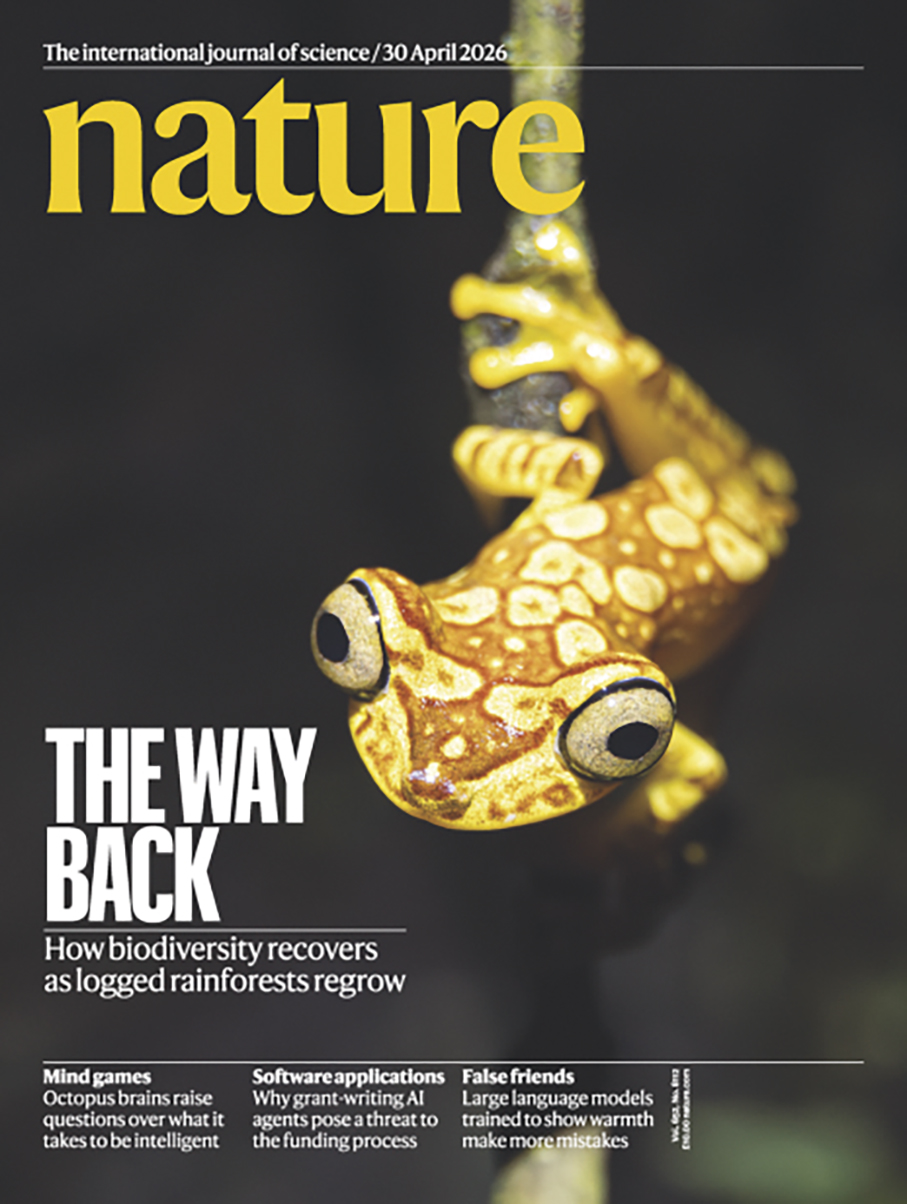
This image provided by the public University of Macau (UM) on Thursday shows the cover of the international academic journal Nature.