

Interview by William Chan
Organised by the Macau Band Directors Association, the Macau Band Fair 2026 features the saxophone quartet Quatuor* Rodin.
Formed at the Conservatoire Royal de Liège**, the ensemble comprises Korean players Han Dahyeon, Yun Yeachan, and Kim Donghwan alongside local saxophonist Lee Chi Pok.
Guided by renowned cellist François Deppe, the group successfully bridges French repertoire with contemporary creations, and had their debut performance in 2022. Deppe personally named the quartet after the iconic French sculptor Auguste Rodin as a tribute to their refined, nuanced interpretations of French music.
The birth of Quatuor Rodin
Lee told the Post that the quartet formed organically when three Korean master’s students joined his class at the conservatory. Their initial bond was forged through shared adversity when Deppe assigned them an obscure, handwritten manuscript for a chamber music project. Although the score was nearly illegible and rehearsals were gruelling, Lee noted that overcoming these challenges built their mutual trust.
The turning point came when they began rehearsing Debussy’s String Quartet. Lee fondly remembered the long Belgian May evenings, practising until dusk and walking out under pink-purple skies. For him, the magic of that period was less about the repertoire and more about how those intense hours made them genuinely fall in love with playing together, transforming them into a cohesive quartet.
Lee expressed profound admiration for Deppe’s deep cultural and historical intellect. While Deppe is celebrated for his contemporary music achievements with the Ictus Ensemble, Lee was most inspired by his ability to uncover deep artistic connections within any piece of music, regardless of its genre.
“Deppe consistently challenged the quartet to translate string sensibilities onto the saxophone through meticulous breath control, phrasing, and balance.” Lee credited this rigorous guidance with defining their artistic trajectory, adding that Deppe’s strict yet deeply supportive mentorship provided the vital stage opportunities that allowed the young ensemble to thrive.
A deep thinker in a fast-paced world
Having known Lee for a decade, I have long admired his exceptional skill as a rising star. Yet, Lee humbly dismissed the idea that he possesses superior natural talent, noting that many peers surpass him in technique and speed. Instead, he acknowledged a trait his mentors often call a “deep” musicality: a habit of relentless, multi-angled reflection.
Lee pointed out that he constantly interrogates musical phrases to uncover their deeper meanings. While he admitted this analytical nature can be a double-edged sword that risks overthinking on stage – where intuition must rule – he views his curiosity as his true gift. Ultimately, he prioritises dedication over talent, drawing inspiration from the incredibly hardworking musicians around him.
Despite his impressive credentials, Lee’s path to music was not linear. He noted that as a teenager, he suppressed his musical ambitions, fearing the career was too unrealistic. The turning point came in his senior year of high school with the movie La La Land, which inspired him to pursue his dreams regardless of external judgment.
Though he spent a year studying veterinary medicine in Taiwan, Lee used that time to solidify what he truly wanted out of life. With the immense support and trust of his parents, he ultimately found the courage to pivot back to his true calling.
Heritage vs. innovation
Lee’s fascination with contemporary music began in middle school under his teacher Hugo Loi in Macau. Rather than finding unconventional sounds alienating, Lee was instantly captivated by their novelty. He advises listeners not to force “understanding” onto contemporary music, but to experience it as an immersive sonic space.
For Lee, classical music represents heritage – a responsibility to safeguard and transmit timeless beauty. Contemporary music, by contrast, represents active creation that challenges established aesthetics. He relishes navigating both worlds, arguing that musical vitality relies on this continuous dialogue between tradition and innovation. This dynamic is perfectly mirrored in Belgium, where Lee observed that while classical concerts often draw older crowds, younger generations enthusiastically pack halls for experimental, contemporary performances.
Quatuor Rodin will be performing at the Small Auditorium on July 18 at 7:45 p.m. Tickets are priced at 180 patacas, with various discounts available. To purchase, visit: macauticket.com/TicketWeb2023/programme/P-055952
* “Quatuor” is the French term for a quartet. It primarily refers to a musical ensemble of four singers or instrumentalists, or a composition written for four parts. - Gemini
** The Royal Conservatory of Liège (RCL) (French: Conservatoire royal de Liège) is a historic conservatory in Liège, Belgium. It is one of four conservatories in the French Community of Belgium that offers higher education courses in music and theatre. - Wikipedia

Quatuor Rodin performs at Liège Philharmonic Hall in 2023. – Photos provided by Lee

Quatuor Rodin members poses with their teacher François Deppe in 2024.
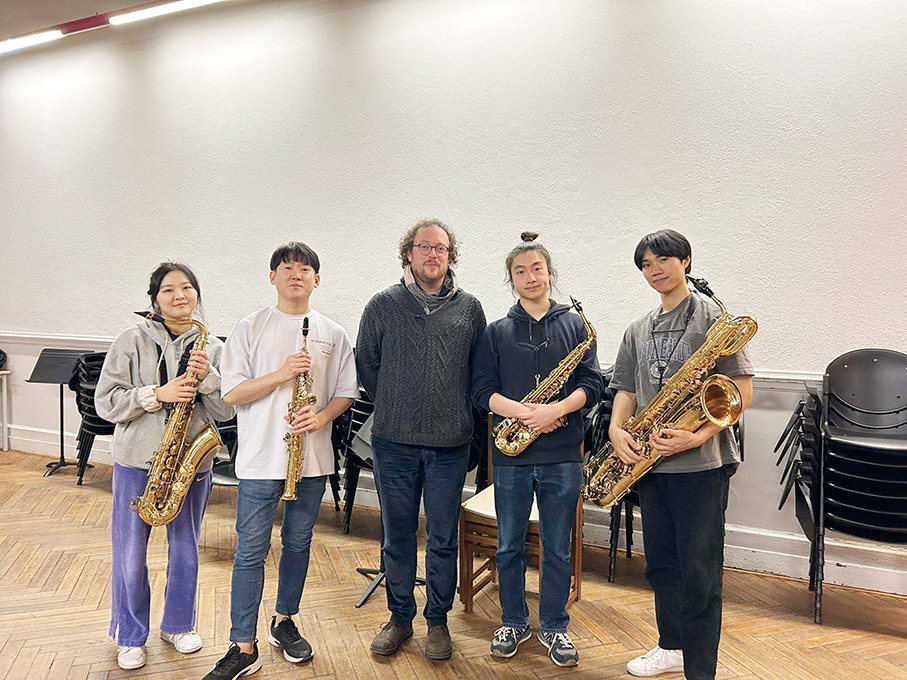
Quatuor Rodin poses with Belgium composer Frederik Neyrinck (centre) in 2023.

Lee Chi Pok poses with his saxophone in this file photo.