

Commentary by Manuel Silvério
Independent Sports Analyst and Regional Development Consultant (Former senior public official with extensive international experience and a long-standing commitment to public policy and sports development)
Macau offers its residents a high standard of living that is stable, safe and comfortable. It is a compact and functional city where almost everything seems close at hand. Yet comfort also carries its own risks. When a society becomes too accustomed to convenience, it may, almost without noticing, develop a kind of greenhouse mentality: people grow up protected, but sometimes removed from the real demands of the wider world.
For that reason, the expedition organised by the Association of Macanese Youth to Qinghai Province, from July 26 to August 1, 2026, was far more than a study visit. It was, in many ways, a step outside that greenhouse. It offered direct contact with the plateau, the high altitude, the cold, the dry heat, the vast distances, the power of nature, China’s ethnic diversity, ecological security, historical memory and the immense territorial scale of the country.
A Journey Beyond Tourism
The journey did not begin under ideal circumstances. Our departure from Macau took place under Signal No. 3, as Tropical Cyclone Noul approached. Upon arrival, we were reminded that Qinghai had recently experienced an earthquake before our visit, and while our delegation was still travelling across the plateau, another tremor occurred. Nature itself seemed to remind us that travelling through Qinghai requires respect, prudence and humility.
Over the following days, as we crossed endless highways, endured early departures, strong winds, intense sunshine, sudden rain, high altitude and dramatic changes in temperature, it quickly became clear that Qinghai cannot be understood through the window of an air-conditioned vehicle.
The real learning took place in the field: in the shorter breaths taken at more than three thousand metres above sea level; in the shared fatigue; in the generous meals, naturally different from our own culinary habits; in the conversations held aboard the coach; and in those moments when the body longed for rest, yet the mission demanded that we continue.
It also emerged through friendship and mutual support. During the most demanding days, the evening ritual of gathering around a hot pot became almost a collective embrace. It warmed the body, restored our energy and strengthened the bonds within the group.
Perhaps that human dimension was one of the expedition’s greatest strengths. Our local guides, who regularly accompany official delegations, confided that they had never worked with a group so courteous, patient and understanding. Such a simple compliment says a great deal. Throughout a demanding itinerary, the young people from Macau demonstrated not only curiosity, but also courtesy, respect, discipline and civic responsibility.
That, too, is Macau.
That, too, is a way of representing the Macao Special Administrative Region (MSAR).
A Speech that Gave Meaning to the Mission
One of the most meaningful moments of the expedition took place during the farewell and evaluation dinner, when the Head of Delegation, Leonel Alves*, delivered a speech that captured the human, community and institutional significance of the visit to Qinghai.
Throughout the entire seven-day programme, both Mr Alves and Ms Qiu Yu, Director-General of the Coordination Department of the Liaison Office of the Central People’s Government in the Macao SAR, accompanied the delegation from beginning to end. They shared the same roads, the same timetable, the same fatigue and the same challenges imposed by the plateau. This was not a protocol visit observed from a distance, but an experience lived side by side.
In his closing remarks, Mr Alves expressed his sincere gratitude to the Liaison Office of the Central People’s Government in the Macao SAR and, in particular, to Ms Qiu for her close support, dedication and constant guidance throughout the expedition.
He then emphasised that the mission had gone far beyond the limits of an ordinary sightseeing itinerary. In his view, the visit to Qinghai had become a journey of learning, community cohesion and intergenerational transmission, bringing together the Macanese community, engaging younger generations and contributing to the country’s overall development.
That idea deserves careful reflection.
At a time when many youth activities risk becoming little more than organised trips, group photographs or items on an annual calendar, the Qinghai experience demonstrated that an immersion programme can achieve something far more meaningful. It can become education. It can provide genuine contact with the country. It can offer an opportunity to understand, first-hand, that China is far more than its great cities, illuminated avenues, monumental shopping centres or the familiar images of contemporary development.
Qinghai invited us to discover another dimension of the nation: its inland regions, its immense distances, its ethnic and religious diversity, its strategic resources, its ecological security, its historical memory and the resilience of its people.
It was in that context that Mr Alves’ speech acquired particular significance. It was not merely a formal address delivered at the end of a visit. It was an attempt to transform a shared experience into a deeper sense of collective awareness.
Macau as Home, the Country as the Horizon
In his address, Leonel Alves recalled that, under the Basic Law of the Macao Special Administrative Region, Macau is the true home of the Macanese** community. It should never be regarded as merely a place of passage, but as a place of belonging, responsibility and future.
This observation carries particular significance today. In 2026, with more than half of the initial fifty-year period established under the principle of “One Country, Two Systems” already behind us, the Macanese community cannot rely solely on memory, culture or family heritage. It must also ask itself what role it wishes to play in the future of the Macao SAR.
The continuity of a community is not secured simply by preserving memories of the past. It depends upon active participation, responsible citizenship and the ability to contribute meaningfully to the society in which it lives. For the Macanese community, this means developing a deeper understanding of Macau, acquiring greater knowledge of the country and preparing younger generations to serve a reality that has changed profoundly.
Mr Alves was equally clear in stressing that Macanese youth should broaden their understanding of global geopolitics and national security. The Qinghai experience enabled the delegation to witness first-hand the country’s strategic mineral resources, its vast territory, the importance of ecological security and the historical depth of regions that rarely feature in the everyday imagination of those living in Macau.
At a time marked by growing external challenges, international instability and increasing competition among major powers, Macau’s stability cannot be viewed in isolation. The prosperity of the Macao SAR is closely linked to the strength, stability and continued development of the country.
It was within this context that Mr Alves expressed one of the evening’s most memorable reflections: When the country does well, Macau does better.
The sentence is simple, yet it conveys a clear political and community message. Macau does not exist apart from the national reality. Its stability, its special status, its capacity for development and its role as a platform all depend upon a strong, cohesive country capable of responding successfully to complex challenges.
For the Macanese community, this awareness is particularly important. Owing to its unique cultural heritage, shaped by centuries of interaction between East and West, the community continues to have an important role to play in Macau. However, that role requires more than identity alone. It demands knowledge, preparation, discipline, linguistic ability, civic maturity and a genuine sense of responsibility.
Preparing the Next Generation
Mr Alves further observed that everything accomplished today should be viewed in the light of future generations – our children and grandchildren – so that they may continue to live, work and prosper with stability in the Macao SAR while deepening Macau’s integration into the Guangdong–Hong Kong–Macao Greater Bay Area.
This is a decisive point. When discussing Macanese youth, we are not speaking merely of emotional continuity or cultural preservation. We are speaking about a concrete future: employment, education, mobility, professional skills, a sense of belonging, civic participation and the ability to build meaningful lives in Macau and throughout the region.
Integration into the Greater Bay Area (GBA) and a deeper understanding of the Chinese mainland should be regarded as progressive learning journeys. Whenever possible, they should be accompanied by practical experiences – immersion programmes, internships, language training, professional exchanges and hands-on projects – capable of transforming curiosity into competence and a sense of belonging into meaningful participation.
Macanese youth are far from homogeneous. Some are highly qualified, cosmopolitan, multilingual and ambitious. Others are less confident, less exposed to wider opportunities or still searching for their direction in life. For that reason, opportunities in the Greater Bay Area and throughout the Chinese mainland should not be designed solely for those who are already well prepared. They should also help less confident young people broaden their horizons, strengthen their resilience, enrich their general knowledge and develop the confidence to overcome limitations.
This is precisely where journeys such as the expedition to Qinghai acquire their true value. When properly organised, they are not tourism. They are education. They remove young people from the routines of everyday life and encourage them to live together, adapt, listen, observe, face discomfort, deal with the unexpected and understand that the country is far greater and more complex than the images presented through social media.
Yet such experiences will only fulfil their purpose if they are followed by continuity. It is not enough simply to take young people on distant journeys. Preparation beforehand, proper guidance throughout the programme and structured follow-up afterwards are equally essential. Every expedition should generate reflection, new ideas, stronger networks, greater responsibility and a deeper understanding of Macau’s place within the country’s overall development.
Qinghai, National Security and Development
In the same address, Mr Alves recalled a message conveyed to him during the dinner hosted by Wang Runyu, Executive Vice-Minister of the United Front Work Department of the Qinghai Provincial Committee of the Communist Party of China. In his own words, he emphasised the importance of following the guidance of President Xi Jinping by persevering in our efforts, embracing innovation with courage and strengthening the country’s capacity for high-quality development.
This reference gave the speech a broader perspective. The visit to Qinghai should not be seen merely as a community activity organised by the Association of Macanese Youth. It should also be understood as part of a wider process of getting to know the country, strengthening national integration and preparing younger generations in the Macao SAR to better understand the challenges of China’s contemporary development.
Qinghai offered many valuable lessons. At Base 221, the former Atomic City, national security ceased to be simply a legal or political concept. It became the living memory of scientists, engineers, technicians, workers, families and entire communities who accepted difficult missions under extremely demanding conditions.
Deng Jiaxian symbolises a generation that worked far from public recognition, guided by a simple yet powerful conviction: a vulnerable country cannot enjoy genuine peace. The strategic strength developed there should not be interpreted as a glorification of war, but rather as an expression of national sovereignty whose highest purpose is to safeguard national security and prevent war.
In Golmud and at Qarhan Salt Lake, the immense territory, strategic mineral resources, salt lakes, logistics, energy production and the harsh climate revealed another China, one that extends far beyond the familiar image of the country’s great metropolitan centres. There exists an inland China, less visible and less photographed, that guarantees strategic resources, ecological security and long-term national resilience.
Qinghai is also a land of remarkable diversity. The presence of Tibetan, also known as Zang, Hui, Han, Mongolian, Tu, Salar and many other ethnic communities reflects a deeply plural reality. At Hongjue Monastery, history reminds us of centuries of relations between the Central People’s Government and the great spiritual lineages of Tibetan Buddhism. At Qinghai Lake, the close relationship between ecology, spirituality and daily life revealed a profound respect for nature and for the cycles of existence.
Crossing the Qaidam Basin, where wind turbines stretch to the horizon, offered another lesson in green development. The powerful winds of the plateau, which physically challenged us throughout the journey, also represented clean energy transformed into future prosperity. In Guide and Kanbula, where the surprisingly clear waters of the Yellow River flow through spectacular Danxia landforms, the landscape told another story: one of human determination to manage territory wisely, protect fragile ecosystems and create sustainable communities in demanding environments.
These experiences helped us understand that national development is not measured solely by modern skylines, high-speed railways, skyscrapers or major international events. It is equally built upon anonymous work, personal sacrifice, territorial planning, ecological security, cultural diversity and perseverance in regions where life remains particularly demanding.
Making Better Use of Macau’s Human Resources
This experience also leaves an important message for the institutions of the Macao SAR. Macau needs more demanding immersion programmes, better organised and more closely connected to the country’s realities. These should not become merely symbolic journeys undertaken to fulfil annual schedules or produce official photographs. They should be genuine missions of learning, civic education, direct contact and leadership development.
The Macanese community, particularly its younger generations and those of Portuguese descent, can continue to make a valuable contribution if properly prepared. Macau cannot be compared with Hong Kong in terms of scale, critical mass or human resources. As a smaller special administrative region with its own unique characteristics, it becomes even more important to make intelligent and effective use of every individual possessing distinctive cultural, linguistic and interpersonal skills.
Within this context, the Macanese community should not be regarded merely as the guardian of a historical legacy, but as a valuable strategic human resource. Its members can help Macau interpret different cultures, communicate with greater sensitivity, strengthen its role as a platform between China and the Portuguese-speaking world, and contribute to economic, cultural, educational, tourism, sporting and institutional cooperation.
Making full use of this potential requires vision, method and confidence. It is not enough simply to recognise the symbolic importance of the Macanese community. It is essential to create concrete opportunities for young Macanese to be educated, entrusted with responsibilities, tested in practical situations and encouraged to contribute actively.
It also requires institutions to stop viewing young people merely as spectators. They should not be invited simply to attend ceremonies, applaud achievements or appear in official photographs. They should progressively be encouraged to write, present ideas, participate in projects, assume responsibilities, organise events, visit Mainland China, receive delegations, build links with the Greater Bay Area and demonstrate through practical action that Macanese identity is not merely a memory of the past, but a living capacity to contribute.
Three Years, Two Provinces, On Autonomous Region
Over the past three years, I have had the privilege of taking part in the Association of Macanese Youth’s expeditions to Jilin, Ningxia and Qinghai. They are three very different provinces, each with its own identity, geography and history. Yet, taken together, they offer a powerful insight into the diversity and strength of the country.
We did not travel merely to Tiananmen Square to watch a military parade. Nor did we limit ourselves to visiting China’s great metropolitan centres, with their wide boulevards, illuminated skylines, monumental shopping malls and impressive infrastructure. Those images certainly form part of contemporary China, but they do not tell the whole story.
The greatest lesson of these journeys lay elsewhere.
It was found behind the scenes, in regions where life is more demanding, where the climate tests endurance, where distances are immense, where the land requires perseverance, where stability is built through quiet dedication and where national development appears less as spectacle than as a daily task.
Jilin revealed another face of China’s Northeast. Ningxia demonstrated the importance of cultural frontiers, ethnic coexistence and economic transformation. Qinghai added yet another dimension: the high plateau, strategic resources, ecological security, spirituality and human resilience.
For Macau, this learning is indispensable. We cannot aspire to serve as an international platform, a meeting point between cultures and a bridge between China and the Portuguese-speaking world if we possess only a limited understanding of the country itself.
A bridge is only as strong as the foundations that support it on both sides.
Returning with a Sense of Responsibility
At the end of the expedition, we returned to Macau tired, yet profoundly changed.
After seven days of travelling through high-altitude landscapes, enduring cold and heat, fatigue, discovery and companionship, the delegation returned with a far clearer understanding of the country’s scale and of the responsibility that comes with truly knowing it beyond the familiar images.
We brought home photographs, memories, amusing stories, new friendships and a deep sense of gratitude for the generous hospitality we received. More importantly, however, we returned with a renewed awareness.
The comfort that Macau offers should be appreciated, but it must never lull us into complacency.
Its stability should be valued, but it must never become an excuse for inaction.
The Macanese identity should be preserved, but it must never become imprisoned by nostalgia.
The young people of Macau need to experience the wider world.
They need to know their country.
They need to understand the Greater Bay Area, the Chinese mainland, its cultural frontiers, its more demanding regions, its strategic resources, its people and the unseen foundations that sustain the nation’s prosperity.
Only then will they be fully prepared to participate, with maturity and confidence, in the future development of the Macao SAR.
Macau is our home.
The country is our wider horizon.
Between the two, the Macanese community can continue to serve as a living bridge, provided it prepares its younger generations to serve with intelligence, humility and courage.
If the purpose is to better understand the country, to serve Macau and to contribute to our shared future, we shall gladly be ready to go again.
(End)
*Leonel Alves Leonel Alberto Alves (歐安利), 69, is a prominent Macanese lawyer, private notary, and long-standing public figure MSAR. He is a former lawmaker and current member of the MSAR Government’s Executive Council, its top advisory body. He also heads the Macau Holy House of Mercy (SCM) – the world’s oldest existing Western charity organisation in the Far East. - MPD
**Customarily, the term “Macanese” refers to residents of mixed Portuguese and Asian descent or upbringing (around 1.5 percent of Macau’s population), as well as the broader diaspora. - MPD
N.B. The article uses “Macau” in most narrative sentences but uses “Macao” in official tittles or administrative designations. – MPD
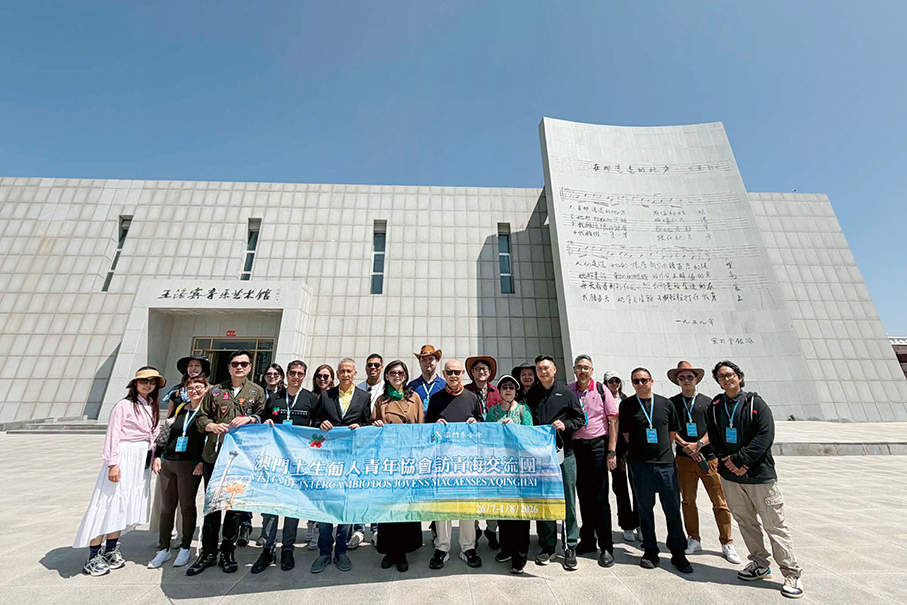
Members of a delegation from the Association of Macanese Youth pose in front of the Wang Luobin Music and Art Museum (also known as the Wang Luobin Memorial Hall) in Haiyan County, Haibei Tibetan Autonomous Prefecture, Qinghai Province, on July 28, 2026. Pictured in the front row are Director-General of the Coordination Department of the Liaison Office of the Central People’s Government in the MSAR Qiu Yu (sixth from left), Delegation Head Leonel Alves (fifth from left), and Advisor to the Delegation Manuel Silvério (seventh from right). Wang Luobin (1913–1996) was a renowned Chinese songwriter and music ethnographer, widely celebrated as the “King of Northwest Folk Songs.” – Photo courtesy of Tracy Leong