

The government yesterday announced the mergers and restructuring of several public entities, which will take effect on Tuesday next week.
The Consumer Council (CC) and the Science and Technology Development Fund (FDCT) will be merged into the Economic and Technological Development Bureau (DSEDT).
Both the council and the fund are currently bureau-level public entities.
The administrative, financial, and IT duties of four bureaus directly overseen by the chief executive will be performed by a single entity – the Government Headquarters Affairs Bureau (DSASG). These four bureaus comprise the Policy Research and Regional Development Bureau (DSEPDR), the Government Information Bureau (GCS), the Public Assets Supervision and Management Bureau (DSGAP), and the Personal Data Protection Bureau (DSPDP).
The Macao Conservatory, currently operated under the Cultural Affairs Bureau (IC), will be moved to the Education and Youth Development Bureau (DSEDJ).
Secretary for Administration and Justice Wong Sio Chak, who is also the spokesman for the government’s top advisory body – the Executive Council, made the announcement during a press conference at Government Headquarters yesterday.
The mergers and restructuring of public entities are among the major initiatives under the local government’s current campaign to deepen public administration reform.
DSEDT-CC-FDCT merger
Currently, the Economic and Technological Development Bureau, headed by a director and two deputy directors, comprises six departments and 13 divisions, while the Consumer Council, headed by a president and a vice-president, comprises one department and three divisions.
Including its president, the board of the Science and Technology Development Fund currently has three members. The president receives a bureau-director salary, while the other two members each receive a bureau-deputy-director salary. The fund currently comprises four departments.
During yesterday’s press conference, Wong noted that these three bureau-level public entities currently comprise three bureau-director-level positions, five deputy-director-level positions, 11 departments, and 16 divisions in total.
After the council and the fund merge into the bureau on Tuesday next week, Wong said, the restructured bureau will comprise seven departments and 11 divisions. It will, as currently, be headed by a director and two deputy directors.
More specifically, the restructured bureau’s seven department-level subunits will comprise six departments and a Consumer Council – which will perform the same duties and functions as the current Consumer Council.
The other six departments will be respectively tasked with external trade, industrial and commercial development, cooperation and planning for sci-tech research, sci-tech industry, intellectual property, and business activity licensing and inspection.
The restructured Economic and Technological Development Bureau will be regulated by a new administrative regulation governing its organisational structure and operation, which will take effect on September 1. Government-drafted administrative regulations, aka bylaws, do not require the legislature’s approval.
The current administrative regulation of the Consumer Council will be abolished on Tuesday next week.
Despite being merged into the Economic and Technological Development Bureau, the Science and Technology Development Fund will continue to have its own administrative regulation – regulated by a new one from Tuesday next week. No longer operating as a bureau-level public entity, the fund will instead be operated by the bureau.
The fund will have a board consisting of five members, all of whom will each receive a salary equivalent to 50 points for public servants – 4,700 patacas currently.
DSASG restructuring
Meanwhile, according to Wong, the organisational structure of the Government Headquarters Affairs Bureau (DSASG) will also be streamlined.
Wong noted that the bureau currently comprises a director, two deputy directors, three departments, and eight divisions. After its restructuring on Tuesday next week, it will comprise a director, a deputy director, three departments, and six divisions.
The new administrative regulation governing its organisational structure and operation will also enable the bureau to perform the administrative, financial, and IT duties of four bureaus directly overseen by the chief executive: the Policy Research and Regional Development Bureau (DSEPDR), the Government Information Bureau (GCS), the Public Assets Supervision and Management Bureau (DSGAP), and the Personal Data Protection Bureau (DSPDP).
Consequently, Wong noted, the respective administrative regulations governing these four bureaus’ organisational structures will also be amended. Specifically, the number of deputy-director-level positions, departments, and divisions in the four bureaus combined will be reduced by one, one, and four, respectively.
The Policy Research and Regional Development Bureau will have only one deputy director, a change from two currently.
The other three bureaus will each, as currently, have one deputy director.
Macao Conservatory
Meanwhile, Wong also elaborated on the government’s decision to move the Macao Conservatory from the Cultural Affairs Bureau (IC) to the Education and Youth Development Bureau (DSEDJ).
After the relocation, the Macao Conservatory will become a public school operated by the Education and Youth Development Bureau. Moreover, the Macao Conservatory will run an affiliated education centre – operated as a continuing education institution for members of the general public.
Wong said that the relocation aims to create higher-quality, forward-looking arts education for young local people while fostering the integration of arts education into Macau’s overall education policies.
The culture bureau’s current administrative regulation will be amended – removing the Macao Conservatory from its organisational structure – while the current regulation governing the education bureau’s structure will be kept intact. Instead, the operation of the Macao Conservatory under the education bureau will merely be formalised by an executive order published in the Official Gazette (BO).
Wong underlined that the academic certificates and qualifications of the students enrolled in the Macao Conservatory will not be affected.
Meanwhile, Wong also said that the merger of the Cultural Affairs Bureau, the Sports Bureau (ID), and the Cultural Development Fund will get off the ground in October or November.
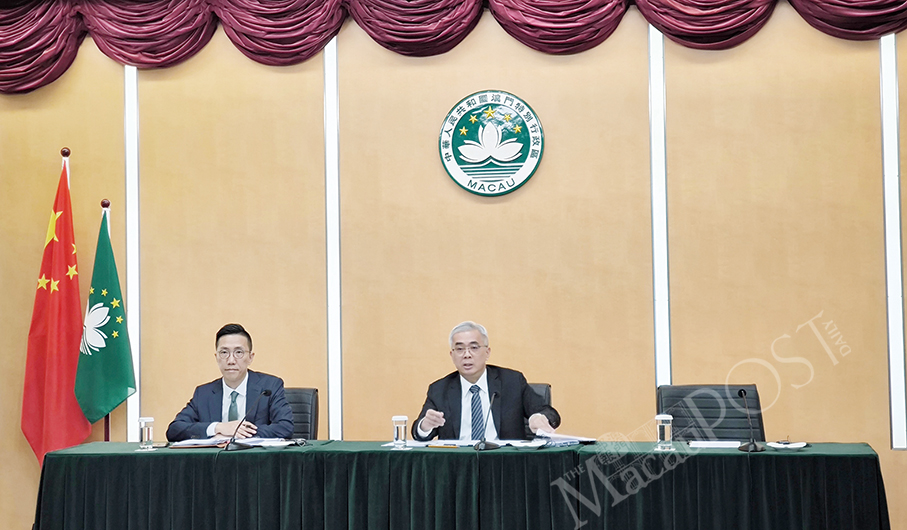
Secretary for Administration and Justice Wong Sio Chak (right) speaks during yesterday’s press conference at Government Headquarters as Economic and Technological Development Bureau (DSEDT) Director Yau Yun Wah looks on.
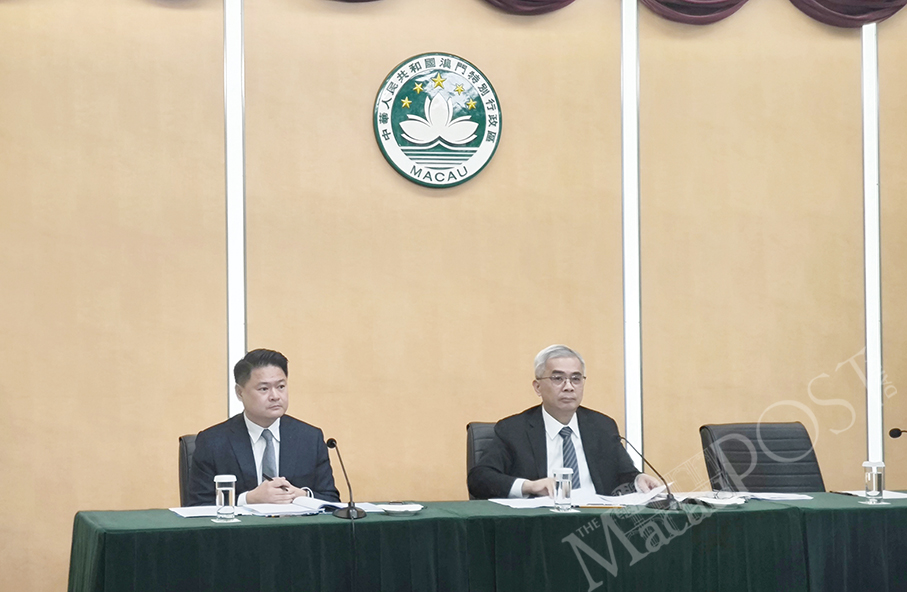
Wong Sio Chak and Government Headquarters Affairs Bureau (DSASG) Director Derek Loi Chi San address yesterday’s press conference.
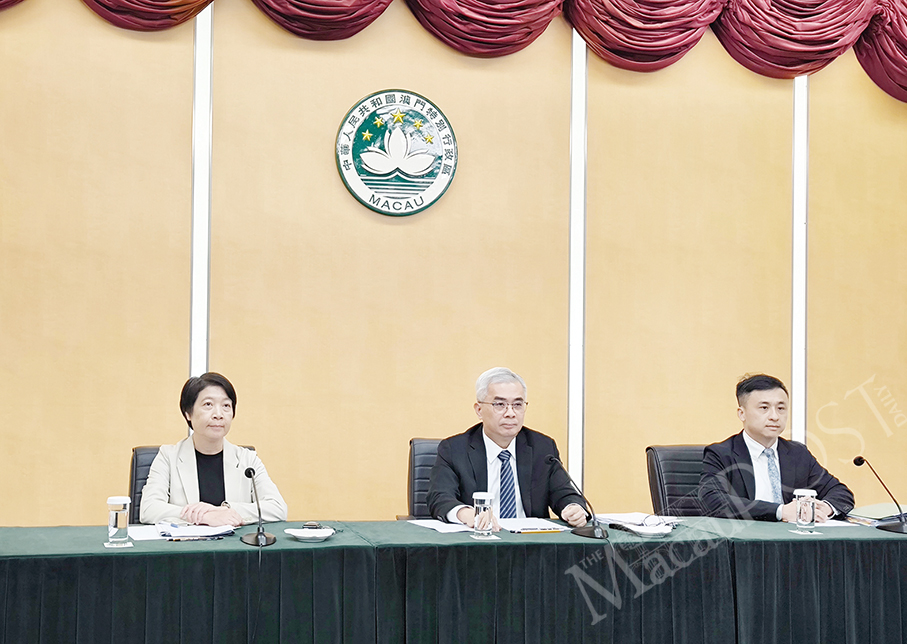
Wong Sio Chak, Cultural Affairs Bureau (IC) President Deland Leong Wai Man (left), and Education and Youth Development Bureau (DSEDJ) Deputy Director Wong Ka Ki address yesterday’s press conference. – Photos: Tony Wong