

A seminar marking the 130th anniversary of the birth of General Ye Ting was held yesterday afternoon at the Macao Cultural Centre (CCM), bringing together scholars from the Chinese mainland and Macau to discuss the military leader’s revolutionary career and ties to the city.
The seminar was organised by the Cultural Affairs Bureau (IC), co-organised by the Research Association of Yeting, and hosted by the Centre for Macao Studies at the private Macau University of Science and Technology (MUST), with support from the Institute of Modern History at the Chinese Academy of Social Sciences (CASS), the Research Centre for Macao History at the Chinese Academy of History and MUST’s Institute for Social and Cultural Research.
The one-day seminar featured keynote speeches and panel discussions focusing on Ye’s revolutionary beliefs, his historical connection with the Dongjiang Column*, his military strategy, his activities in Macau, the contemporary value of the “Iron Army spirit”**, and the preservation of revolutionary heritage.
Cultural Affairs Bureau (IC) President Deland Leong Wai Man pointed out that Ye was one of the principal founders of the Chinese People’s Liberation Army (PLA) and a pivotal revolutionary figure in modern Chinese history.
“Macau was an important place where Ye and his family lived and stayed, and has since become a key centre for research into his historical links with the city,” Leong noted.
She added that Macau would continue to deepen research into its revolutionary history and Ye’s links with the city, as well as catalogue and preserve relevant historical materials.
MUST President Zhu Jian-Kang said the university would continue to promote academic cooperation between the Chinese mainland and Macau and deepen research into Ye’s life and activities in the city.
“The research will provide a stronger academic foundation for patriotic education in Macau,” Zhu said.
Ye’s descendant Ye Xiaoyan also recalled her family’s experiences during Ye’s time in Macau, including how relatives sold their belongings to support the revolutionary cause, adding that she would continue to organise historical archives and promote the “Iron Army spirit”.
* The Dongjiang Column was a Communist Party of China-led anti-Japanese guerrilla force that operated in the Dongjiang (East River) region of Guangdong and Hong Kong during the War of Resistance Against Japanese Aggression. – DeepSeek
** The term “Iron Army Spirit” (铁军精神) primarily refers to the revolutionary spirit of the PLA, particularly the unit descended from the Ye Ting Independent Regiment. The Iron Army Spirit is defined as a “family treasure” that guides troops to overcome difficulties, unite in struggle, and achieve victory. It is considered an important manifestation of the nature and purpose of the people’s army. - DeepSeek
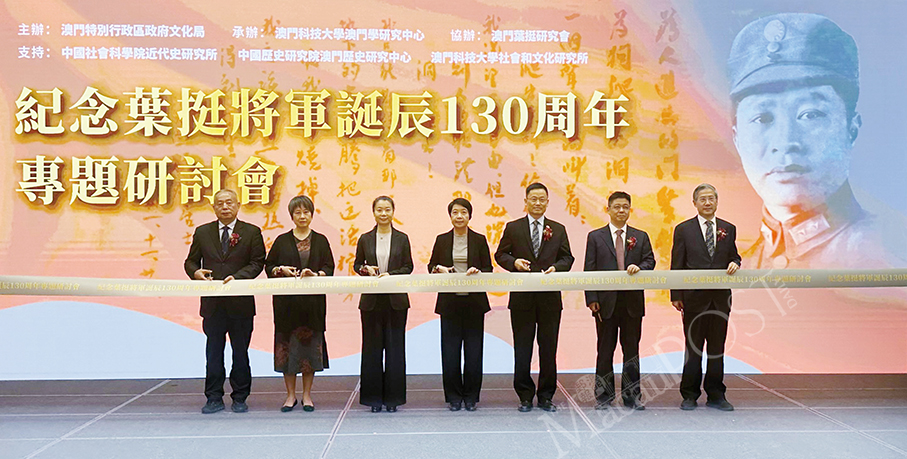
From left to right: Lin Guangzhi, director of MUST’s Institute for Social and Cultural Research; Ye Xiaoyan, co-founder of the Research Association of Ye Ting; Bai Bing, deputy director of the Department of Publicity, Cultural and Sports Affairs of the Central People’s Government Liaison Office in the Macao SAR; Deland Leong Wai Man, acting president of the Cultural Development Consultative Council and president of the Cultural Affairs Bureau (IC); Zhu Jian-Kang, president of MUST; Zhu Hu, deputy director of the Institute of Ancient History, Chinese Academy of Social Sciences; and Li Jin Feng, researcher and deputy director of the Macao History Research Centre, Chinese Academy of History, during yesterday’s ribbon-cutting ceremony at the Macao Cultural Centre in Nape. – Photo: Sherwin Hng