

Interviews by Rui Pastorin
After five days of the “International Film Camp”, the eight outstanding short film projects chosen by an expert panel of judges were unveiled on Tuesday night, with each creator going on to receive a total of HK$300,000 to make their visions come true.
Sponsored by Sands China and organised by the Asian Film Awards Academy, the camp at The Venetian Macao in Cotai was held from September 18 to 22 and was themed “When Strangers Meet”. It enabled a total of 16 participants to receive expert mentoring to refine their short film concepts and pitches, join masterclasses, and network, among others.
With the funding, the eight chosen recipients each have until December to finish short films spanning 15 to 20 minutes.
Speaking with the Post in individual and group interviews on Tuesday, fellow awardees Chan Chon Sin from Macau and Kyrgyzstan’s Ilimbek Maksatbekov highlighted how the overall experience was not only helpful, but serves as an important opportunity for filmmakers.
‘I feel like I can finally execute my project more freely’
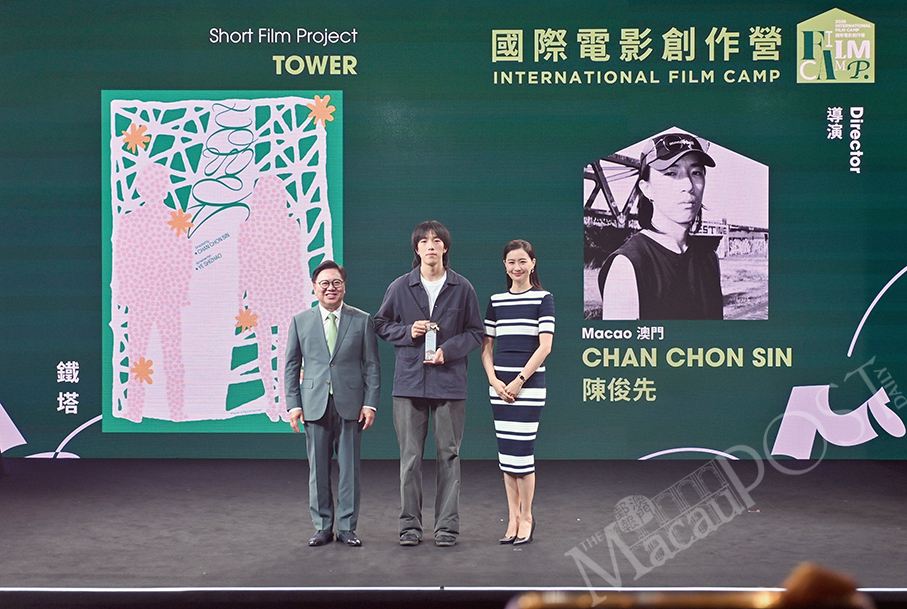
Macau local Chan Chon Sin (centre) holds his award while posing with Asian Film Awards Academy Chairman Wilfred Wong Ying-wai (left) and International Film Camp (IFC) Ambassador, actress, writer and director Fala Chen. – Photos taken during Tuesday’s awards and closing ceremony at The Londoner Macao by Rui Pastorin
Feeling both honoured and excited about his win, local filmmaker Chan said that the initiative opens up opportunities given the fact that the city does not have much funding for film projects.
“As a Macau creator, it’s kind of hard to find our funding through our different platforms or areas”, he said. “We need to go to different countries, reaching out to different platforms for our funding”.
He added that Macau does not have a “formal film industry”, requiring filmmakers to create projects in a more “indie film” or “run-and-gun shoot” style. With the funding, he noted: “I feel like I can finally execute my project more freely” and have more freedom to have what he wants in his film, executing according to his vision.
The project he wants to bring forth? A short film called “Tower”, which incorporates the city’s “spectacle landmarks”. Telling a very local story, Chan described it as “a ridiculous dark comedy” that also shows the real Macau. “I want to really tell a Macau story to the global audience”
Moreover, Chan noted a positive camp experience, pointing out that he was particularly grateful for the recommendations for script adjustments made by experienced Hong Kong director and screenwriter Heiward Mak.
“She’s a great mentor, to be honest, and she’s very selfless”, he said, sacrificing a lot while always making time to make necessary adjustments to each pitch and script. “I really appreciate my mentor’s hard work”.
‘Even if you don’t win, you get to know your story better’
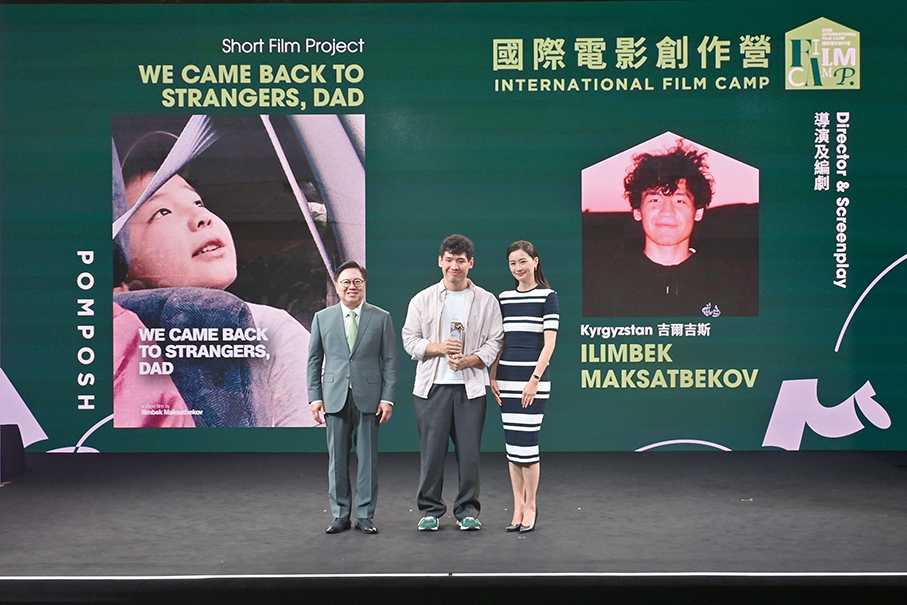
Kyrgyzstan’s Ilimbek Maksatbekov (centre) poses with IFC Ambassador Fala Chen and Asian Film Awards Academy Chairman Wilfred Wong Ying Wai during Tuesday’s ceremony.
For Kyrgyzstan’s Maksatbekov, he admitted that he initially didn’t know much about the programme, but after being drawn by the prospect of learning from filmmaking veterans and industry experts, it sounded “too compelling not to apply”.
“I think it’s a huge platform, especially like the range of countries and regions it takes, it’s quite amazing. And especially in our region, it’s not that easy to get significant support, especially for short films, so I think it’s a quite unique opportunity that we’ve been given here”, Maksatbekov pointed out.
Maksatbekov, whose project is entitled “We Came Back to Strangers, Dad”, also noted that just being able to take part in the camp itself to network and learn was already an “extraordinary opportunity”.
“I think one of the most important things is that even if you don’t win, you really get to know your story better, and it’s going to be easier to go to pitch in some other places, or even just to execute and have the idea, it really helps” he said, highlighting that participants got to learn how to communicate the core vision behind each story.
“Most of us, we worked through the nights and just really trying to figure out what our story is about, how to make it better, so I feel like [it was an] intense period of learning”, he added.
A way to enter film production
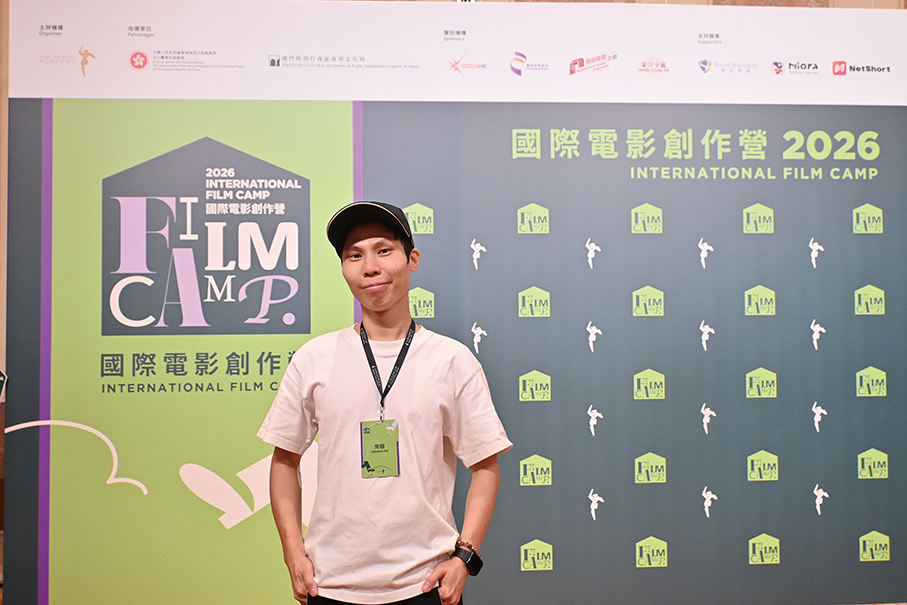
Macau filmmaker and “New Art Studies in Filming – Micro Movie Support Programme” participant Achilles Lei poses after speaking with the Post prior to Tuesday’s awards and closing ceremony.
Meanwhile, aside from the 16 film campers, participants including Achilles Lei (李振華), who is joining the Sands China-sponsored “New Art Studies in Filming – Micro Movie Support Programme”, was also able to sit in on the camp.
Speaking with the Post, the camp, he said, works not only for him, but also for youngsters hoping to enter film production as although one might graduate with a degree and has acquired a lot of knowledge, the fact is they don’t know how to apply it.
“They are not involved in the industry. They just know how to do it, but they’ve never done it”, Lei, who also emphasised the microfilm programme’s ability to develop the skills of its participants, said.
Therefore, Lei pointed out: “I think this type of financial support [the micro movie support programme] and the film camp brings a lot of experienced directors and producers in front of us so that we can ask them questions”, as well as about the problems they are facing, answering all of the questions through a lens of understanding. “They used to be green just like us, so I think that would be very helpful”.