

The government announced yesterday that it has finished drafting a bill proposing to streamline its administrative system for licensing various types of businesses, with the aim of making it easier for residents to launch and run their businesses.
Under the proposed new system, regulations will be eased for various businesses that currently require a permit or licence.
Businesses such as bowling alleys and hair salons - whose normal operations do not affect public safety and order - will no longer need to obtain a specific permit or licence; they will merely need to complete the normal commercial registration for businesses in general.
Businesses such as snooker halls, beauty salons, dry cleaners, and gyms - whose normal operations pose a relatively low risk to public safety and order -will only need to obtain a registration certificate to operate.
Businesses such as massage parlours, health clubs, amusement arcades, internet cafés, karaoke bars, and cinemas - whose operations pose a relatively high risk to public safety and market order - will remain subject to the granting of a permit or licence.
Moreover, the government also proposes launching a new registration system for businesses where individuals provide paid photography and filming services for others at tourist attractions, a type of business that is currently not subject to any official regulations. The government proposes that only local residents be eligible to register to run this type of business.
Secretary for Administration and Justice Wong Sio Chak, who is also the spokesman for the government’s top advisory body - the Executive Council - made the announcement during a press conference at Government Headquarters yesterday. The press conference was also attended by Legal Affairs Bureau (DSAJ) Acting Director Ng Chi Kin and Municipal Affairs Bureau (IAM) President Chao Wai Ieng.
The bill will be submitted to the Legislative Assembly (AL) – which will resume operating on Friday next week after a two-month summer recess – for debate, review, and a vote.
The government proposes establishing a new legal system to replace the current decree-law on the matter promulgated in 1998, when Macau was still under temporary Portuguese administration.
The government carried out a 45-day public consultation earlier this year on the drafting of the bill.
Businesses listed by the 1998 decree-law are currently required to obtain a specific permit or licence to operate.
The new system proposed by the bill will divide these businesses into three categories.
The first category comprises businesses without the need to obtain a registration certificate, permit, or licence. They will merely need to complete normal commercial registration to operate.
The second category comprises businesses requiring a registration certificate to operate, while the third category comprises businesses that will remain subject to the granting of a permit or licence.
Pointing out that the 1998 decree-law has been in force for over 27 years, Wong said that with Macau’s socioeconomic development and changes in its business environment, the implementation of the decree-law can no longer meet civil society’s demands for streamlined administrative procedures and enhanced administrative efficiency in regulating businesses.
Wong said that with the objective of creating a fair, transparent, and predictable business environment and market order while boosting the efficiency of interdepartmental coordination, the government has concluded that – without prejudice to safeguarding public safety and order – its administrative procedures for licensing and supervising businesses can be eased, simplified, and streamlined.
Wong said that the government drafted the bill after assessing the opinions gathered during the public consultation earlier this year while considering Macau’s real situation.
Moreover, Wong said, the government also proposes relaxing entry restrictions for patrons at certain venues, including karaoke bars, after striking a balance between safeguarding minors’ healthy physical and psychological development and the need for family entertainment.
Currently, two groups of individuals are barred from entering karaoke bars: minors under the age of 16, and students wearing school uniforms.
During yesterday’s press conference, Legal Affairs Bureau (DSAJ) Acting Director Ng Chi Kin said that the entry restrictions for karaoke bars proposed by the bill remain unchanged from those proposed in the public consultation document.
Ng noted that under the bill, students in school uniform will remain barred from karaoke bars. However, minors under 16 will be allowed entry between 8:00 a.m. and 8:00 p.m., provided they are accompanied by a parent or guardian.
Municipal Affairs Bureau (IAM) President Chao Wai Ieng said that the bill proposes that those providing paid photography and filming services for others at tourist attractions without completing a registration will be fined between 5,000 patacas and 100,000 patacas.
According to Chao, the bill also proposes that those who have registered to run this type of business but provide such services at locations other than the ones they have registered for will be fined between 5,000 patacas and 20,000 patacas.
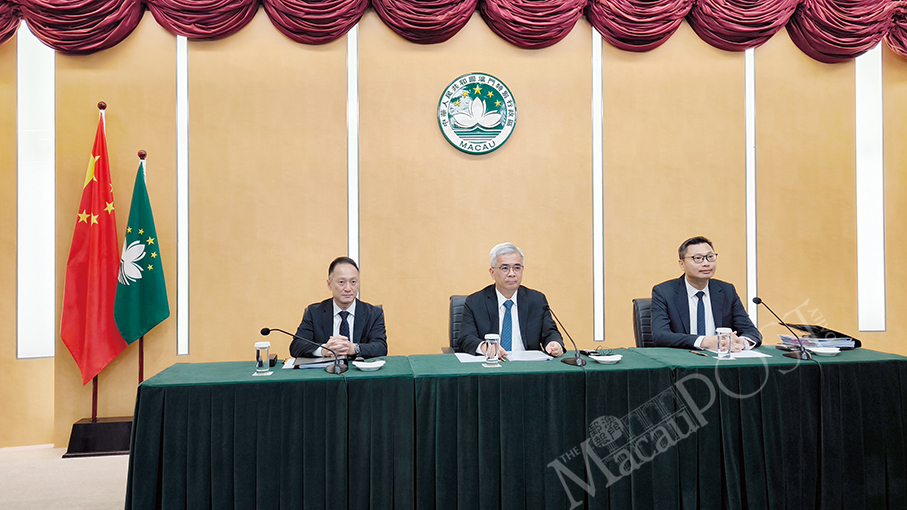
Secretary for Administration and Justice Wong Sio Chak (centre), Legal Affairs Bureau (DSAJ) Acting Director Ng Chi Kin (left), and Municipal Affairs Bureau (IAM) President Chao Wai Ieng address yesterday’s Executive Council press conference at Government Headquarters. – Photo: Tony Wong