

The Macao Community Construction Promotion Association, in collaboration with the Chi Lam Vai Concern Group, held a forum yesterday at the heritage walled village’s activity area to raise awareness and offer suggestions regarding the local government’s proposed revitalisation plan.
The government established last month a “Specialised Working Group for the Renewal and Revitalisation of Pátio do Espinho” under the “Leadership Group for the Promotion of Urban Renewal”.
Former Executive Council spokesman and lawmaker Leong Heng Teng, who serves as the convenor of the concern group, expressed his heartfelt gratitude that the government has officially turned its attention to the last remaining ancient walled village in Macau. He voiced hope that the principles of “residents first, living conservation, and gradual renewal” would be adopted to strike the right balance between heritage conservation, residents’ livelihoods, and cultural tourism development.
Leong pointed out that the village is located at the core of Macau’s World Heritage buffer zone, adjacent to the Ruins of St Paul’s. It is the largest remaining walled village in Macau to retain its original residential character, containing historical features such as an ancient wall, an ancient well, and old trees.
However, Ip Tat, co-convenor of the concern group, noted that the village has long faced significant challenges, including ageing infrastructure, an inadequate water and electricity supply, poor drainage in the alleys, and exposed electrical wiring – all of which jeopardise residents’ daily lives and safety.
According to Ip, the village consists of 120 houses and fewer than 100 residents. Currently, Chi Lam Vai’s main tourist attraction is a Na Tcha-themed café and souvenir shop.
According to a statement released during yesterday’s forum, the concern group has put forward four directional recommendations:
First: Residents should be involved in the planning process from the start, moving away from the passive “plan first, consult later” model.
Second: The principle of “secure housing first, revitalise later” should be upheld, prioritising the identification of safety hazards and the upgrading of the water, electricity, and drainage networks.
Third: Attention should be paid to conserving the ancient wall, ancient well, and old trees, while making good use of vacant spaces to create greenery and public cultural venues, thereby avoiding excessive commercial development.
Fourth: Consideration should be given to coordinating the repair of residential exterior walls, drawing on overseas experiences such as “Rainbow Houses” in China’s Taiwan region to beautify the streetscape.
Speaking to reporters on the sidelines of the forum, Ip expressed hope that, once initial planning is complete, the government will communicate with residents and community associations before prioritising upgrades to the electricity supply and drainage. He added: “There should be no large-scale demolition and reconstruction – the character of the walled village must be preserved.”
Macao Community Construction Promotion Association President Leong Keng Seng also told reporters he believes the village’s unique historical value can be leveraged to develop cultural and creative industries by tapping into foot traffic from the Ruins of St Paul’s, provided this does not negatively impact existing residents. He suggested that “moderate” commercialisation could be considered by referencing other successful models, and that opinions gathered through symposia would be submitted to the government for review.
Chi Lam Vai (also known as Chi Lam Chuen – 茨林圍), known in Portuguese as Pátio do Espinho (“Courtyard of the Thorn”), is a 400-year-old walled village. It is situated just a street away from the UNESCO World Heritage-listed Na Tcha Temple—one of Macau’s two temples dedicated to the tutelary deity known in Mandarin as Nezha—and close to the UNESCO World Heritage-listed Ruins of St Paul’s.
Na Tcha is a Daoist tutelary deity particularly popular in Macau. The area surrounding the Na Tcha Temple and the Ruins of St Paul’s forms part of the UNESCO World Heritage-listed Historic Centre of Macao.
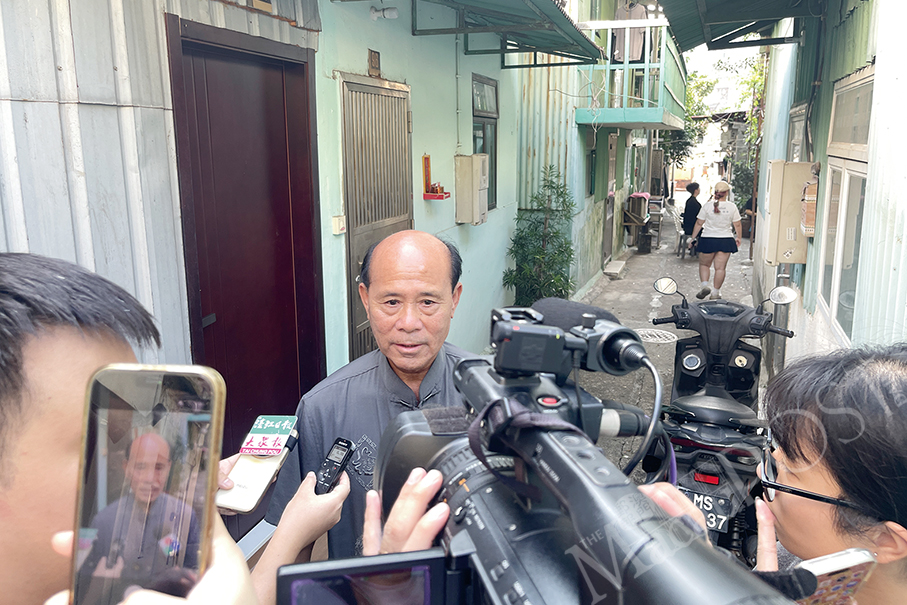
Chi Lam Vai Concern Group Convenor Ip Tat speaks to reporters on the sidelines of yesterday’s forum held at the heritage walled village’s activity area.
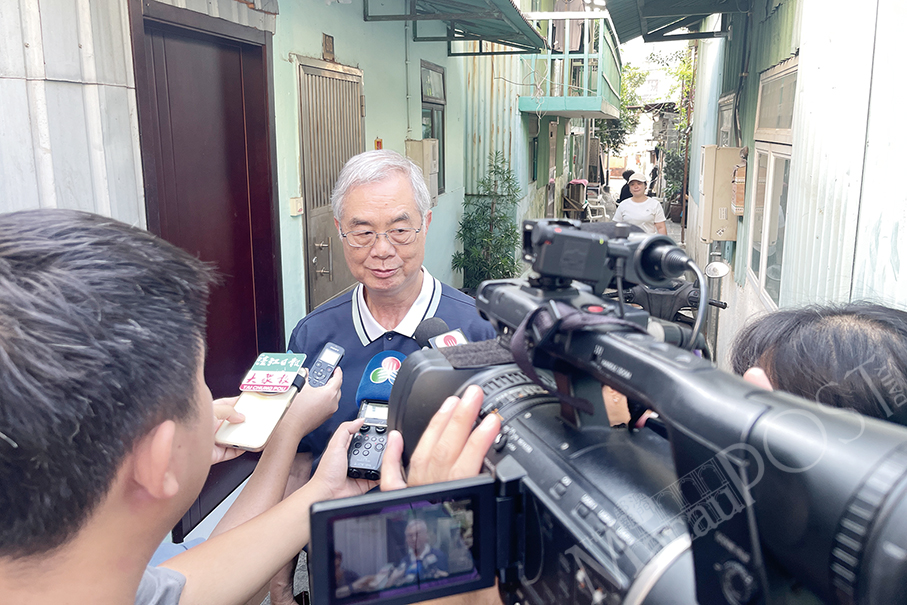
Macao Community Construction Promotion Association President Leong Keng Seng speaks to reporters on the sidelines of yesterday’s forum. – Photos: Armindo Neves