

Interview by Rui Pastorin
With its roots in Europe, homeopathy is included within the World Health Organisation’s framework of Traditional, Complementary and Integrative Medicine (TCIM). While critics question its effectiveness and attribute its reported benefits to the placebo effect, homeopathy remains part of the broader conversation about complementary approaches to health and wellbeing.
Yet alongside its critics are devoted advocates who believe homeopathy offers something other approaches to treatment have not provided for them.
But just what is homeopathy? And from the perspective of a practitioner, how does it work?
‘Like Cures Like’
Homeopathy has its roots in Germany, being founded by German physician Samuel Hahnemann (1755–1843) in 1796, who dedicated most of his life to its practice and development.
In a chapter of the “History, Present and Prospect of World Traditional Medicine” book, long-time homeopathy practitioner, academic and advocate Prof. Aaron To Ka Lun describes homeopathy as one of the most established systems within traditional and complementary* medicine. Coined by Hahnemann, the term combines the Greek words “homeo” (similar) and “pathos” (suffering), reflecting his Law of Similars, on which the practice is based.
Central to homeopathy is the principle of “like cures like” – the belief that a substance capable of producing certain symptoms in large doses can, in minute doses, treat similar symptoms. Homeopathic theory also distinguishes between a substance’s primary action and the body’s secondary response.
Breaking it down further, To, in a recent interview with the Post at the “Living Homeopathy” centre in Nam Van, which he established in Macau – as well as in Hong Kong – back in 1994, likened it to a simpler example: taking a cold shower during the winter.
“In winter, if you take a cold shower, you will feel very cold in the moment [the primary action],” To, who is from Hong Kong and has led the Hong Kong Association of Homeopathy (HKAH) and the Macau Association of Homeopathy (MAH) since 2005, said. “But afterwards, you will feel very warm [secondary response].”
Similarly, onions can trigger a runny nose and watery eyes when cut; according to homeopathic theory, a remedy prepared from onions may help relieve similar symptoms.
Homeopathy also differs from conventional Western medicine and Traditional Chinese Medicine (TCM) in its underlying principles, its views on symptom suppression, and its approach to individualising treatment.
Expanding on this individualised approach, To pointed out that consultations are lengthy and detailed. The practice draws on “provings,” which the New York School of Homeopathy defines as “the testing of a potentised substance to find out which symptoms that substance is capable of producing, and hence curing.”
Practitioners also consult the Materia Medica, a reference work that To described as presenting “very detailed symptoms of each remedy picture,” organised into different sections. “Then we have to find a remedy which is very similar to all of your symptoms,” he said.
To emphasised a guiding principle within the homeopathic community: “If you’re not willing to understand your patient thoroughly, you will be unable to treat the patient.”
Future Development
As more people explore alternative forms of treatment, To highlighted homeopathy’s potential and the role it could play in future healthcare. He acknowledged, however, that challenges remain, citing standardisation as a key hurdle.
He actively promotes homeopathy in both the Chinese mainland, where he has been invited to participate in national initiatives and conferences, and Macau, where the centre hosts public talks. Locally, he hopes the government will develop a greater understanding of homeopathy and remain open to its potential role in healthcare.
He concluded by advocating an integrated approach to care, bringing together homeopathy, TCM and conventional Western medicine to draw on their respective strengths and expertise. In his view, no single approach is inherently superior; what matters most is the patient’s wellbeing.
“Complementary medicine refers to additional healthcare practices that are not part of a country’s mainstream medicine. Evidence-based complementary medicine has the potential to support mainstream medicine and more comprehensively support people’s health and well-being needs.” – WHO
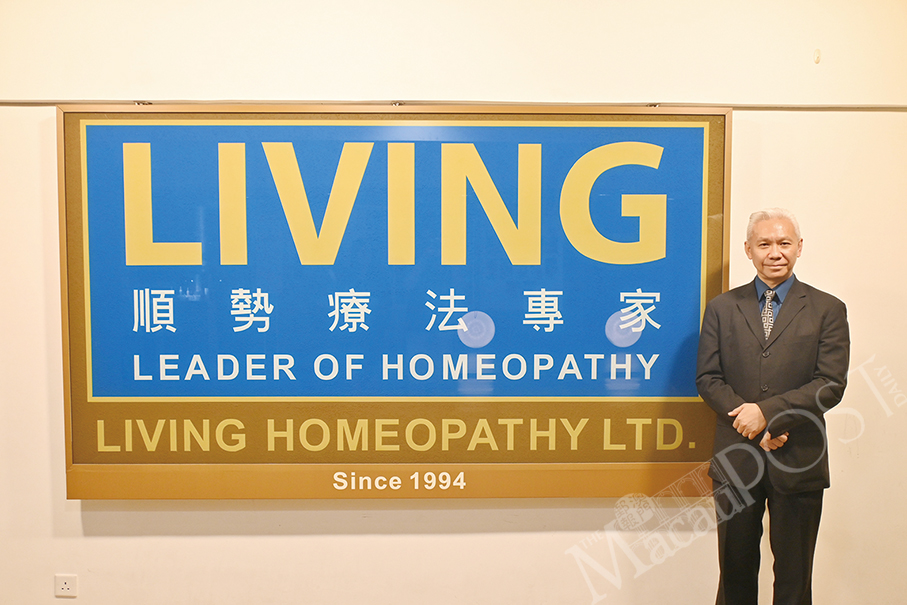
Long-time homeopathy practitioner, academic and advocate Prof. Aaron To Ka Lun poses during the recent Post interview at the “Living Homeopathy” centre in Nam Van. – Photo: Rui Pastorin