

The public Macao Union Hospital in Cotai began offering iodine-131* diagnostic and treatment services this month, allowing patients with thyroid** diseases to undergo assessment, examinations, treatment and follow-up in Macau, according to a statement by the hospital yesterday.
The large-scale healthcare complex in Cotai is officially known as Islands Healthcare Complex – Macao Medical Centre of Peking Union Medical College Hospital (CMM-PUMCH). It is jointly operated by the internationally renowned Peking Union Medical College Hospital (PUMCH) in Beijing and the Macau government thanks to the Central People’s Government’s support.
Colloquially, it is known as “Hip Woh” in Cantonese.
“Islands” is the official term referring to Taipa, Coloane, and Cotai.
The centre’s nuclear medicine department launched the services on Sunday, with an initial focus on thyroid iodine-131 uptake testing, radioactive iodine treatment for hyperthyroidism*** and post-operative whole-body SPECT-CT imaging**** for thyroid cancer patients.
The statement said that it has procured iodine-131 capsules and established the required supply and clinical application procedures, laying the groundwork for further services, adding that thyroid conditions such as hyperthyroidism, post-operative assessment of differentiated thyroid cancer and the functional evaluation of certain thyroid nodules may require iodine-131 for measurement, imaging or treatment.
The new services are intended to reduce the need for patients to travel outside Macau for care, as well as address lengthy appointment waits, difficulties with cross-border follow-up and discontinuity in post-treatment monitoring, the statement noted.
Drawing on the expertise and technical resources of Peking Union Medical College Hospital’s nuclear medicine department, the Macao Union Hospital has nuclear medicine imaging equipment, dedicated thyroid function testing devices and standardised procedures for radioactive medicines, the statement underlined.
Its one-stop service covers specialist assessment, iodine uptake measurement, imaging, dosage calculation, oral administration of iodine-131 capsules, radiation protection guidance and subsequent follow-up, the statement said, adding that iodine-131 uptake testing helps assess thyroid function and distinguish hyperthyroidism from conditions such as thyroiditis, while also informing treatment planning.
Radioactive iodine treatment works by being selectively absorbed by thyroid tissue and releasing beta radiation to destroy part of the tissue, the statement noted, pointing out that the non-invasive treatment allows individualised dosage adjustment and may be suitable for some patients whose hyperthyroidism responds poorly to medication, recurs or cannot be treated surgically.
Post-operative whole-body SPECT-CT imaging can assess residual thyroid tissue, local recurrence or metastatic lesions, and is an important tool in the management and long-term follow-up of differentiated thyroid cancer, the statement noted, adding that the launch would help strengthen Macau’s nuclear medicine services and improve the standardised diagnosis and treatment of thyroid diseases, enabling more patients to receive appropriate care locally and supporting the development of precision and specialist medicine.
*Iodine-131 (I-131) is a radioactive form of the element iodine that is widely used in medicine to diagnose and treat certain health conditions, particularly those involving the thyroid gland. – Gemini
**The thyroid is a small, butterfly-shaped gland located at the front of your lower neck, just below your voice box. – Gemini
***Hyperthyroidism (overactive thyroid) happens when your thyroid gland makes too much thyroid hormone. – Gemini
****A SPECT-CT imaging scan is a two-in-one medical test that combines a SPECT scan (which shows how your organs and tissues are working) with a CT scan (which shows what your organs and bones look like). – Gemini
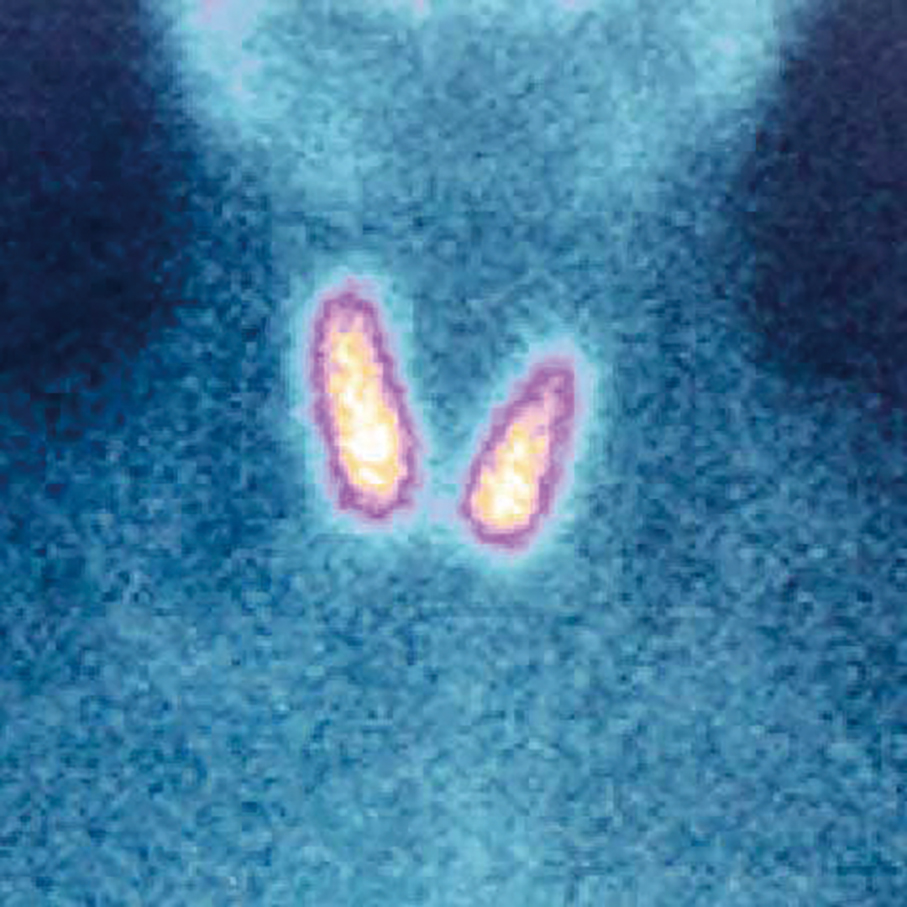
According to Gemini, this image shows an iodine-131 scan (or a thyroid scan using radioactive iodine-131). It depicts the uptake of the radioactive isotope in the thyroid gland. – Image courtesy of Singapore’s Farrer Park Hospital