


Vox Pop by Armindo Neves & Rui Pastorin
Super Typhoon “Ragasa” skirted Macau on Wednesday, bringing with it strong winds and heavy rain, which triggered severe floods.
Macau’s highest typhoon warning signal, No. 10 (T10), was hoisted that morning, with the city experiencing over 250 incidents like flooding and power cuts in low-lying areas.
Post reporters yesterday interviewed members of the public living along Rua Leste do Mercardo Almirante Lacerda (罅些喇提督市東街), Rua da Praia do Manduco (下環街) and Travessa de Cinco de Outubro(十月初五日巷) about their experiences during the typhoon, including their reactions to people who chose to venture out into the flooded streets when Signal No.10 was up.
Experiences near Red Market
The vicinity of the Red Market was particularly hard-hit during Typhoon Hato in 2017, with streets quickly inundated by floodwaters that reached depths of over two metres, submerging the market’s ground floor. What was their experience like this time?
The owner of a fish stall surnamed Leong said that although Ragasa was more powerful than previous typhoons like Hato and Mangkhut, which initially caused him great concern, his stall, fortunately, did not suffer any flooding.
As a resident of the Inner Harbour district, Leong said he witnessed severe flooding in Rua da Praia do Manduco area, where he lives, where the floods caused significant damage. He even observed people ignoring the hazardous water quality and venturing out to catch fish on the streets while Typhoon Signal No. 10 was still in effect.
Leong noted that rescue teams, including the customs and fire services, were actively assisting in the disaster zone and had handled over a hundred incidents during the typhoon, according to media reports he read. However, Leong said he believes that those who chose to venture outdoors while typhoon warning signals were in force were wasting public resources. Apparently, he was referring to the fact that, in the end, some of those people had to be rescued by civil protection officials.
A resident surnamed Kuang said that the Red Market area did not experience flooding this time. However, she saw severe disaster situations elsewhere in Macau by checking news reports on her phone. She recalled the devastating scene during Typhoon Hato when floodwaters inundated shops, and considered herself fortunate to have avoided a direct hit this time. In her view, the outcome was “much luckier” than during previous typhoons.
Moreover, the owner of a fruit stall surnamed Ng said that he had anticipated his shop’s location would not be flooded, as the newly built flood prevention facilities along the waterfront from Fai Chi Kei to Ilha Verde district had played a key role in keeping flooding away this time, and the water level remained safely below the warning line.
Ng said he saw on television that people were catching fish in the Rua da Praia do Manduco area and disapproved of the behaviour, as fishing in the streets is unhygienic. When asked about disaster preparedness, he admitted he himself had not taken any measures.
Compared to the severe damage caused by past monster typhoons like Hato, he expressed no fear this time, citing the protection from the newly installed flood prevention infrastructure and the fact that the winds’ ferocity was less severe than forecast. His tone conveyed confidence and calmness about what he witnessed during Ragasa’s onslaught.
Amateur ‘fish-catchers’ during T10
As Ragasa impacted Macau, Jonas still found some enjoyment during the typhoon – catching fish.
Initially, Jonas had stayed home, but in the afternoon, he was among others on the flooded streets, catching fish with their bare hands or even makeshift fishing nets. Asked if he was afraid of any possible hazards at the time, he said: “Of course, the fear was still there”. However, the local Filipino said that he felt that finding a silver lining in difficult situations such as these was something he and many others were used to. He went on to praise the government’s swift preparations for and response to Ragasa, and the fact that flood waters quickly subsided due to the government’s efforts.
A 31-year-old F&B worker said that she had stayed indoors during the typhoon and was prepared for the situation, echoing the preparedness and swift action by the government. However, she condemned those who chose to disobey warnings as the storm raged on, pointing out that the government had actively prepared people for the typhoon and warned them of the dangers it posed, as well as constantly urging the public to stay indoors. She highlighted hazards they could have encountered outdoors ranging from falling objects to dangerous gusts, the reasons why these rules were imposed in the first place.
Jethro shared the same opinion, saying: “That’s dangerous. At the height of the storm, people shouldn’t even be going out” given potential hazards like electrocution from an exposed live wire and the importance of self-preservation. He also compared Macau’s reactions to Ragasa to those that ravaged the city in the past, noting: “The government was much more prepared than they were before”, with even post-typhoon cleanups proceeding much faster.
The government’s swift preparations and response, and its active support for members of the public throughout the typhoon was also highlighted by a 38-year-old woman working in security, citing that this was the reason people knew what to do. She highlighted, however, that she also saw videos circulating on social media of people going out and catching fish during the super typhoon, which left her disappointed. “That was not at all safe”, especially considering the depth some of the waters reached in some areas, she said, adding that some people were just simply “hard-headed”.

Staff members of a shop in the inner harbour clean up after Super Typhoon “Ragasa”.
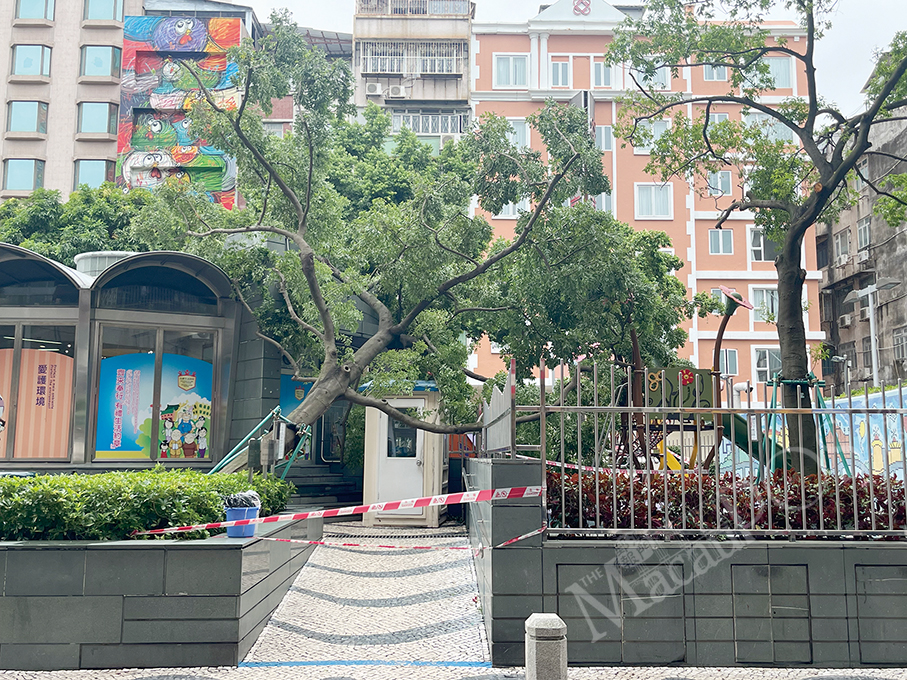
Strong winds from the super typhoon caused a tree to fall. – Photos: Rui Pastorin