

The Legislative Assembly (AL) yesterday passed a government-initiated bill that will establish a new public procurement system aiming to ensure the transparency, openness, fairness, and impartiality of the government’s acquisition of goods and services.
The bill’s outline was passed during a plenary session of the legislature in January last year, after which the bill was reviewed by its 1st Standing Committee, before it was resubmitted to yesterday’s plenary session, which Secretary for Economy and Finance Anton Tai Kin Ip attended, when it was voted on article-by-article in its second and final reading.
The bill will take effect on September 1 next year, when the new public procurement law will replace the current public procurement legislation, Decree Law 122/84/M, which came into force in 1985 when Macau was still under temporary Portuguese administration.
Currently, the general practices of the government’s acquisition of goods and services are regulated by Decree Law 122/84/M, a piece of legislation with only 20 articles. The administrative procedures in detail for the acquisition are regulated by another piece of legislation, Decree Law 63/85/M, which also came into force in 1985.
The general practices of the government’s launch of different kinds of tenders for public construction projects are currently also regulated by Decree Law 122/84/M, while the administrative procedures in detail for the launch of tenders and the granting of public project agreements are regulated by another piece of legislation, Decree Law 74/99/M, a piece of legislation with over 200 articles, which came into force in late 1999, shortly before the establishment of the Macau Special Administrative Region (MSAR) on December 20, 1999.
The bill passed yesterday will establish a new and comprehensive system for the government’s acquisition of goods and services, a new public procurement law with 152 articles, which will abolish both Decree Law 122/84/M and Decree Law 63/85/M in September next year when it takes effect.
Concerning public project tenders, as the new public procurement law will only regulate the general principles for the matter, the current Decree Law 74/99/M will remain in force.
As Decree Law 122/84/M will be replaced by the new public procurement law in September next year, the bill passed yesterday will also amend certain provisions listed in the current Decree Law 74/99/M, including listing some of the existing rules concerning public project tenders listed in Decree Law 122/84/M in the amended version of Decree Law 74/99/M.
Consequently, from September next year, the government’s acquisition of goods and services will be regulated by a single and comprehensive public procurement law, which will also cover the basic principles with which the government’s launch of tenders for public construction projects must comply, while the administrative procedures in detail for public project tenders will continue to be regulated by Decree Law 74/99/M.
During yesterday’s plenary session, Tai noted that the legislation of the new public procurement law is the government’s first step aiming to improve its public procurement system in general, while for the second step, the government will review the ongoing implementation of the current Decree Law 74/99/M for possible amendments.
Tai quoted the Public Works Bureau (DSOP) as pointing out that the current Decree Law 74/99/M is a large and very technical piece of legislation regulating the administrative procedures for public project tenders, because of which, he said, the government will first review the effectiveness of the future implementation of the new public procurement law before studying the feasibility of proposing a new and comprehensive piece of legislation to replace Decree Law 74/99/M.
According to the new public procurement law, the government’s acquisition of goods and services and its launch of tenders for public construction projects must be carried out in compliance with various principles such as transparency, openness, fairness, and impartiality.
The new law will also establish a centralised procurement system run by the Financial Services Bureau (DSF) tasked with the acquisition of consumables, such as stationery and potable water, for all public entities, with the aim of improving the government’s efficiency in purchasing goods for public entities and reducing its procurement costs. The Financial Services Bureau will be tasked with drawing up a list of items to be covered by the centralised procurement system after considering suggestions from various public entities.
According to the new law, the Financial Services Bureau will set up a dedicated website providing members of the general public with important information and details about the government’s public procurement activities carried out by its different public entities.
From September next year, the current official minimum threshold amounts requiring the government to launch a public tender for the acquisition of goods and services and for public construction projects will remain unchanged at 4.5 million patacas and 15 million patacas. The current amounts have been in force since 2021.
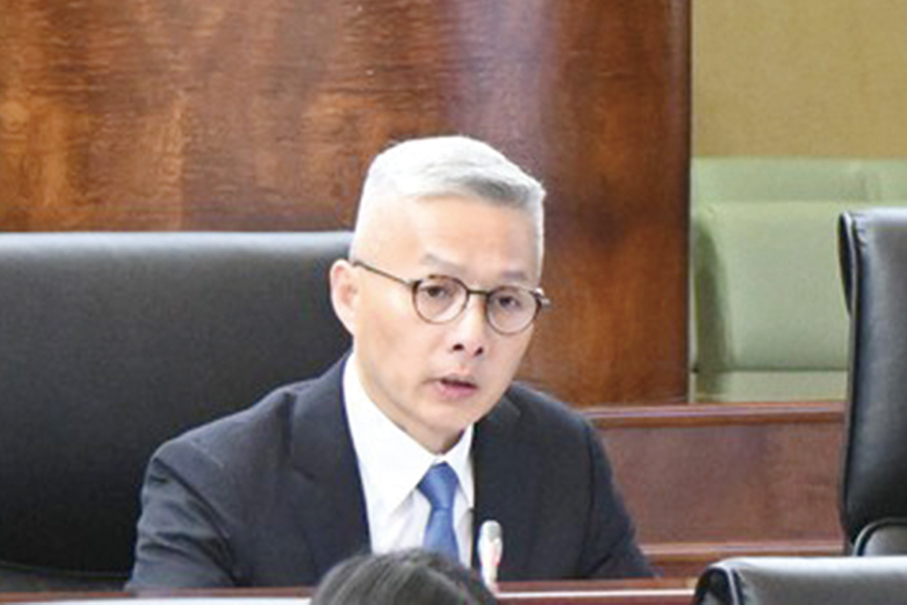
Secretary for Economy and Finance Anton Tai Kin Ip speaks during yesterday’s plenary session in the Legislative Assembly’s (AL) hemicycle. – Photo: GCS