

The first Patriotic Education Base for young Hong Kong and Macao people was inaugurated in Beijing yesterday, marking a milestone in fostering patriotism in the regions and answering the call for more nationwide efforts to deepen a sense of national identity among youngsters from the two cities.
On the 80th anniversary of Victory over Japan Day and the end of World War II, the base has been set up at the Museum of the War of Chinese People’s Resistance Against Japanese Aggression near Lugou Bridge*. Located near Beijing, the bridge was the site of a battle on July 7, 1937 that marked the beginning of the nationwide resistance against Japanese aggression.
During the unveiling ceremony, Xu Qifang, executive deputy director of the Hong Kong and Macao Affairs Office of the State Council, said that establishing the base will help deepen patriotic education among young people in Hong Kong and Macao.
Xu said he hopes that the base can pioneer innovative approaches to patriotic education for the regions’ youth, and provide valuable insights into how such bases can best be constructed in future. He also highlighted the enduring tradition of patriotism among the people of Hong Kong and Macao, adding that patriotism is a cornerstone for the sustained success of the “One Country, Two Systems” principle.
Chief Secretary for Administration of the Hong Kong Special Administrative Region government Eric Chan Kwok-ki, who also delivered a speech at the ceremony, said the establishment of the educational base marks a significant step forward in patriotic education in Hong Kong. This platform will allow young people from Hong Kong and Macao to deepen their understanding of the nation’s history and to have a clearer sense of the mission they must carry forward in developing the motherland.
Chan said he supports the selection of the location for the education base and views the history of the War of Resistance Against Japanese Aggression as the most compelling material for patriotic education.
Chan said that during the war, all Chinese people, including those from Hong Kong, fought for their homeland and justice, collectively defending the country’s territories and national honor with their lives. Chan said he believes that revisiting this piece of history near Lugou Bridge will undoubtedly strengthen the determination of young people to play their part in the rejuvenation of the Chinese nation.
Citing the establishment of the base as an example, Chan expressed his gratitude for the longstanding and robust support from the central government in promoting Hong Kong’s patriotic education. He also expressed his hope for the future development of more patriotic educational resources nationwide, allowing Hong Kong and Macao youth to gain a more comprehensive understanding of the country’s history and achievements through on-site research and exchanges.
Macao’s Secretary for Social Affairs and Culture Wallis O Lam said that the museum, with its wealth of historical artifacts and detailed archival records, vividly brings history to life, serving as a dynamic classroom for patriotic education. O Lam pledged she would maximize the base’s potential as a platform to engage more Macao residents, particularly the youth, and encouraged residents to visit the base and experience the spirit of resistance against aggression firsthand. By doing this, O Lam said, she hopes the tradition of loving the country and Macao can be passed down from generation to generation.
Numerous officials from the central authorities and the two special administrative regions were present at the ceremony, including Executive Vice-Mayor of Beijing Xia Linmao.
The Macao Government Information Bureau (GCS) said in a statement late last night that “the memorial hall is the only comprehensive museum in the country that fully reflects the history of the Chinese People’s War of Resistance Against Japanese Aggression, and it is also a national first-class museum and an outstanding demonstration base for patriotic education in the country,” adding that the establishment of the first Patriotic Education Base for Youth from Hong Kong and Macao by the governments of Hong Kong and Macao “carries significant meaning”.
According to the GCS statement, O Lam pointed out in her speech that, 80 years ago, despite being in a special environment, Macao contributed to the national war effort in various ways, always sharing the same breath and destiny with the motherland.
O Lam noted that in order to commemorate the 80th anniversary of the Victory in the War of Resistance, the Macao Special Administrative Region government has set up a cross-departmental working group to coordinate a series of commemorative activities, delve into local war history materials, strengthen exchanges and cooperation with the mainland and Hong Kong, and guide Macao residents, especially young people, to gain a comprehensive and accurate understanding of the war history through large-scale exhibitions, academic seminars, special education, and retracing the routes of the war, thereby further stimulating the patriotic enthusiasm of young people.
– Courtesy of China Daily (additional reporting based on GCS statement)
*The term “Lugou Bridge” (盧溝橋 – “Reed Ditch Bridge”) refers to a historically significant bridge located near Beijing. Its importance stems from two major aspects: its ancient architectural heritage and its role as the catalyst for the Second Sino-Japanese War. In the West it is also known as Marco Polo Bridge. – DeepSeek
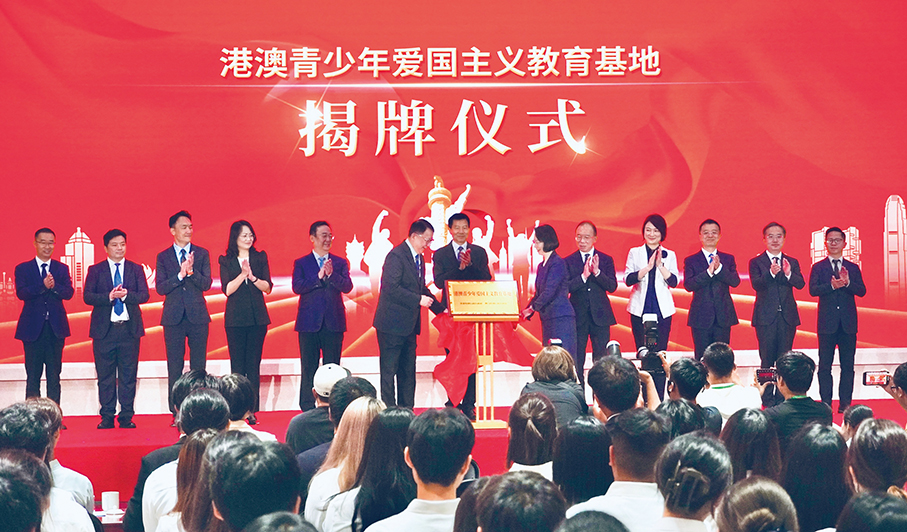
Witnessed by Executive Deputy Director of the Hong Kong and Macao Affairs Office of the State Council Xu Qifang (centre), Hong Kong Chief Secretary for Administration Eric Chan Kwok-ki (front, centre left) and Macao Secretary for Social Affairs and Culture Wallis O Lam (front, centre right) unveil the inaugural plaque of the Patriotic Education Base for young Hong Kong and Macao people in Beijing yesterday. – Photo: GCS