

Analysis Armindo Neves and Ida Cheong
Nineteen days have passed since the deadly inferno in Hong Kong’s Tai Po District’s Wang Fuk Court estate on November 26.
According to the latest updated data released by the Hong Kong police last Tuesday, the fire resulted in 160 fatalities, 79 injuries and six individuals reported missing. Among the injured was a one-year-old child.
Speculation about the possible causes of the blaze have ignited a public debate over construction site safety, centring on the use of potentially flammable bamboo scaffolding*, the quality of the supposedly fire-retardant scaffolding nets, and the enforcement of no-smoking rules at construction sites.
Following the fire, a range of speculative theories began circulating among the public. For instance, many believe that the vertical bamboo scaffolding structure acted like a chimney, allowing flames to rapidly ascend along the bamboo poles from lower to higher levels within a short period of time. The intense heat caused sections of the scaffolding to collapse, and burning bamboo fragments were carried by strong winds to nearby buildings, accelerating the fire’s spread from Block One of Wang Fuk Court to six other blocks. The eighth block was spared from the inferno. The scaffolding’s large volume and potentially combustible material, coupled with dry weather conditions, reportedly turned it into a “fuel reservoir,” making the fire extremely difficult to extinguish. Furthermore, there is public speculation that the fire may have been started by workers smoking on the scaffolding, by sparks from welding, or by flammable materials on the scaffolding mesh catching fire.
However, as of yesterday, the exact cause of the fire remained unknown.
Various possible causes of the fire have been put forward by senior officials in Hong Kong. For instance, Chief Secretary for Administration Eric Chan Kwok-ki and Secretary for Development Bernadette Linn Hon-ho said separately on November 27 that while bamboo scaffolding is flexible, its fire resistance is significantly inferior to that of metal scaffolding. For safety reasons, both advocated for a full transition to metal scaffolding in suitable environments as soon as possible. Secretary for Security Chris Tang Ping-keung also noted on November 28 that bamboo scaffolding can fracture under high temperatures and that flying embers can contribute to the spread of fire.
The Post has interviewed several people from different sectors by asking them about their views on the matter.
Regarding the proposal to replace bamboo scaffolding with metal scaffolding, a local civil servant surnamed Ieong told the Post that she was against the change as she believes that the core issue lies with flammable materials like foam panels, not the bamboo scaffolding itself. She pointed out that bamboo scaffolding has advantages such as being insulating and quite fire-resistant (not catching fire in a blaze). In contrast, she argues that metal scaffolding could not only lead to job losses for scaffolders but also poses risks such as electrical conductivity and melting under high temperatures, potentially creating new safety hazards.
Regarding speculation that workers smoking on-site caused the fire, a citizen surnamed Lou, who studied civil engineering in Taiwan and has worked on local construction sites, told the Post that it was extremely difficult to control workers from smoking, as due to their high-intensity physical labour, smoking was their only way to relieve stress. As for replacing bamboo scaffolding with metal scaffolding, he said that bamboo was actually very difficult to ignite. Conversely, metal scaffolding, due to its high thermal conductivity, would transfer heat rapidly in a high-temperature fire, potentially hindering escape efforts.
Regarding the causes of the blaze, Macau Scaffolders Union President Chio Tak Sio told the Post that the Tai Po inferno’s possible causes should not be oversimplified. He underscored that a confluence of risk factors including weather conditions, material quality, on-site waste, the possibility that the disaster was caused by a discarded cigarette end, and lapses in management, rather than the bamboo scaffolding, ultimately may have caused the fire, adding that the incident has revealed a public perception gap, where such fire catastrophes are mistakenly attributed solely to bamboo scaffolding while underlying issues such as poor on-sight management and low material standards are easily overlooked.
Chio pointed out that bamboo scaffolding, the craft of which enjoys intangible cultural heritage status in Macau, remains the backbone of building construction in Macau, considering that about 90 percent of local construction projects use bamboo scaffolding, adding that there are 26 bamboo scaffolding companies in Macau, 24 of which exclusively work with bamboo, while only two handle both bamboo and steel.
Meanwhile, bamboo costs roughly just one-third of the price of steel scaffolding, and bamboo poles can be easily cut and adjusted on-site, unlike fixed-size steel tubes, making them ideal for Macau’s narrow alleyways and irregular building façades, Chio said, who also pointed out that storing bamboo poles requires less space than metal poles, and old bamboo can be disposed of more easily.
Chio noted that steel scaffolding, primarily used by major casinos for aesthetic and perceived safety reasons, as they are generally deemed to be non-flammable, faces significant barriers to wider adoption, such as high cost, lack of flexibility, and higher requirement for storage space.
With only two local firms capable of handling steel scaffolding, industry-wide transition from bamboo to metal was, at least currently, impractical due to a lack of technical support and skilled personnel, Chio said.
Construction scaffolding net standards in Hong Kong and Macau
In Macau, the industry predominantly uses scaffolding mesh with fire-resistant properties which typically melt rather than ignite when exposed to fire and can be reused 10 to 20 times, Chio said.
Chio noted that he has visited Hong Kong construction sites several times for exchanging information, noticing that Hong Kong’s scaffolding mesh market comprises a mix of rather different qualities, with some contractors using inferior, non-fire-resistant nets, which he described as flimsy, mosquito-net-like material, compromising overall safety.
Smoking illegal on construction sites
According to Macau’s tobacco control law, which took effect on January 2012, smoking at the workplace is prohibited. Violators face a fine of 1,500 patacas.
Chio underlined that construction workers are allowed to smoke during designated break times and that construction sites employ their own safety staff. However, he acknowledged, government inspectors monitoring construction sites are unable to achieve full coverage, leading to some workers smoking in hidden areas. Chio also said a key issue was the inconsistency between government regulations and individual site rules, creating confusion and compliance difficulties for workers, such as concerning safety harnesses.
Local bamboo scaffolding’s workforce situation
Chio noted that the local scaffolding sector’s workforce comprises about 200 non-resident workers (NWRs) with only around 10 local workers physically able to set up scaffolding, most of whom are over 60 years old, including the most experienced practitioner one who has worked 63 years in the trade.
The NRWs in the scaffolding industry earn a daily wage of around 800 patacas, while local workers’ daily salary amounts to 1,300-1,400 patacas, with foremen earning up to 1,500 patacas, said Chio, who admitted that the scaffolding industry is unable to attract local recruits. He added that the sector’s core challenges are a critical talent shortage, lack of flexible labour allocation, and insufficient government support in areas like dedicated storage areas, subsidised training programmes, and sector-specific labour policies, all of which was driving up operational costs for the companies.
Chio suggested that labour recruitment, site-specific safety rules and harmonisation of trade rules and government regulations should be optimised, including the simplification of “impractical” safety requirements, aiming to better reflect the realities of bamboo scaffolding work.
*Bamboo scaffolding is a type of temporary structure used in construction, maintenance, and access work. Its primary components are poles made of bamboo (typically the species Bambusa pervariabilis or Phyllostachys), which are securely tied together using plastic or nylon strips (having largely replaced traditional bamboo strips) to form a sturdy, flexible framework. – DeepSeek
**According to UNESCO, Intangible Cultural Heritage (ICH) refers the practices, representations, expressions, knowledge, skills – as well as the instruments, objects, artefacts and cultural spaces associated therewith – that communities, groups and, in some cases, individuals recognise as part of their cultural heritage. - DeepSeek

This photo taken yesterday shows a construction site on Rua Cidade do Porto (波爾圖街) covered by bamboo scaffolding and mesh. – Photo: Armindo Neves
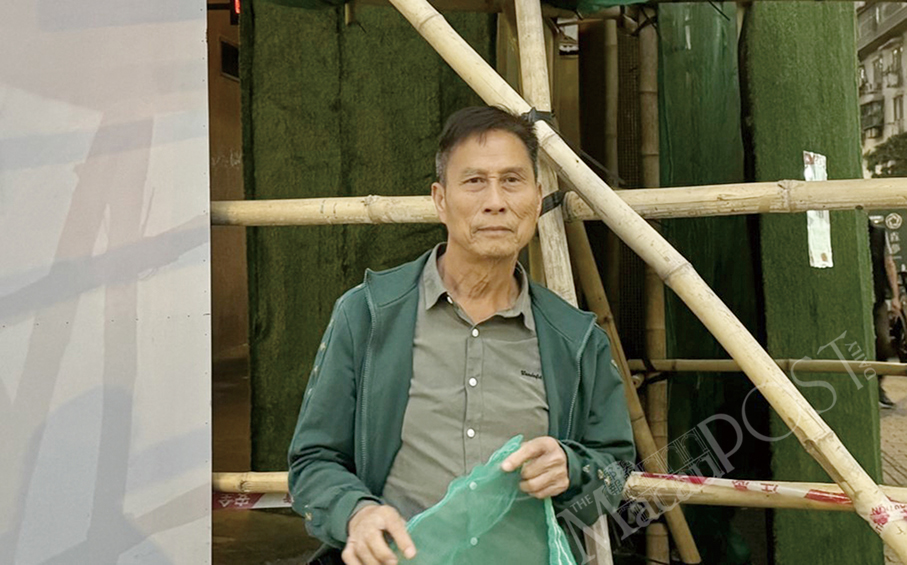
Macau Scaffolders Union President Chio Tak Sio poses in front of a scaffolding net at Kiu Kwong Building, which is undergoing renovation, on Rua Graciosa in Areia Preta district on Friday. – Photo: Ida Cheong