

The Macao New Chinese Youth Association (MNCYA) hosted a press conference yesterday about the findings of its survey about Macau’s wet markets which showed, among other things, that around 56.1 percent of local youth are still “satisfied” with them.
The study was conducted in October, surveying 644 local residents aged 18 to 44. The press conference was held at the Macao Daily News Building.
According to the findings, the primary motivation for visiting traditional wet markets is “sampling food at the cooked food centres” (38.4 percent), followed by “purchasing fresh produce” (37.0 percent). The findings also show that 67.2 percent of the respondents support the idea of allocating more resources to revitalise traditional wet markets, while 41.9 percent believe that the foremost improvement needed is the “level of environmental hygiene.”
Regarding open-air markets, the findings show that 58.5 percent of the respondents primarily obtain information about them through social media. Spending at open-air markets is generally modest, with 39.4 percent of the respondents having spent between 51 and 200 patacas there in the past year. The main attractions are “enjoying the relaxed and unique on-site atmosphere” (32.4 percent) and “sampling specialty street food” (31.5 percent).
Based on the findings, the association representatives presented during the press conference four policy recommendations: promoting the functional upgrade and spatial revitalisation of traditional wet markets; utilising idle land to create holiday-themed markets; establishing “youth-led” branded markets; and fostering the integration of the “pet economy” with market economies to align with youth consumption trends.
Wet markets’ stall vacancy rate around 30 pct only
Meanwhile, the Collective Wisdom Policy Centre also hosted a press conference yesterday about the findings of its survey, showing that the booth vacancy rate of traditional wet markets stands around 30 percent.
The centre belongs to the Macau General Union of Neighbourhood Associations (UGAMM; colloquially known as Kai Fong). The press conference was held at the UGAMM headquarters in Toi San district.
The findings point out that the current state of Macau’s wet markets is characterised by “improved hardware but operational pressure”. Internal challenges include a singular business format, rigid regulations, low levels of digitalisation, and an ageing workforce. Externally, wet markets face intense competition from supermarkets, community stores, and cross-border consumption, according to the findings.
Based on the findings, the centre recommended the systematic transformation of traditional wet markets, aiming to reshape them into integrated community hubs that combine “essential services, cultural experiences, community interaction, and tourism exploration.”
The findings show some specific strategies, including establishing a cross-departmental task force to classify and position wet markets following “one market, one policy” approaches, such as markets like Taipa Market, aiming to position them as “culture-tourism integrated” hubs, while others like Toi San Market should be developed as “comprehensive community centres”.
Representatives of the centre also suggested promoting a “vertical layering” model for wet market spaces to create diversified complexes, introducing new business formats and recreational public areas. They also recommended speeding up digital transformation by establishing a unified online platform and revising management regulations to relax operational restrictions while improving the licensing mechanisms for wet market stalls.
The representatives also said they believe that the transformation of traditional wet markets must start with high-level design. Through differentiated positioning and systematic renovation, their community and economic vitality could be revitalised, they said.
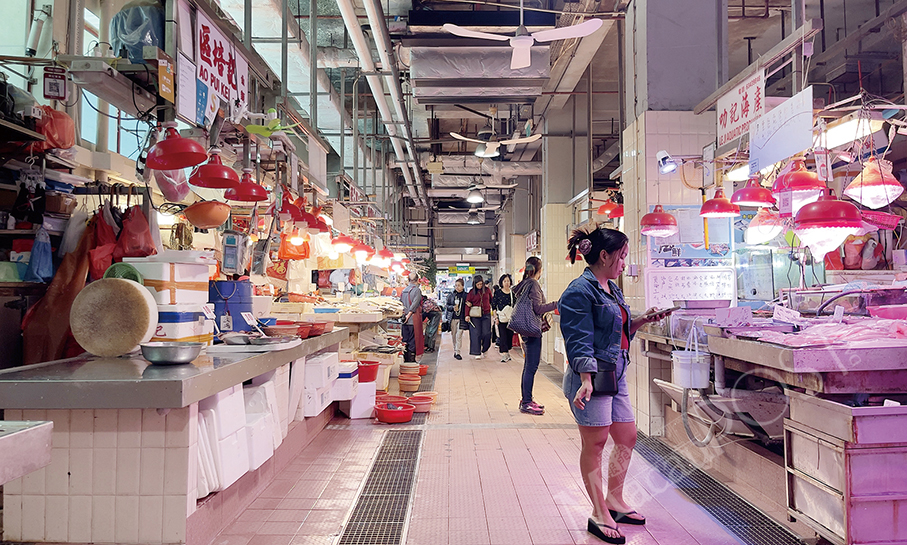
Shoppers visit the central S. Domingos wet market yesterday. – Photo: Armindo Neves