


The Alliance for a Happy Home thinktank hosted a press conference yesterday about the findings of its “Macau Youth Career Development Survey”, which indicate that young employees’ priorities are their “salary and benefits”, “work-life balance” and “job stability” when choosing a career.
The survey targeting local youths aged 18 to 45 collected 703 questionnaires online, of which 568 were valid. All the respondents were employed when they returned the questionnaires. The press conference was held at the Women’s Association Building (commonly known as Fu Luen Building in Cantonese) on Rua do Campo.
Youths willing to join on-the-job training
The findings also pointed out that up to 74.6 percent of the respondents said they were willing to participate in on-the-job training, primarily motivated by “meeting job requirements and maintaining competitiveness”, “achieving promotions and salary increases”, and “obtaining academic qualifications or professional credentials”, reflecting the proactive attitude of local youths towards career development, according to the findings.
Regarding skill enhancement directions, the findings also show that nearly half of the youths listed “language ability” as their top priority, followed by “soft skills (such as complex problem-solving, negotiation skills)”, “leadership and management skills”, and “digital application capabilities”.
In terms of training resources, nearly 50 percent of the respondents said they hope to access “practical courses on cutting-edge digital skills (e.g., AI, big data),” while 46 percent said they desire to participate in internationally recognised professional technical certification courses. Around 50 percent of the respondents noted that their companies support employees’ participation in training.
Moreover, 37.1 percent said that “the amount of time and financial cost of obtaining professional certifications” were significant obstacles to professional development, according to the findings.
Meanwhile, the findings also show that 50.2 percent of the respondents said that they face main challenges in career development such as “remuneration not meeting expectations”, followed by “fierce competition for positions” (42.4 percent), “lack of relevant experience” (33.3 percent), and “skills not matching market demands,” among other challenges.
Additionally, over half (52.8 percent) of the respondents pointed out that “Macau’s market scale is small, lacking large and complex projects to develop advanced skills”, and 40 percent said they believe “Macau lacks high-level, internationally certified professional training courses”.
Regarding policy support, the respondents said they hope the most that the government will prioritise providing “high-level on-the-job training courses” (based on a demand rating of 4.18 points out of 5) and “funding for international professional certifications” (4.15 points out of 5).
Notably, the respondents said they prefer the government to directly provide high-quality course resources (37.1 percent) over “direct cash subsidies” (31.5 percent), indicating that young employees place greater emphasis on substantive capacity-building support than cash.
4 policy recommendations
Alliance for a Happy Home Deputy Director Loi I Weng told reporters after yesterday’s press conference that her association proposes four policy recommendations: 1) Formulating medium- to long-term talent demand lists and skill-standard-aligned talent pools in line with the government’s “1+4” key industries; 2) Enhancing talent cultivation plans, such as supplementing existing advanced study courses with international certification courses including finance and healthcare; 3) Increasing incentives for talent cultivation and certification to at least 10,000 patacas to alleviate financial pressure on the young employees; and 4) Implementing modular, micro-credential courses, combining online and offline models, and encouraging enterprises to provide flexible training leave.

Alliance for a Happy Home President Wong Kit Cheng (centre), Vice President Loi I Weng (left), and the survey’s researcher Lei Ka Chon pose during yesterday’s press conference. Wong and Loi are lawmakers. – Photo: Ida Cheong
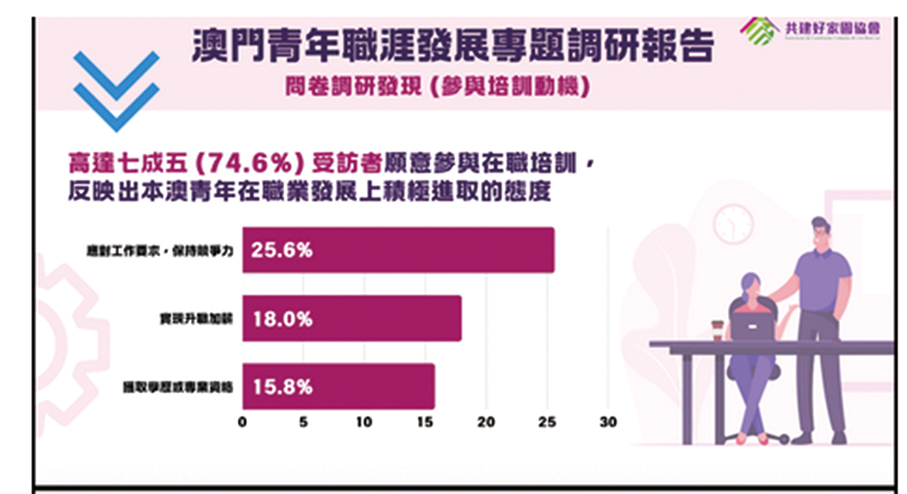
This handout slide provided by the Alliance for a Happy Home group yesterday shows up to 74.6 percent of youths are willing to participate in on-the-job training,