

The Macau government is gathering public opinion on its plan to expand the city’s Light Rapid Transit (LRT) network in the short, medium, and long terms, comprising six new lines that, together with the existing lines, will form a circular LRT network.
The plan’s full version was released on Friday.
Construction of two of the six proposed lines is earmarked for the near future, namely the current Seac Pai Van Line’s extension to Coloane Village, and the under-construction East Line’s extension to the Qingmao pedestrian border checkpoint in Ilha Verde and the future sports park in Fai Chi Kei.
Construction of the proposed South Line connecting Barra and the Hong Kong-Zhuhai-Macao Bridge’s (HZMB) Macau checkpoint is earmarked for the medium term.
Concerning the proposed West Line running between the Qingmao checkpoint and Barra, the government is proposing to schedule construction of the section between Qingmao and the Fai Chi Kei waterfront in the medium term, while the section between the Fai Chi Kei waterfront and Barra will be designated as a construction project to be launched in the long term.
The proposed Taipa Central Line serving central Taipa and the proposed Taipa North Line running between the Zone E1 land reclamation area and the current LRT Ocean Station will also be earmarked as LRT projects to be launched in the long term.
While the proposed Seac Pai Van Extension Line will be an elevated line, all other proposed LRT lines will be built underground and/or underwater.
The government’s LRT expansion plan, officially known as Strategic Study for the Development of the Macau Light Rapid Transit, does not propose exact schedules as to when construction of the six lines could get off the ground, merely classifying them as projects to be launched in the short, medium, and long terms.
The government started its process on Friday to gather opinions from members of the public until February 28 about its LRT expansion plan. The plan’s ongoing public opinion collection process are coordinated by the Public Works Bureau (DSOP), the public entity tasked with organising and overseeing public construction projects. The plan’s full version, available in Chinese and Portuguese, was uploaded onto a dedicated website (https://www.dsop.gov.mo/public/event/lrt2026/) on Friday.
The government has scheduled six sessions to gather opinions from attendees about its LRT expansion plan and answer their questions, comprising two sessions for members of the general public and four sessions for representatives from different segments and sectors of civil society.
The two sessions for the general public will be held on February 1 and 8 at the auditorium on the ground floor of the headquarters of local power utility CEM.
The government held the first session on Friday, attended by legislators, members of the government-appointed Urban Renewal Council, and officials from various public entities. Friday’s session was chaired by Secretary for Transport and Public Works Raymond Tam Vai Man, flanked by several officials under his portfolio.
Macau’s LRT system currently comprises Taipa Line, Seac Pai Van Line, and Hengqin Line in operation. The Taipa Line serves Taipa and Cotai with its extended section connecting to the peninsula’s Barra through the lower enclosed deck of the Macau-Taipa Sai Van Bridge.
The Seac Pai Van Line connects the Taipa Line’s Cotai section with Coloane’s sprawling Seac Pai Van public housing estate, while the Hengqin Line connects the Taipa Line’s Cotai section with the Macau-side zone of the Hengqin joint checkpoint.
Currently, the only ongoing LRT project is the East Line project connecting the Barrier Gate checkpoint at the peninsula’s northern tip and the Taipa Ferry Terminal via the Zone A and Zone E1 land reclamation areas. The East Line will cross the sea between Zone A and Zone E1 through an undersea tunnel.
The LRT East Line is scheduled to come into service in 2029.
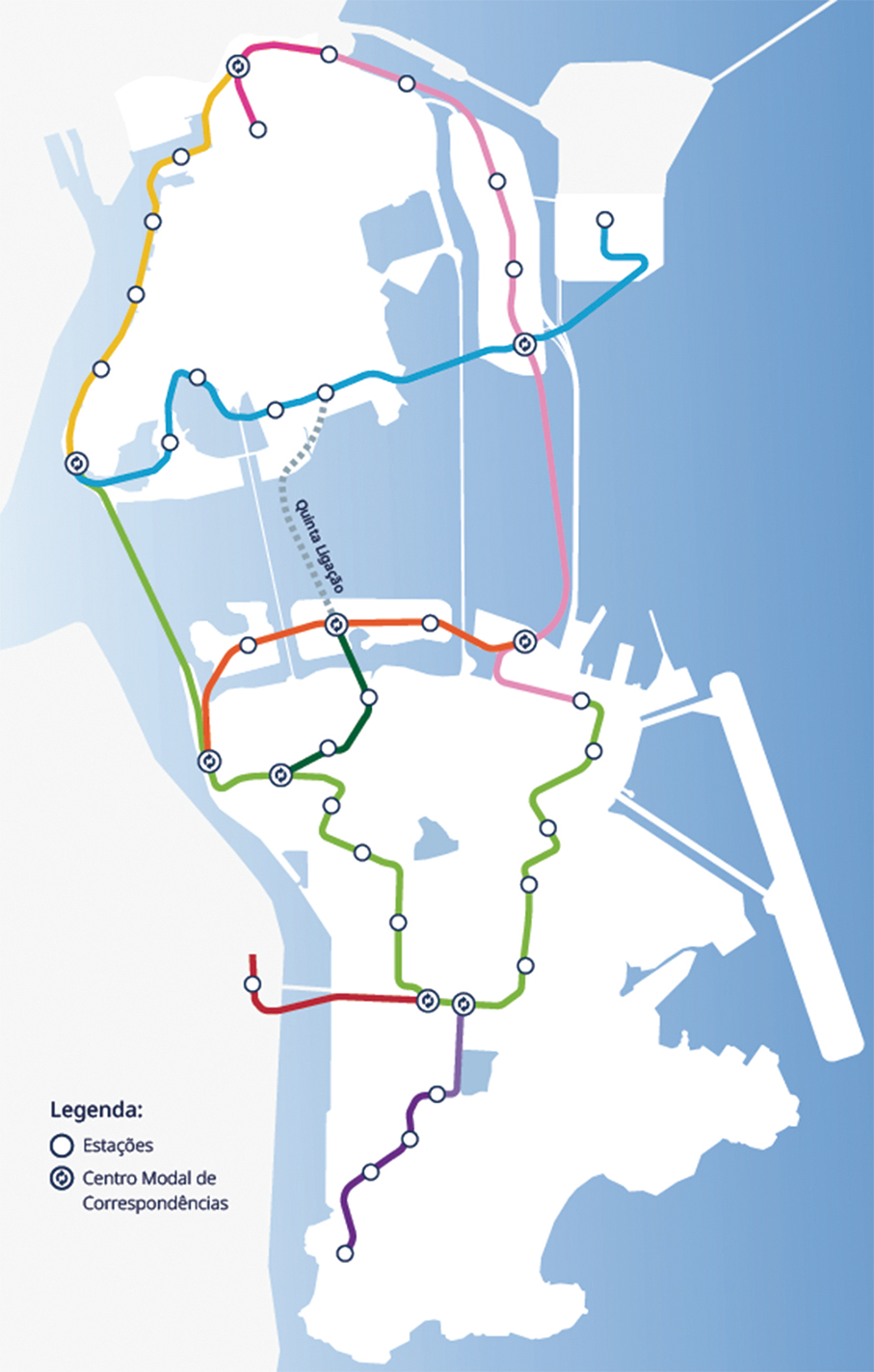
This map released on Friday shows the LRT’s existing lines together with future lines proposed by the government’s LRT expansion plan.
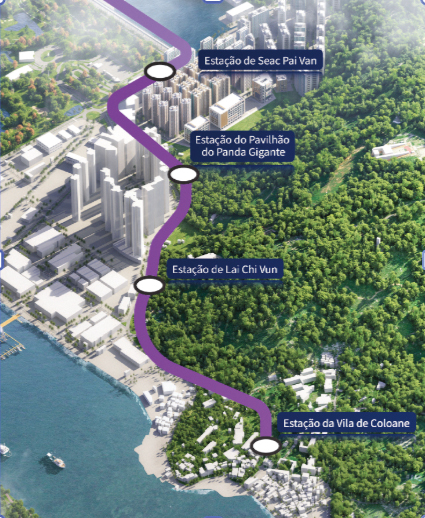
This diagram shows the proposed Seac Pai Van Extension Line’s stations.
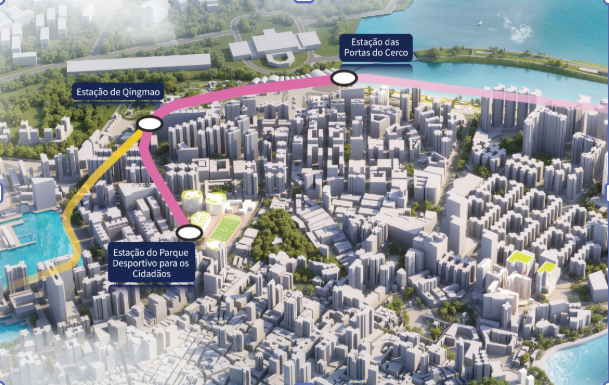
This diagram shows the proposed East Line Extension Line (dark pink) and part of the proposed West Line (yellow).
East Line Extension Line
According to the LRT expansion plan released on Friday, the government is proposing to prioritise the construction of the East Line Extension Line.
The proposed East Line Extension Line, classified by the plan as a project that could get off the ground in the near future, would run from the Barrier Gate checkpoint to the Qingmao checkpoint, from where the proposed West Line would start, meaning that the East Line Extension Line and the West Line would be connected to each other at Qingmao Station.
According to the plan, the proposed East Line Extension Line would have a spur line running to the future sports park, located on the plot of land where the now-defunct greyhound racetrack (Yat Yuen Canidrome) is located. Construction of the sports park’s first phase got off the ground earlier this month and is slated to be completed in 2029.
The whole East Line Extension Line would be built underground, with a total length of 1.5 kilometres.
Seac Pai Van Extension Line
According to the plan, the 2.1-kilometre-long Seac Pai Van Extension Line would run between Coloane’s sprawling Seac Pai Van public housing estate and Coloane Village, along which two other stations would be set up, namely a station near the Giant Panda Pavilion in Seac Pai Van Park, and a station near the Lai Chi Vun shipyards area.
The whole Seac Pai Van Extension Line would be an elevated line.
The plan says that construction of the Seac Pai Van Extension Line would not be difficult, because of which the government is proposing to designate the line as a project for the near future.
South Line
According to the plan, the proposed South Line would run from the HZMB Macau checkpoint to the future ES5 station in the southern area of Zone A (a station of the ongoing LRT East Line project), from where it would run to Nape where two stations would be set up with one near the waterfront Kun Iam statue and the other one near Avenida 24 de Junho, to Nam Van Lake district with a station near Plot A9, to Sai Van district with a station near Macau Tower, before finally arriving in Barra.
Plot A9 is the still undeveloped plot on the waterfront between AIA Tower and the Nam Van Peninsula residential building.
Most of the 7.7-kilometre-long South Line would be built underground and underwater, but with the section on the HZMB man-made island to be an elevated segment.
West Line
According to the plan, the proposed West Line would run from the Qingmao checkpoint to the Fai Chi Kei waterfront, from where it would run along the Inner Harbour to Barra
The 3.7-kilometre-long West Line would be built underground and underwater along the Inner Harbour, with stations at Patane district, near Avenida de Almeida Ribeiro (the city’s main thoroughfare, commonly known as San Ma Lou in Cantonese), and near Praia do Manduco neighbourhood (known as Ha Van in Cantonese).
The plan says that the section between Qingmao and the Fai Chi Kei waterfront would be less difficult because of which it could get off the ground in the medium term. Concerning the section between the Fai Chi Kei waterfront and Barra, however, the construction would need to be carried out in tandem with future flood-prevention projects for the Inner Harbour. Consequently, the government is proposing to designate this section as a project to be launched in the long term.
Taipa North Line
According to the plan, the proposed Taipa North Line would run from the future ES6 station in Zone E1 (a station of the ongoing LRT East Line project, to be known as Pac On Station) to the future Zone D land reclamation area (reclamation scheduled to be completed in November 2029), to the current Zone C land reclamation area (reclaimed but not yet developed), and to the current Ocean Station located near the Ocean Gardens residential estate.
The 3.9-kilometre-long Taipa North Line would be built underground and undersea.
Taipa Central Line
According to the plan, the proposed Taipa Central Line would run from the future Zone D land reclamation area to near Estrada Almirante Marques Esparteiro in Taipa, near the Taipa Central Park, and the current Jockey Club Station on the Taipa Line.
The 2.2-kilometre-long Taipa Central Line would also be built underground and undersea.
Both the Taipa North Line and the Taipa Central Line are earmarked as LRT projects to be launched in the long term.