

The Macau Special Administrative Region (MSAR) government and the Liaison Office of the Central People’s Government in the MSAR jointly organised a session yesterday where over 10 speakers in the field of national security, selected by the central authorities’ respective entities, delivered talks, with some of them also referring to cultural performances, with the aim of enabling the attendees to gain a deeper understanding of the central authorities’ holistic approach to national security, according to a statement by the Macau Government Information Bureau (GCS) yesterday.
The statement did not mention the exact number of speakers who addressed the session.
According to the statement, the session, held at the University Hall on the University of Macau (UM) campus, was attended by MSAR Chief Executive Sam Hou Fai, Liaison Office Director Zheng Xincong, Foreign Ministry Commissioner Bian Lixin, Chinese People’s Liberation Army (PLA) Macau Garrison Deputy Commander Dai Jingsong, Macau Legislative Assembly (AL) President André Cheong Weng Chon, and Macau Court of Final Appeal (TUI) President Song Man Lei.
In addition to the dignitaries, the session, according to the statement, was attended by about 700 members in Macau’s civil society, including top officials of the local government, local lawmakers, Macau deputies to the National People’s Congress (NPC), Macau members of the Chinese People’s Political Consultative Conference (CPPCC) National Committee, as well as top representatives from other Macau-based central government entities, Macau-based Chinese mainland media organisations and Macau-based major Chinese mainland enterprises, apart from members from various other segments of Macau’s civil society.
3 traditional fields, 17 non-traditional fields in national security
The central authorities’ holistic approach to national security lists various non-traditional threats to national security that the country is facing, in addition to the traditional ones.
The three traditional fields listed by the central authorities’ holistic approach to national security comprise political security, military security, and homeland security, while the 17 non-traditional fields in national security listed by the approach comprise economic security, financial security, cultural security, societal security, science and technology security, cybersecurity, food security, ecological security, resource security, nuclear security, overseas interests security, outer space security, deep sea security, polar security, biosecurity, artificial intelligence security, and data security, according to the Hong Kong government’s themed website on national security.
Details in English about the 20 fields in national security are available on: https://www.nsed.gov.hk/national_security/index.php?l=en&a=safety
The GCS statement said that yesterday’s session was organised with the aim of enabling members of Macau’s civil society to gain a deeper understanding of the central authorities’ holistic approach to national security and then put it into practice, promoting in-depth and solid publicity and education on national security in Macau, and fostering social synergy for safeguarding national security and Macau’s prosperity and stability.
The same as this year’s annual National Security Education Exhibition, which will start next Wednesday, yesterday’s session was themed “Coordinating Development and Security, Safeguarding the New Journey of the 15th Five-Year Plan”.
The Central People’s Government released the full version of the nation’s 15th Five-Year Plan on March 13 after the plan’s draft outline was passed by the National People’s Congress (NPC) in Beijing on the previous day. The plan, officially known as 15th Five-Year Plan for Economic and Social Development, covers the period between 2026 and 2030.
Yesterday’s GCS statement said that the central authorities’ respective entities attached great importance to the session so that they specially selected over 10 “outstanding” speakers in the field of national security from enterprises, higher education institutions, and scientific research institutes in the Chinese mainland to deliver talks during yesterday’s session held in Macau. The statement said that the speakers comprehensively demonstrated vivid practices and real-life examples of the implementation of the holistic approach to national security in various industries and sectors across the country, covering areas such as political security, military security, homeland security, economic security, cultural security, science and technology security, and nuclear security.
Topics covered by yesterday’s session
The GCS statement mentioned examples of the topics addressed by five of the over 10 speakers during the session.
One of the speakers, drawing on personal experience of defending the border and protecting the country, demonstrated the firm commitment of military personnel in the new era to building an impregnable Great Wall of steel to safeguard every inch of the motherland, according to the statement.
Another speaker, according to the statement, recounted the glorious history of the Macau-based Nam Kwong (Group) Company Limited, bearing witness to the journey of co-existence and mutual prosperity between Chinese mainland state-owned enterprises and Macau, as well as their blood-tied bonds, demonstrating their mission and responsibility as a driving force in advancing the cause of “One Country, Two Systems”.
Another speaker, according to the statement, used the life experiences of three generations of a family in Macau to illustrate how national security is intrinsically linked to the well-being of ordinary people.
Another speaker, through a stage performance, took the audience on an immersive journey into the splendid history and culture of the Temple of Confucius, eloquently explaining the profound importance of cultural security to the nation.
A fellow speaker, by exploring the historical origins of A-Ma (Mazu), demonstrated that both sides of the Strait belong to the Chinese nation and share the same devotion to their homeland, recalling that safeguarding national sovereignty and advancing the great cause of national reunification is the shared mission of all Chinese people.
Meanwhile, a separate GCS statement yesterday announced that the opening ceremony of this year’s National Security Education Exhibition will be held at 6 p.m. on Wednesday next week, April 15.
The opening ceremony, according to the statement, will also include an award presentation ceremony for an essay competition and a short video contest, with the theme being “AI Safeguarding National Security”.
After the award presentation ceremony, a 30-minute cultural and artistic performance on national security will be presented, according to the statement.
Unchanged from last year, the one-month National Security Education Exhibition will be held at the Services Platform Complex for Commercial and Trade Cooperation between China and Portuguese-speaking Countries (aka Forum Macao Complex), located near Macau Tower, running until May 15.
After the opening ceremony on Wednesday next week, the exhibition will be open to members of the general public from 3 p.m. on the following day.
The exhibition will be open between 10 a.m. and 8 p.m. daily.
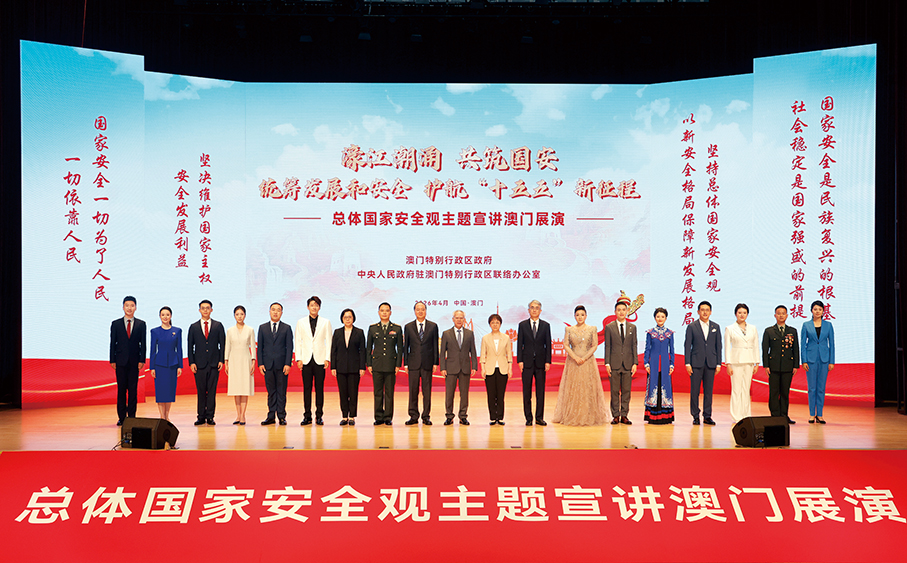
Chief Executive Sam Hou Fai (centre), Liaison Office Director Zheng Xincong (to the left of Sam), Foreign Ministry Commissioner Bian Lixin (to the right of Sam), Chinese People’s Liberation Army (PLA) Macau Garrison Deputy Commander Dai Jingsong (to the left of Zheng), Legislative Assembly (AL) President André Cheong Weng Chon (to the right of Bian), and Court of Final Appeal (TUI) President Song Man Lei (to the left of Dai) pose for a group photo with the speakers addressing yesterday’s session held at the University of Macau (UM) about the central authorities’ holistic approach to national security. – Photo: GCS
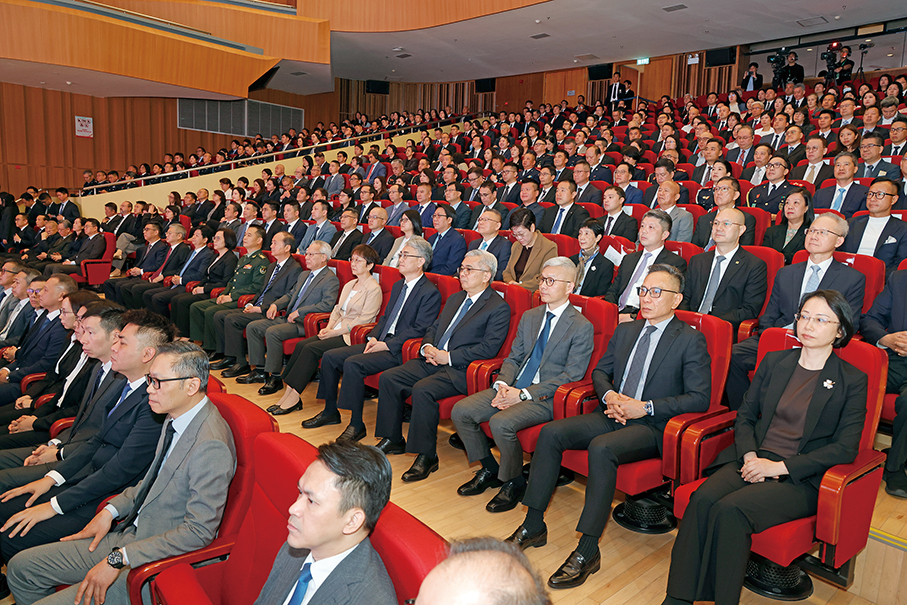
Dignitaries and other guests attend yesterday’s session at the University Hall on the University of Macau (UM) campus. – Photo: GCS