

The Civil Aviation Administration of China (CAAC), Hong Kong’s Civil Aviation Department (HKCAD) and the Macau Civil Aviation Authority (AACM) signed four cooperation arrangements in Hong Kong yesterday, expanding mutual recognition of airworthiness standards and strengthening certification cooperation, including for the domestically developed and manufactured C929 aircraft, according to a statement by AACM yesterday.
The arrangements consist of an amendment to the existing joint maintenance management framework alongside three new arrangements covering mutual acceptance of type certificates, airworthiness management of aviation fuels and chemicals, and type certification of the C929 aircraft, the statement said.
The four arrangements include the “Amendment to the Cooperation Arrangement on Joint Maintenance Management”, which removes geographical restrictions and allows maintenance and training certificates issued by any approved organisation in the three Chinese regions to be mutually recognised.
They also include the “Cooperation Arrangement on Mutual Acceptance of Type Certificates”, enabling Hong Kong and Macau to accept type certificates issued by the Chinese mainland without repeating technical assessments.
In addition, the “Cooperation Arrangement on Airworthiness Management of Aviation Fuels and Chemicals” is where permits issued by the Chinese mainland authorities are recognised to diversify supply sources.
Moreover, the “Cooperation Arrangement on Type Certification of the C929 Aircraft” allows Hong Kong and Macau representatives to participate in the certification process of the C929 wide-body aircraft developed by Commercial Aircraft Corporation of China, Ltd. (COMAC).
According to Wikipedia, the Comac C929 is a long-range 250-to-320-seat wide-body twinjet airliner developed and manufactured by the state-owned aircraft manufacturer COMAC, competing with Europe’s Airbus A330neo and the United States’ Boeing 787 Dreamliner.
Representatives from Hong Kong and Macau will participate in its type certification process, allowing both special administrative regions (SARs) to stay updated on the latest airworthiness developments, the statement said, noting that the arrangements were signed by CAAC Deputy Administrator Hu Zhenjiang, HKCAD Director-General Liu Chi-yung and AACM President Pun Wa Kin.
Prior to the signing, CAAC representatives visited Macau and met with AACM on Tuesday, the statement noted. Discussions covered aviation development projects, accident investigation cooperation, safety management and the low-altitude economy, the statement noted.
According to the statement, Hu said both sides should strengthen technical cooperation and personnel exchanges, while encouraging Macau to leverage its “One Country, Two Systems” policy advantages to enhance competitiveness in civil aviation.
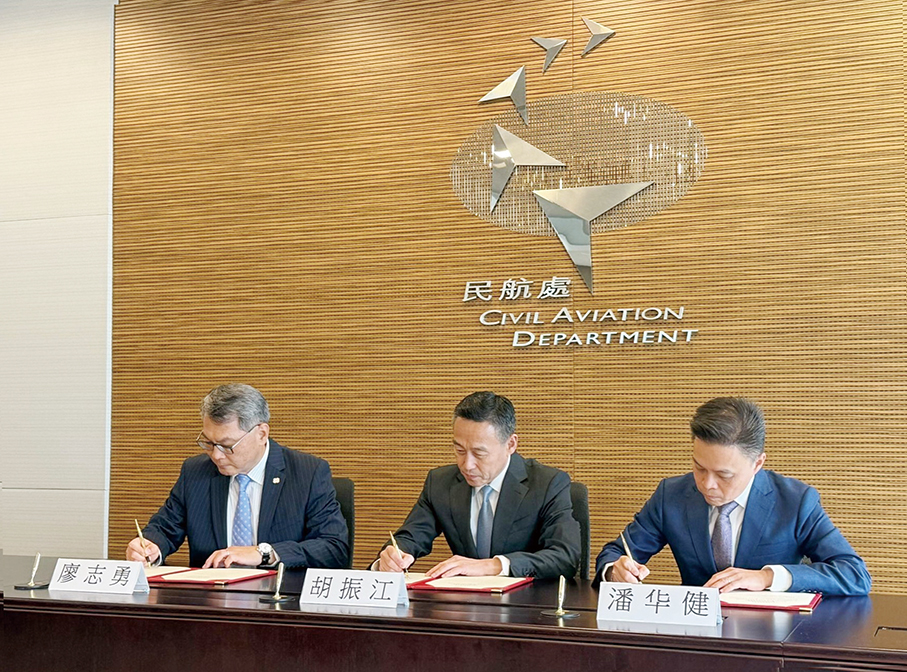
This handout photo provided by the Macau Civil Aviation Authority (AACM) yesterday shows the representatives of the Civil Aviation Administration of China (CAAC) (centre), Civil Aviation Department of Hong Kong (HKCAD) (left), and AACM signing the four cooperation arrangements in Hong Kong earlier in the day.