

The local government announced in a press conference at Luso International Bank Building in Nam Van yesterday that it will provide a diesel subsidy of 3.3 patacas per litre for vehicles and all industrial and commercial premises where diesel-powered equipment is operated, starting Monday next week for a period of two months.
The two-month subsidy, the government said yesterday, aims to relieve the operational cost pressure on diesel-using businesses resulting from the surge in global oil product prices triggered by the ongoing conflict in the Middle East, thereby preventing the higher cost of diesel from being passed on to the prices of goods affecting residents’ daily lives.
In Macau, diesel-powered motor vehicles are commercial vehicles as Macau does not import diesel-powered private cars.
The subsidy was announced by the Macau government’s Cross-departmental Working Group for Fuel Monitoring during a press conference yesterday.
The working group consists of officials from the Economic and Technological Development Bureau (DSEDT), the Consumer Council (CC), the Environmental Protection Bureau (DSPA), the Statistics and Census Bureau (DSEC), and the Fire Services Bureau (CB).
Yesterday’s press conference, chaired by DSEDT Director Yau Yun Wah, was held at the DSEDT headquarters in the Luso International Bank Building in Nam Van. The press conference was also attended by an official from each of the other four public entities.
During the press conference, Yau underlined that “in light of recent international geopolitical instability, which has caused continuous fluctuations in global oil product prices, the Macau government has consistently paid close attention to the impact of this situation on residents’ daily lives and the business sector, closely monitoring the latest developments in the local fuel market”.
Yau said that diesel, as the primary fuel for Macau’s industrial and commercial businesses, constitutes an essential consumable for their operations, while the operations of diesel-using businesses also directly affect residents’ daily lives. Consequently, he said, the government decided to launch the two-month diesel subsidy scheme.
The subsidy will run between 00:00 a.m. on Monday next week and 11:59 p.m. on July 10.
All respective users will directly benefit from the 3.3-pataca-per-litre subsidy when purchasing diesel during the two-month period without having to file an application, Yau noted.
Yau said that 11 million litres of diesel are used per month in Macau on average.
Yau said that there are currently about 8,600 diesel-powered vehicles in Macau, while there are 63 industrial and commercial premises where diesel-powered boilers are operated, and over 200 other industrial and commercial premises where other types of diesel-powered equipment are operated.
In addition, Yau said, Macau’s diesel users covered by the subsidy also includes about 400 vessels.
Yau said that the government expects to spend 80 million patacas on the subsidy scheme, underlining that the government believes that the 80-million-pataca subsidy would be sufficient to cover Macau’s use of diesel for two months.
Yau underlined that diesel users will directly benefit from the 3.3-pataca-per-litre subsidy on the price actually paid after deducting the discount offered by the suppliers.
“During the implementation of the scheme, fuel suppliers must maintain their existing discount schemes for customers, meaning that the selling price shall be calculated by first deducting the discount offered by them, and then deducting the subsidy granted by the government from that discounted price,” Yau said.
Furthermore, Yau said, the customer receipts must clearly indicate details such as the original price and the subsidy amount.
Petrol stations are also required to display information about the plan, Yau said, adding that the government will sign agreements with fuel companies outlining responsibilities and operational procedures. He underlined that companies must maintain accurate transaction records and submit the respective financial reports to the government every 15 days, while the government will also commission independent auditors to review the scheme.
Yau pointed out that legal action will be taken in case of irregularities such as false sales records.
Meanwhile, Yau also said that in order to ensure proper implementation, the Cross-departmental Working Group for Fuel Monitoring will conduct inspections across Macau, checking equipment, fuel storage and sales documentation, while also briefing petrol station staff on details of the subsidy scheme.
Yau stressed that the subsidy is a temporary one and aimed at providing immediate relief to local businesses using diesel, while preventing rising diesel prices from being passed on to consumers.
Yau added that the bureau will continue monitoring global oil price trends and maintain close communication with the local fuel sector to ensure a stable supply and pricing, alongside strengthening transparency through regular public updates on fuel prices.
Yau underlined that Macau’s fuel prices are based on those on the trading platform in Singapore, while in the Chinese mainland they are determined by the National Reform and Development Commission (NRDC).
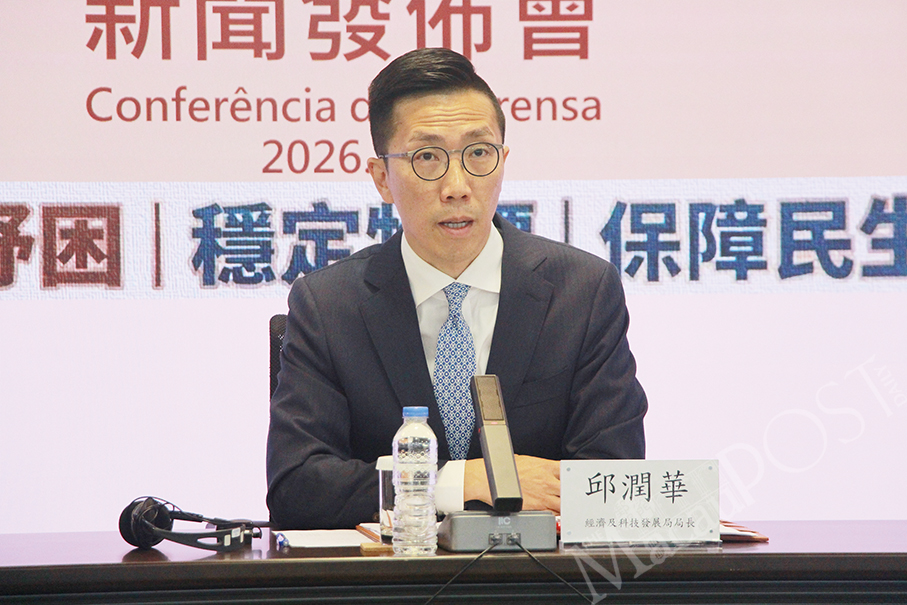
Economic and Technological Development Bureau (DSEDT) Director Yau Yun Wah addresses yesterday’s press conference at Luso International Bank Building in Nam Van yesterday. – Photo: Khalel Vallo