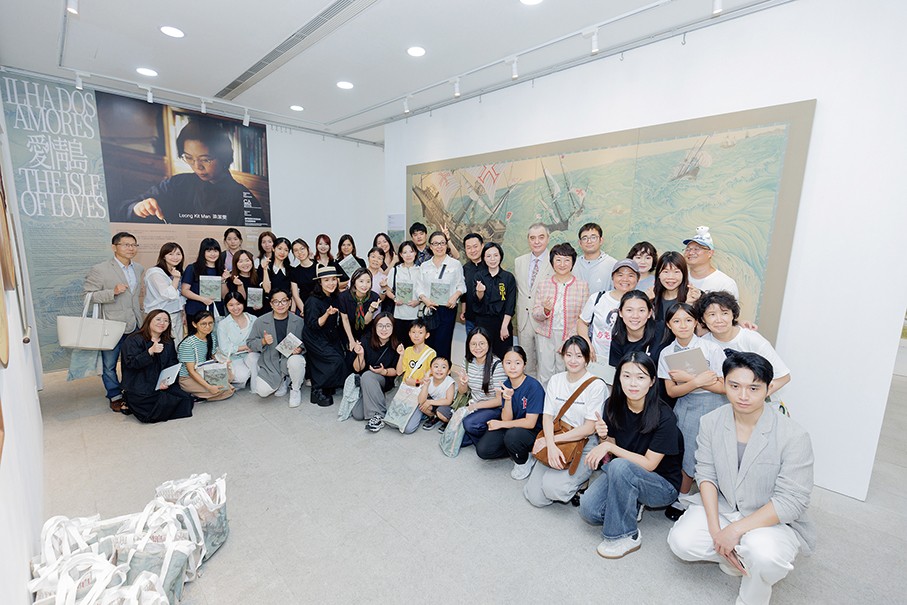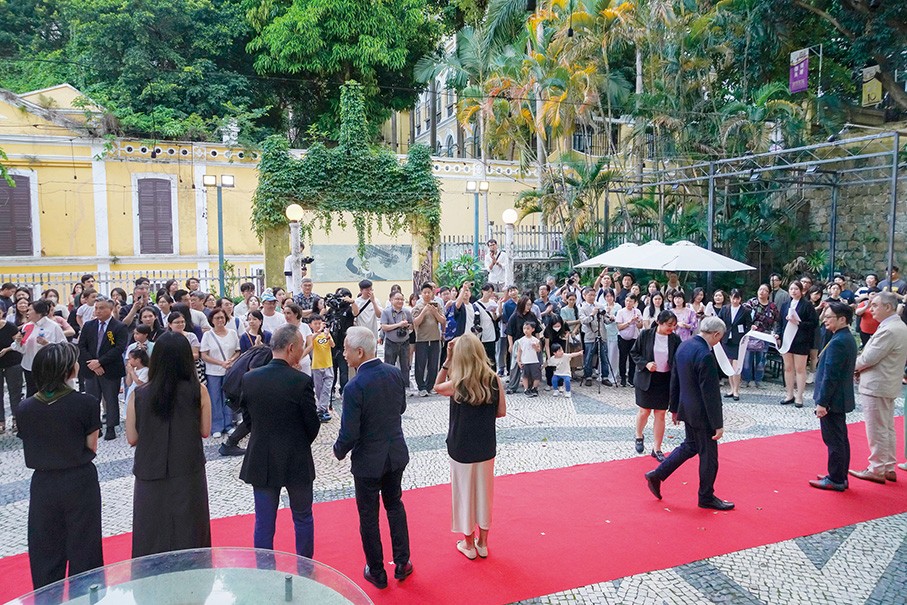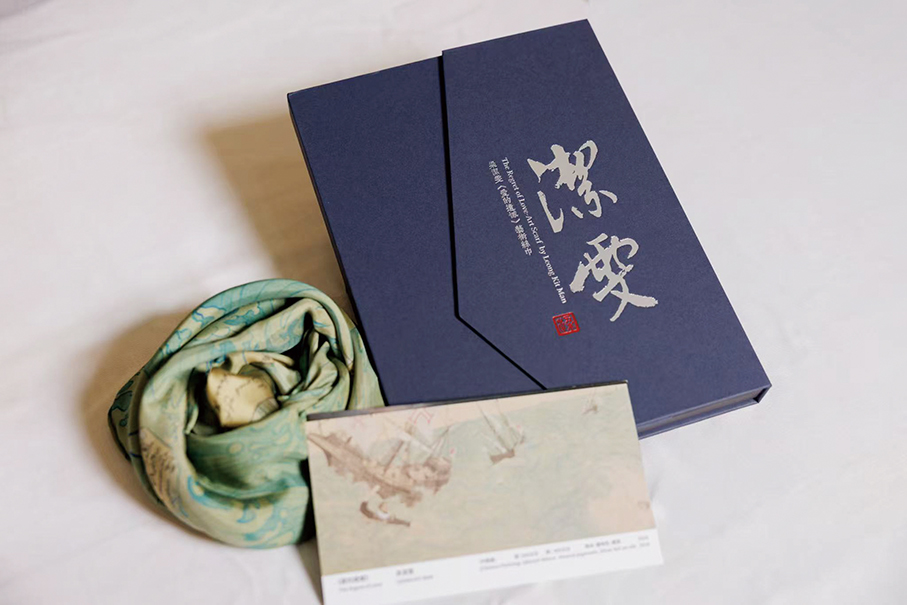


An exhibition celebrating the Day of Portugal, Camões, and the Portuguese Communities kick-started at Albergue SCM last Wednesday, offering a cross-cultural exploration of Portuguese literary history through traditional Chinese painting techniques.
Organised by the Círculo dos Amigos da Cultura de Macau (“Circle of the Friends of Macau’s Culture” – CAC), “Ilha dos Amores” (“Island of Lovers”) features the recent works of local artist Leong Kit Man. Curated by Carlos Marreiros, the solo exhibition focuses on the mythical sojourn of epic poet Luís de Camões in Macau and the vivid imagery of his masterwork, Os Lusíadas.*
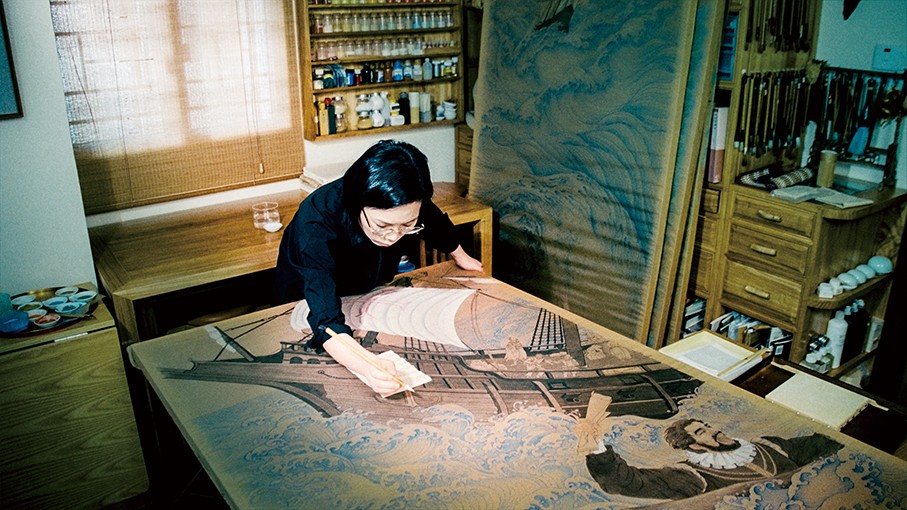
Leong, an assistant professor of Fine Arts at the Macau University of Science and Technology (MUST), holds a PhD from the Chinese National Academy of Arts. She specialises in the Gongbi (meticulous) and Mogu (boneless) heavy-colour painting traditions.** By applying these highly disciplined, detailed Chinese techniques to Western literary themes, Leong aims to establish a visual dialogue between Eastern and Western interpretations of an ideal paradise. The collection explores the shared human imagination, uncovering common cultural threads that bind the two distinct traditions together.
The anatomy of The Regret of Love
At the opening ceremony, Leong and Marreiros introduced the artwork to the audience. The centrepiece of the exhibition is The Regret of Love (O Arrependimento do Amor), a monumental painting measuring 400 by 180 centimetres, executed with mineral pigments and silver foil on silk. The work depicts the tragic 1558 shipwreck on the Mekong River, an event in which legend has it that Camões salvaged his manuscript of Os Lusíadas from the waves but was unable to save his Eastern lover.
Rather than adopting a traditional macroscopic view of the sea, Leong employs a micro-level perspective to examine the disaster. The composition meticulously details the structural mechanics, internal decks, and rigging of the listing Portuguese vessel. This intricate layout aligns with the traditional Chinese landscape painting philosophy of ke ju ke you (可居可遊, literally “inhabitable and wanderable”), creating a visual space that feels structurally traversable to the observer. The narrative imagery depicts Camões submerged in turbulent waves while hoisting his scroll to safety, juxtaposed against his lover floating weightlessly beneath the surface surrounded by rising air bubbles and sinking letters.
A Portuguese Yaji Calligraphy Collaboration
In a deliberate nod to the traditional Chinese Yaji (雅集, literally “elegant gathering”)- a historical gathering where artists and scholars collaborated on poetry and painting – the artwork integrates classical Portuguese verses directly onto the silk medium. Because no original manuscripts written by Camões survive today, Macau architect and artist Marreiros conducted historical research into 16th-century Western scripts, analysing contemporary archival documents to reconstruct the orthography of that period. Marreiros designed the calligraphic template, which was then transcribed onto the painting to create a literal synthesis of European epic poetry and Chinese artistic presentation.
Complementing the large-scale The Regret of Love, the exhibition features a singular circular silk painting titled Ilha dos Amores (“Island of Loves”), measuring 80 cm in diameter. This framed piece, in a traditional Chinese round-screen format, presents a detailed Gongbi landscape of the mythical paradise. A large, steep mountain of stylised blue-green rock, dotted with sparse trees, dominates the right side. On a central golden sandy plain, dozens of miniature figures, rendered in meticulous detail, interact. In a unique fusion, these figures, with Camões standing at the top of the mountain, are dressed in classical 16th-century Portuguese and European attire, navigating and congregating within the idyllic scene. The composition visually realises the idealised island paradise described in Cantos IX and X of Os Lusíadas, symbolising a moment of intercultural harmony and peaceful co-existence.
The solo exhibition is being held at Albergue SCM’s Gallery A2, with the exhibition running until July 6; free admission, open every day, from 12:00 p.m. to 7:00 p.m., and from 3:00 p.m. to 7:00 p.m. on Mondays.
* “Os Lusíadas (often anglicised as The Lusiads) is a monumental epic poem written by Luís Vaz de Camões and published in 1572. It is widely regarded as the national epic of Portugal and the most important work of Portuguese literature. Written in the classical style of Homer’s Iliad and Virgil’s Aeneid, the poem depicts the heyday of Portuguese maritime exploration. Etymologically, the term Lusíadas means “the sons of Lusus,” referring to the Portuguese people as descendants of their mythical founder. – DeepSeek/Poe
** On Leong’s artistic technique and style, view the Post’s previous interview:
www.macaupostdaily.com/news/24792

Curator Carlos Marreiros introduces Ilha dos Amores (Isle of Loves) last Wednesday at the gallery. – Photo: William Chan
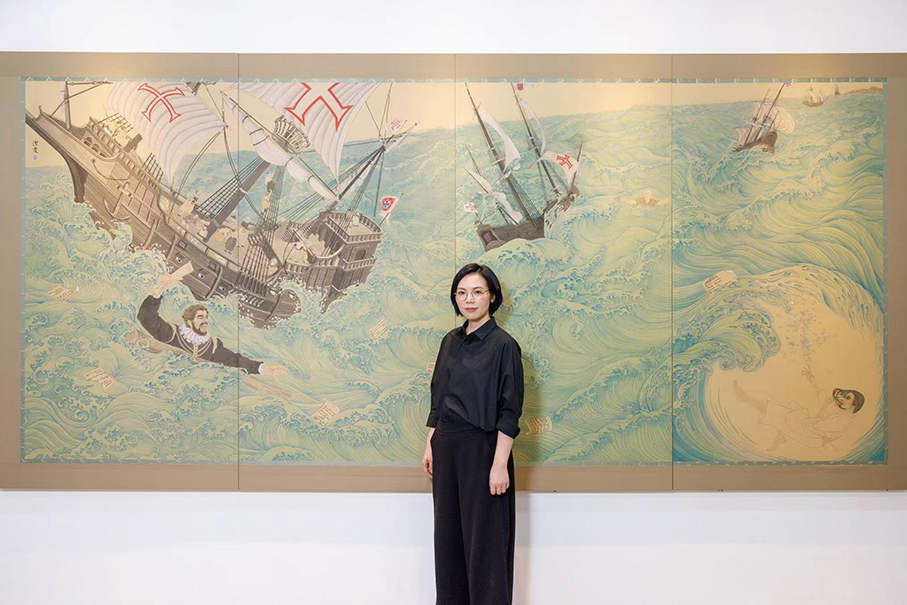
Leong Kit Man poses in front of her work The Regret of Love at the opening ceremony. – Photos provided by Leong