

Culture and Tourism Minister Sun raises 3 insights
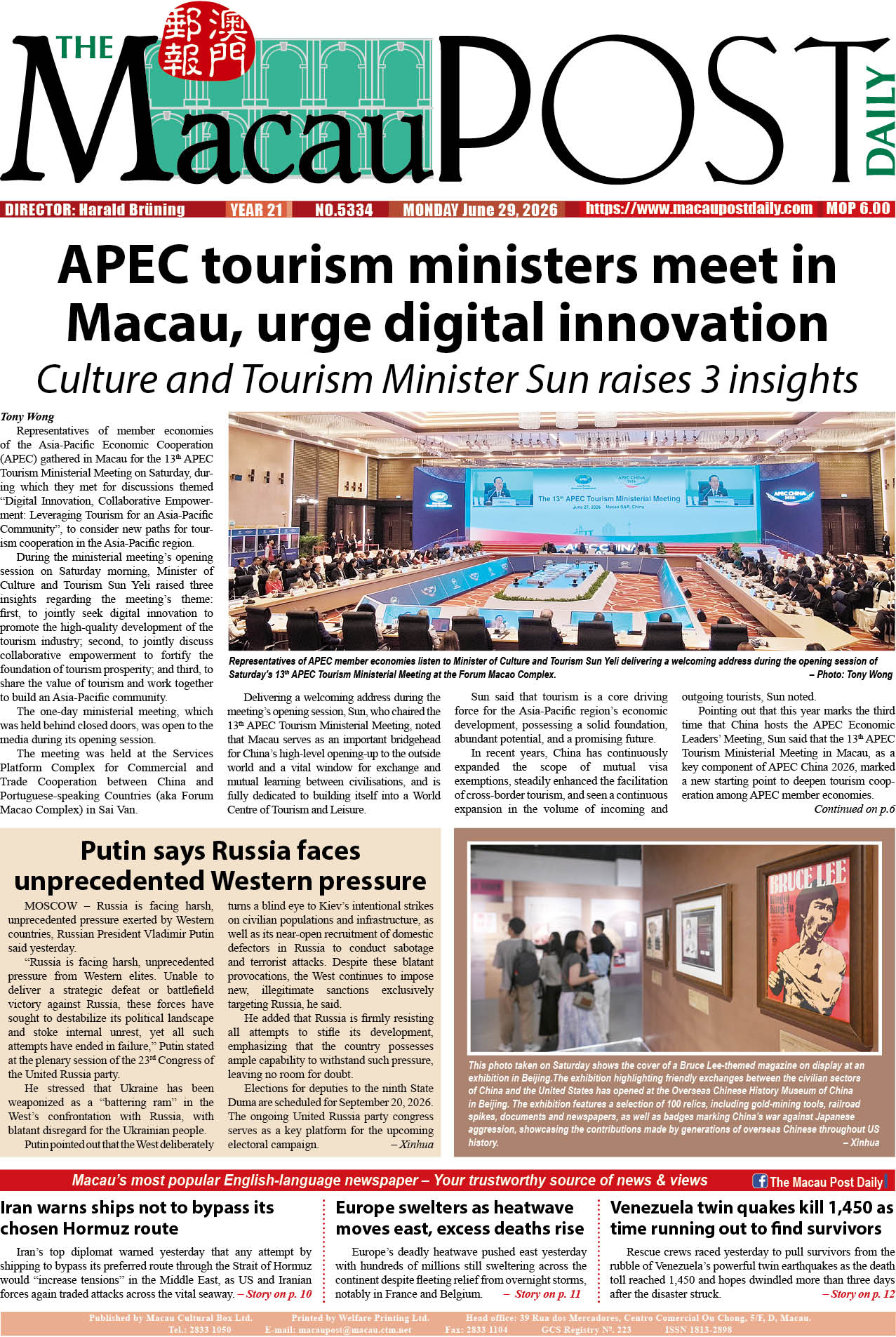
Representatives of member economies of the Asia-Pacific Economic Cooperation (APEC) gathered in Macau for the 13th APEC Tourism Ministerial Meeting on Saturday, during which they met for discussions themed “Digital Innovation, Collaborative Empowerment: Leveraging Tourism for an Asia-Pacific Community”, to consider new paths for tourism cooperation in the Asia-Pacific region.
During the ministerial meeting’s opening session on Saturday morning, Minister of Culture and Tourism Sun Yeli raised three insights regarding the meeting’s theme: first, to jointly seek digital innovation to promote the high-quality development of the tourism industry; second, to jointly discuss collaborative empowerment to fortify the foundation of tourism prosperity; and third, to share the value of tourism and work together to build an Asia-Pacific community.
The one-day ministerial meeting, which was held behind closed doors, was open to the media during its opening session.
The meeting was held at the Services Platform Complex for Commercial and Trade Cooperation between China and Portuguese-speaking Countries (aka Forum Macao Complex) in Sai Van.
Delivering a welcoming address during the meeting’s opening session, Sun, who chaired the 13th APEC Tourism Ministerial Meeting, noted that Macau serves as an important bridgehead for China’s high-level opening-up to the outside world and a vital window for exchange and mutual learning between civilisations, and is fully dedicated to building itself into a World Centre of Tourism and Leisure.
Sun said that tourism is a core driving force for the Asia-Pacific region’s economic development, possessing a solid foundation, abundant potential, and a promising future.
In recent years, China has continuously expanded the scope of mutual visa exemptions, steadily enhanced the facilitation of cross-border tourism, and seen a continuous expansion in the volume of incoming and outgoing tourists, Sun noted.
Pointing out that this year marks the third time that China hosts the APEC Economic Leaders’ Meeting, Sun said that the 13th APEC Tourism Ministerial Meeting in Macau, as a key component of APEC China 2026, marked a new starting point to deepen tourism cooperation among APEC member economies.
Sun raises 3 insights
In his welcoming address, Sun raised three insights regarding the meeting’s theme: “Digital Innovation, Collaborative Empowerment: Leveraging Tourism for an Asia-Pacific Community”.
First, to jointly seek digital innovation to promote the high-quality development of the tourism industry, Sun said.
Sun quoted President Xi Jinping’s previous remarks as pointing out the need to create a new hallmark for a digital Asia-Pacific, and to construct a new economy, new business formats, and new business models.
Sun said that the digital empowerment and informational transformation of the tourism industry have become an irreversible trend, injecting fresh momentum into the high-quality development of tourism. “We need to work together to deepen the integration of tourism, culture, and technology, cultivate more new business formats, and drive the upgrading of the traditional tourism industry”, Sun said.
“We need to enrich the tourist experience by utilising cutting-edge technological applications such as real-time translation glasses, exoskeleton devices, and virtual reality (VR) to break down language barriers, facilitate travel, and deepen cultural appreciation”, Sun said.
The minister also called for initiatives to enhance the effectiveness of tourism governance, resolving challenges such as overcrowding at popular scenic spots and tourism safety issues through new models such as big data forecasting and artificial intelligence (AI) warnings.
The second insight Sun raised is to jointly discuss collaborative empowerment to fortify the foundation of tourism prosperity.
Sun underlined that China is willing to deepen practical cooperation with all parties, better leverage the guiding and driving role of the APEC Tourism Ministerial Meeting, connect forces from all sectors including governments, enterprises, and civil organisations, and build a synergy to jointly promote the prosperous development of the tourism industry.
China is willing to strengthen policy alignment with various countries to introduce more facilitation measures in areas such as mutual visa exemptions, fast-track immigration clearance, cross-border payments, and departure tax refunds, thereby continuously improving the ease and convenience of travel, Sun said.
Sun called for efforts to support enterprises in jointly developing tourism products, designing transnational tourism itineraries, and increasing direct flights and cruise routes within the Asia-Pacific region to better satisfy diverse tourism demands.
The minister also underlined the need to encourage industry associations, higher education institutions, and think tanks to strengthen the exchange of experience and data sharing, promote the alignment of tourism industry standards, and jointly carry out talent cultivation, with the aim of providing support for the sustainable development of tourism.
The third insight Sun raised is to share the value of tourism and work together to build an Asia-Pacific community.
Sun said that the tourism industry is an important component of a better life, a vital engine for economic development, and an essential bridge for cultural exchange. It holds unique value in the historical process of promoting an Asia-Pacific community, he said.
“We need to continuously release the economic and social benefits of the tourism industry, allowing tourism to better serve its crucial functions of enhancing quality of life, boosting economic development, building a spiritual home, and promoting mutual learning between civilisations, with the aim of solidifying the economic foundation and strengthening the bonds of public support for creating an Asia-Pacific community”, Sun said.
Sun also noted that in recent years, China’s tourism industry has been thriving and continuously booming, becoming a major supporting force for economic development in the Asia-Pacific and providing a vast arena for corporate and talent investment.
The 33rd APEC Economic Leaders’ Meeting will be held in Shenzhen on November 18 and 19.
It will be the third time that China hosts the APEC Economic Leaders’ Meeting, after Shanghai in 2001 and Beijing in 2014.
Before the 22nd APEC Economic Leaders’ Meeting was held in Beijing in November 2014, the APEC Tourism Ministerial Meeting was held in Macau in September that year.
This time, it was the second time that Macau had hosted the APEC Tourism Ministerial Meeting, after the one in 2014.
Macau was hosting the five-day 13th APEC Tourism Ministerial Meeting and the 67th APEC Tourism Working Group Meeting between Wednesday and yesterday. As part of the ministerial meeting, the working group meeting was held on Wednesday and Thursday.
APEC tourism ministerial meeting affirms Macau’s capacity to host large-scale int’l conventions: Secretary Ng
During the opening session of the 13th APEC Tourism Ministerial Meeting on Saturday morning, MSAR Secretary for Economy and Finance Ng Wai Han said that being able to host such a grand event is not only a full affirmation of Macau’s capacity to organise large-scale international conventions and exhibitions, but also provides strong encouragement for the MSAR’s ongoing efforts to position itself as a World Centre of Tourism and Leisure.
On behalf of the MSAR, Ng expressed sincere gratitude to the Central People’s Government for its support and trust.
The MSAR government and the Ministry of Culture and Tourism jointly hosted a welcome dinner on Friday to greet the high-level delegates attending the meetings.
Following the ministerial meeting on Saturday, representatives of APEC member economies yesterday conducted an inspection in Macau, including site visits and activities, for an immersive experience of Macau’s rich cultural heritage and unique tourism appeal, according to a statement by the Macau Government Information Bureau (GCS) yesterday.
Yesterday’s inspection was jointly organised by the MSAR government and the Ministry of Culture and Tourism.
3 Spanish-speaking countries among 21 APEC members
The Asia-Pacific Economic Cooperation (APEC) is an inter-governmental forum for 21 member economies in the Pacific Rim which promotes free trade throughout the Asia-Pacific region.
APEC held its first ministers’ meeting in 1989 in Australia whose then prime minister, Bob Hawke, is regarded as the multilateral bloc’s initiator. APEC’s first leaders’ meeting was held in the US, hosted by president Bill Clinton.
China will hold this year’s 33rd leaders’ meeting in Shenzhen on November 18-19, to be hosted by President Xi Jinping.
Unlike the Hong Kong SAR and Chinese Taipei (the name officially used by APEC for China’s Taiwan region), the Macau SAR is not an APEC member economy. APEC is headquartered in Singapore.
In 1993, APEC declared a moratorium on admitting new members.
APEC has three official observers: ASEAN, the Pacific Islands Forum (PIF) and the Pacific Economic Cooperation Council (PECC).
Spanish is an official language in three APEC member economies – Mexico, Peru and Chile.
The Central People’s Government has designated Macau as a platform to promote relations between China and Portuguese- and Spanish-speaking countries.

Representatives of APEC member economies listen to Minister of Culture and Tourism Sun Yeli delivering a welcoming address during the opening session of Saturday’s 13th APEC Tourism Ministerial Meeting at the Forum Macao Complex. – Photo: Tony Wong
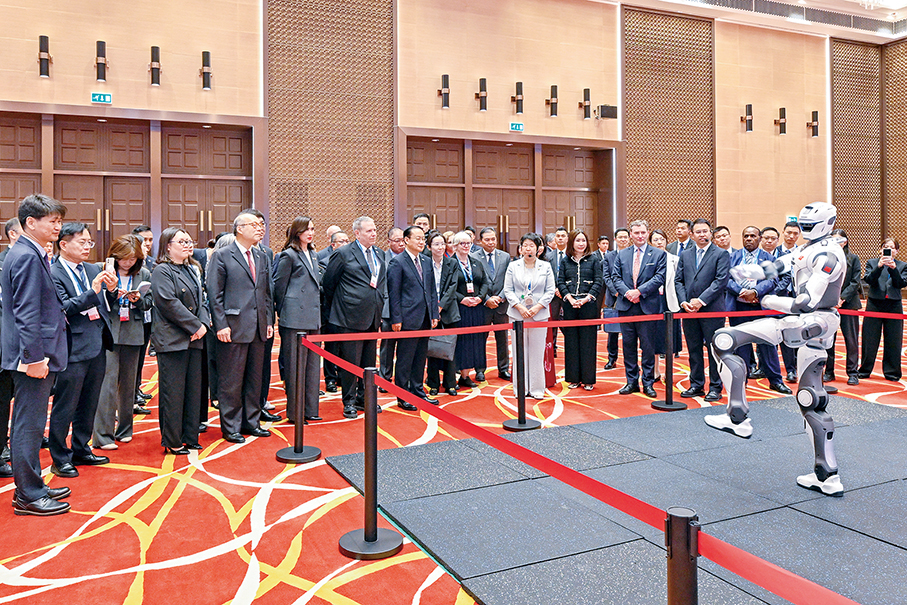
Representatives of APEC member economies watch a robot show at the Forum Macao Complex on Saturday during the cultural and tourism showcase and experience activities organised as part of the 13th APEC Tourism Ministerial Meeting. – Photo: GCS