

Plan projects population of 783,000, land area of 36.96 km2 in 2040
The local government yesterday launched a public consultation on draft amendments to Macau’s urban master plan, proposing to revise the designated land use on the areas earmarked for the government’s three future large-scale projects.
The official urban master plan covers the period between 2020 and 2040.
It will be the first time that the government is amending the urban master plan since it came into force in February 2022.
In line with the government’s latest forecast for the future population, the draft amendments propose to adjust the estimate of Macau’s population to 783,000 in 2040, a change from the 808,000 in 2040 estimated in the urban master plan’s current version.
According to the latest demographic statistics, Macau’s population stood at 688,100 at the end of the first quarter of this year.
The draft amendments released yesterday also propose that the total land area covered by the urban master plan’s amended version will amount to 36.96 square kilometres in 2040, a change from the 36.8 square kilometres in 2040 listed in its current version.
The Macau Special Administrative Region’s (MSAR) total land area currently amounts to 33.4 square kilometres, which does not include the three areas that the Central People’s Government has authorised the MSAR to exercise jurisdiction over, comprising the University of Macau’s (UM) current campus situated in an area of Zhuhai’s Hengqin island, the Macau-side zone of the Hengqin joint checkpoint, and the V-shaped area southeast of Zhuhai’s Gongbei checkpoint used for part of the ongoing Light Rapid Transit (LRT) East Line project.
The MSAR is leasing the three areas from Zhuhai City.
In addition to the MSAR’s total land area per se, however, the total land area regulated by the urban master plan’s current version also covers the UM’s current campus and the Hengqin joint checkpoint’s Macau-side zone. After including these two areas, the total land area currently covered by the urban master plan amounts to 34.85 square kilometres.
According to the draft amendments released yesterday, the total land area to be covered by the urban master plan’s amended version will rise to 36.96 square kilometres in 2040 thanks to the completion of the ongoing Zone D land reclamation area off Taipa northern coast, the completion of the local airport’s ongoing reclamation and expansion project, and other future new land reclamations along Macau’s coastal areas, as well as newly including the V-shaped area southeast of Zhuhai’s Gongbei checkpoint, the jurisdiction over which was transferred from Zhuhai to Macau in 2024 after the urban master plan’s current version was promulgated in 2022.
The MSAR’s urban master plan for 2020 to 2040 is the city’s first-ever official urban master plan, which took effect on February 15, 2022 after its promulgation in the Official Gazette (BO) on the previous day.
Macau’s urban master plan is promulgated by an administrative regulation drawn up by the government because of which it does not require the legislature’s approval.
The public consultation launched yesterday on proposed amendments to Macau’s urban master plan is running for 60 days until August 27.
The draft was uploaded onto the website of the Lands and Urban Construction Bureau (DSSCU) yesterday. The bureau is the public entity tasked with the city’s urban planning.
The government held a meeting yesterday to brief lawmakers, members of the government’s appointed Urban Planning Council (CPU), and officials from various public entities about the draft of its proposed amendments to the urban master plan. The meeting, which was held behind closed doors, was open to the media at the start.
Delivering a speech at the beginning of yesterday’s meeting, Secretary for Transport and Public Works Raymond Tam Vai Man noted that the urban master plan needs to be amended in alignment with the government’s planning of three future large-scale projects aiming to inject new impetus into Macau’s long-term development, namely the Macau International Integrated Tourism and Cultural Zone, the Macau Science and Technology Research and Development Industrial Park, and the Macau International Aviation Hub for the Pearl River West Bank.
Moreover, according to Tam, the government is also proposing amendments to the urban master plan in compliance with various new regulations that concern urban planning promulgated over the past few years.
The draft released yesterday notes that the government’s planned Macau International Integrated Tourism and Cultural Zone will include three major cultural facilities, namely the Macau National Museum of Culture, the Macau International Centre for Performing Arts, and the International Museum of Contemporary Art.
The draft notes that the government proposes to construct the Macau National Museum of Culture on the waterfront area east of Macau Tower, while it proposes to build the Macau International Centre for Performing Arts on the west side of the Zone C land reclamation area off Taipa’s Ocean Gardens residential estate and to construct the International Museum of Contemporary Art on the east side of Zone C.
The draft also notes that the government proposes to set up two industrial parks, located separately from each other, for its planned Macau Science and Technology Research and Development Industrial Park project, namely the plot at the bottom of Big Taipa Hill on Avenida Wai Long, near the airport, previously earmarked for a sandwich-class housing project, and the west side of the Zone E1 land reclamation area off Taipa’s Pac On district.
In compliance with the Macau International Integrated Tourism and Cultural Zone project, the draft amendments propose that Zone C will be earmarked for public facilities, a change from residential and commercial facilities designated by the urban master plan’s current version.
The draft amendments propose that the waterfront area east of Macau Tower will be earmarked for public facilities, unchanged from the current version.
In compliance with the Macau Science and Technology Research and Development Industrial Park project, the draft amendments propose that the area designated by the urban master plan’s current version as residential areas in Zone E1 will instead be earmarked for commercial facilities. Consequently, the whole west side of Zone E1 will be earmarked for commercial facilities.
The urban master plan’s current version designates the west side of Zone E1 as residential and commercial facilities.
The draft amendments propose that the plot on Avenida Wai Long in Taipa will be earmarked for industrial facilities, a change from residential facilities designated in the urban master plan’s current version.
The draft notes that the urban master plan’s current version was drawn up after considering the local airport’s then expansion plan.
The airport’s ongoing reclamation and expansion project got off the ground in late 2024.
However, in line with the final version of the airport’s expansion project, the draft amendments propose to correspondingly adjust the area for the airport earmarked by the urban master plan.
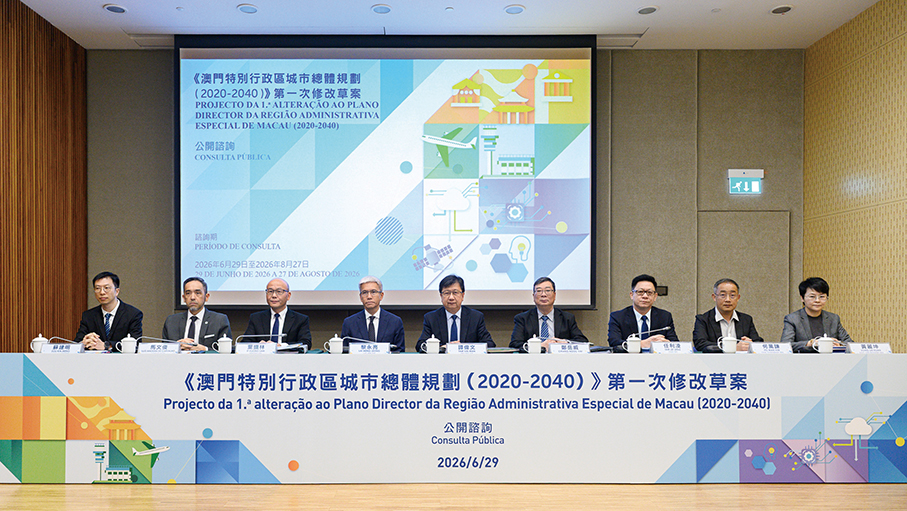
Flanked by officials of various public entities, Secretary for Transport and Public Works Raymond Tam Vai Man (centre) addresses yesterday’s briefing session at the Environmental Protection Bureau’s (DSPA) auditorium on the ground floor of the headquarters of power utility CEM. – Photo: GCS
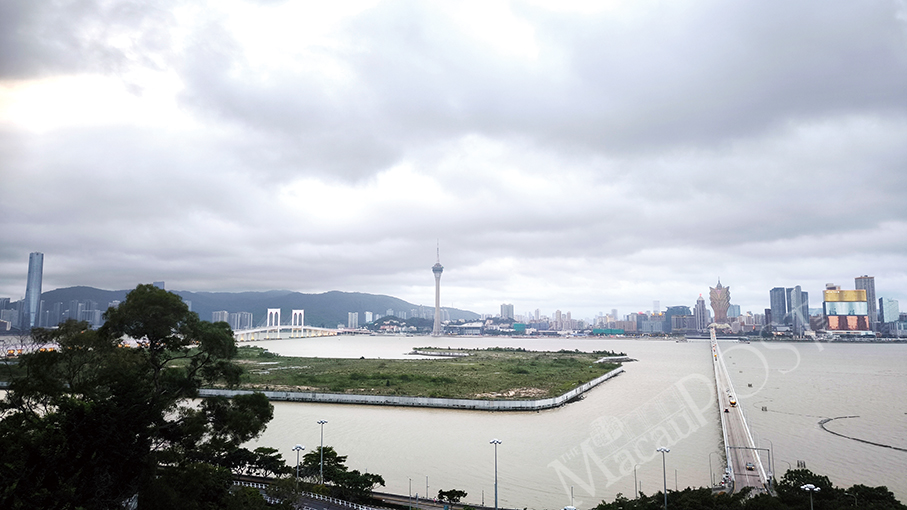
This photo taken last month from Small Taipa Hill shows the Zone C land reclamation area, which is earmarked for the future Macau International Integrated Tourism and Cultural Zone. – Photo: Tony Wong