


Commentary by Sam-Kee Cheng*
On Father’s Day weekend, I took my parents and some senior relatives to Chikan Ancient Town in Kaiping. Chikan is a centuries-old town located on the western edge of the Pearl River Delta. It is the ancestral hometown of many overseas Chinese who emigrated to the United States, Europe, and Southeast Asia in search of work. Many of the town’s beautiful heritage buildings, featuring a unique blend of Western and Chinese architectural styles, were constructed using remittances sent home by these emigrants.
It is wonderful to be able to stay in this ancient town, walking through historic buildings and enjoying live performances, all while benefiting from the convenience of modern infrastructure. This includes air-conditioned hotels, accessible facilities, and excellent transport links – both outside the town (the high-speed train from Hong Kong to Kaiping South Station takes about two hours) and inside it (via vintage dang-dang trams, boats, and small shuttle cars).
Both the local government and the local population have invested heavily in this massive renovation project. While it feels somewhat like staying in a theme park, the vital difference is that this is no fairytale – these were real homes belonging to real people. Thousands of households vacated their properties so that visitors could come to learn about the blood, sweat, and tears behind them. The coordination and financial investment by the local government are equally significant. One only needs to look at the logistics required to resettle thousands of families and build the infrastructure necessary to support a visitor volume that reached over three million in 2025.
For the elderly, the history and performances – deeply rooted in the stories of early emigrants –resonated profoundly with their own life experiences. It evoked memories of the hardships of their youth and the stories they had heard from parents and friends. After watching Homeward Journey, a heart-wrenching show performed on a water stage, my aunt wiped away tears as she told me about relatives who had gone overseas. She recounted stories of families left broken because a father or brother never returned or lost contact, and how the women carried on, struggling to raise children alone. Many of these men and women relied on others to read and write letters for them due to illiteracy, a poignant reality also depicted in the popular Chinese drama Dear You.
The architecture in Chikan also reminded my relatives of the houses they once lived in back in Hong Kong. While those buildings looked grand from the outside, the interiors were divided among multiple households and were incredibly cramped. Back then, it was common for several families to share a single kitchen and bathroom, living in conditions rife with fire hazards and poor hygiene.
The fire and water shows, alongside the Red Wedding dance – based on the true story of Communist Party of China (CPC) members Zhou Wenyong and Chen Tiejun – were the highlights of the trip. That said, all of the eight or so performances I attended were excellent and not to be missed. The singing of “The Internationale” at the end of the Red Wedding show was a stirring experience that prompted reflection on China’s grand history of development through the lens of Chikan.
It is hard not to agree that thanks to the self-sacrifice of past generations, alongside the scientific analysis and practical tools for societal transformation developed under Marxism-Leninism, China has been able to regain its sovereignty, rid itself of a century of humiliation, and rebuild the nation. The success of Chikan is proof of this trajectory.
The Chikan project is part of the “Hundred, Thousand, and Ten Thousand Project” (Baiqianwan Gongcheng) launched by Guangdong Province, which aims to close the wealth gap between affluent urban areas and poorer rural regions. The initiative focuses on industrial development, urbanisation, and rural beautification. By making rural areas beautiful, modern, and sustainable, the province hopes to attract and retain talent. Thousands of jobs have already been created by the Chikan project, which is slated for further expansion. The hotel we stayed at only opened in 2025, yet it was nearly fully booked on a standard weekend.
With its immersive experience, rich history, and delicious, affordable local cuisine, Chikan is an ideal holiday destination. It is rare to find a destination that appeals to all generations while simultaneously encouraging visitors to reflect on their own family history and the country’s development path. The success of Chikan demonstrates that while technology and innovation are vital tools, the most important element of any project is building it upon values that strike a deep chord in people’s hearts.
*Sam-Kee Cheng is a Research Assistant Professor at the University of Macau and an Associate Researcher at the University of Macau Advanced Research Institute in Hengqin (HUMRI).
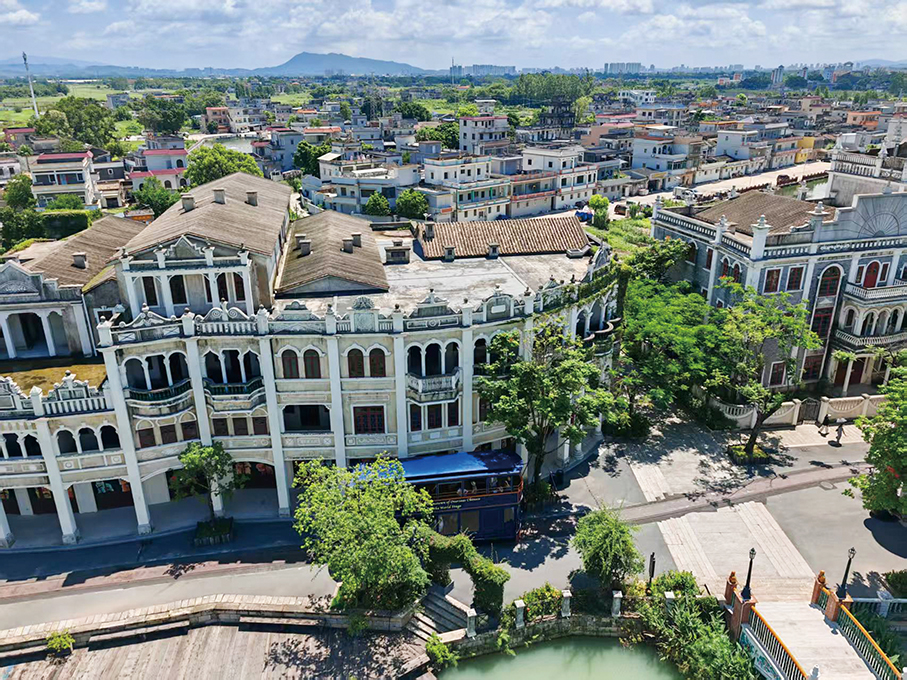
Panoramic view from Rong An Tower, the highest point of the ancient town (accessible via elevator). Photo taken by Sam-Kee Cheng on June 21.
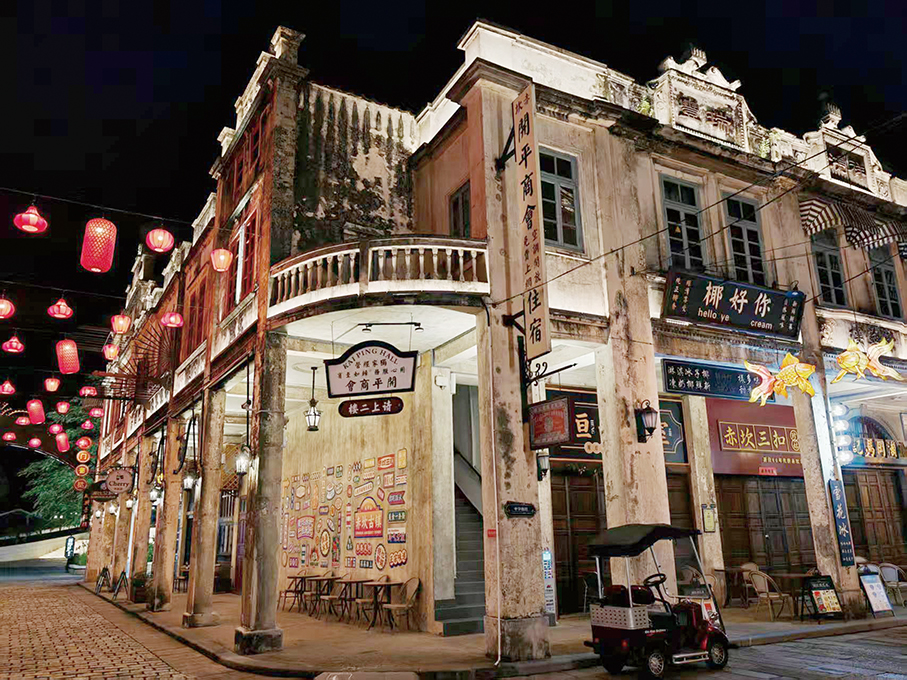
The Kaiping Hall qilou – the streets and arcade buildings are beautifully illuminated at night. Visitors can stroll and enjoy the night scenery following the outdoor evening show, Homeward Journey. Photo taken by Sam-Kee Cheng on June 20.