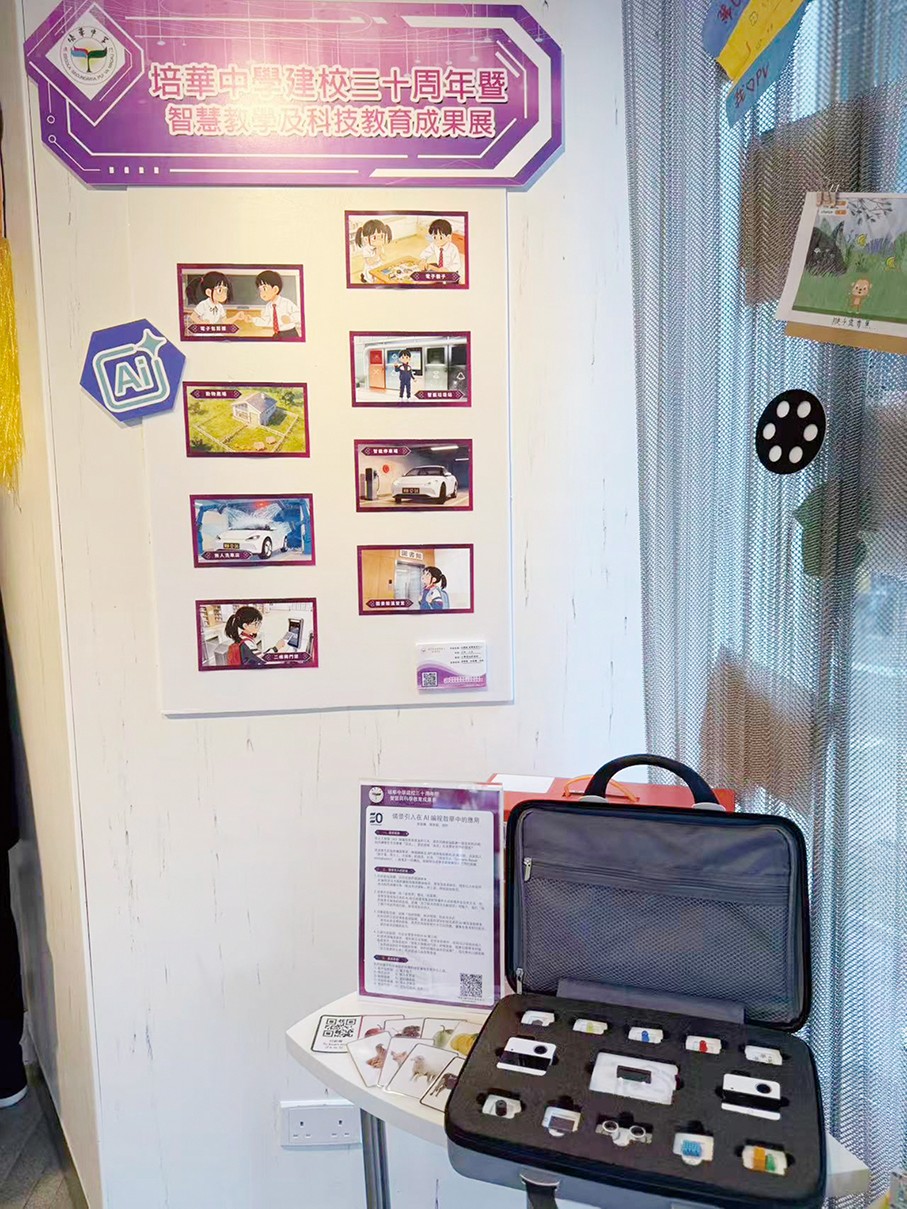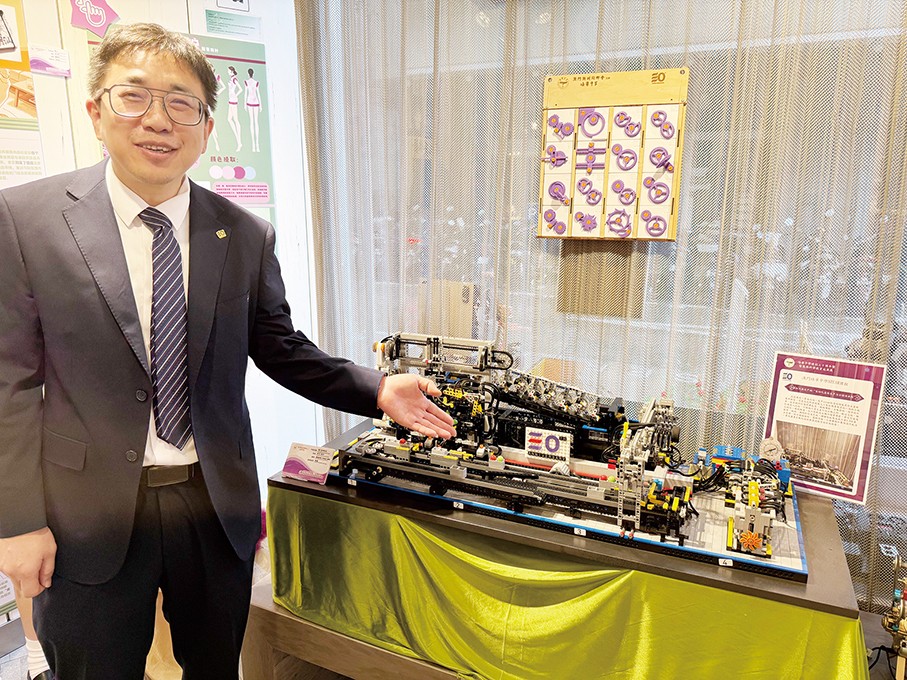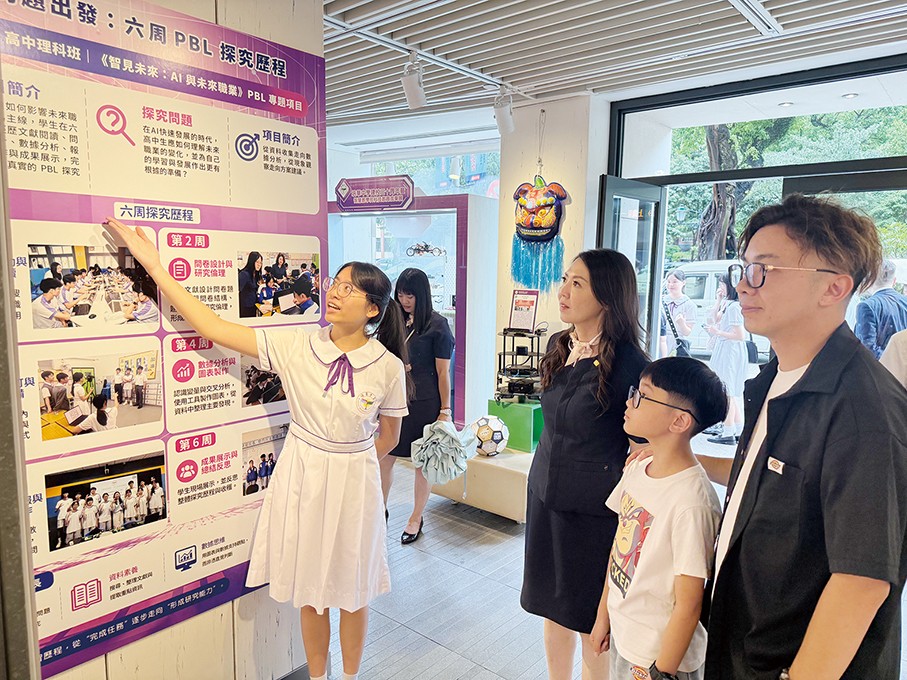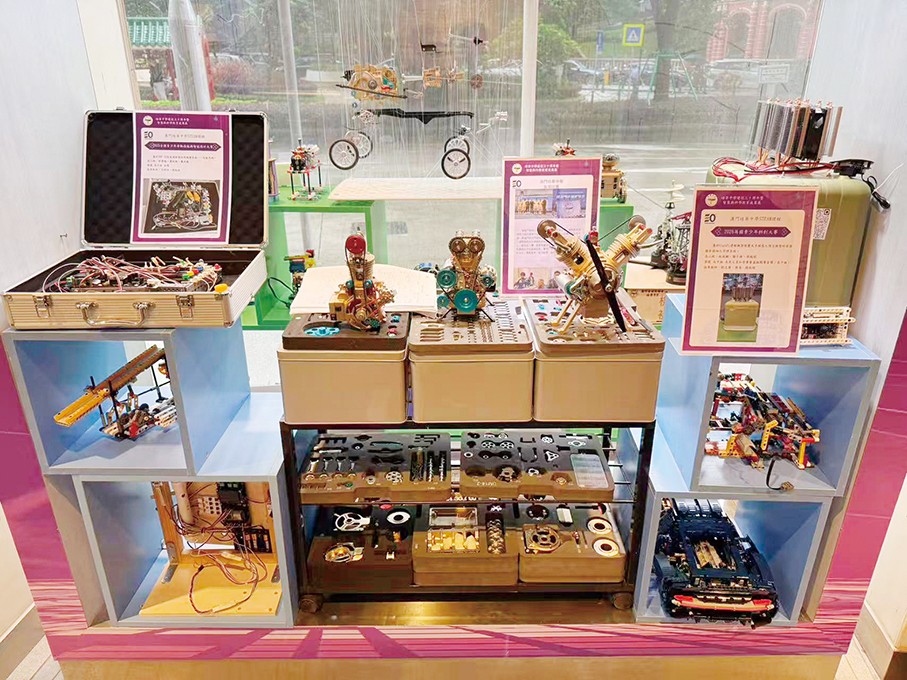


Pui Va Middle School is hosting a month-long exhibition at the Centre of Educational Resources’ Exhibition Gallery near S. Francisco Garden to celebrate its 30th anniversary and showcase the integration of artificial intelligence (AI) across its academic disciplines.
The exhibition concludes on August 24.
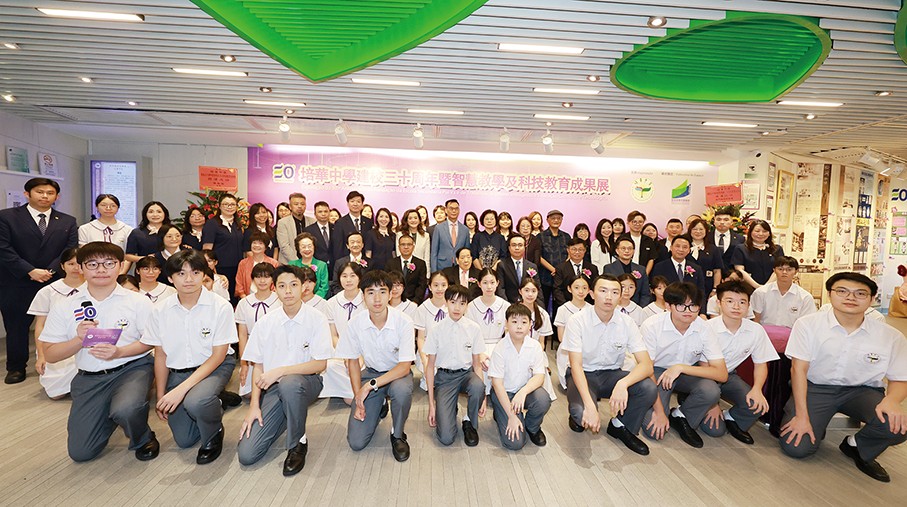
According to a statement released during the opening ceremony on July 17, the exhibition is themed “Pui Va – 30 Years: Setting Sail Once More”. The showcase highlights the school’s achievements in educational innovation, technology, and intelligent teaching, while tracing the growth trajectory of students’ technological and creative abilities from primary through to secondary school.
Lei Chao Lam, principal of Pui Va Middle School, told the Post that over the three decades since the school’s founding, he has maintained that education must be forward-looking – focused not solely on the present, but on the future. He noted that the institution adheres to a philosophy of “placing morality first, prioritising competence, and fostering all-round development”, with the goal of cultivating students who understand national conditions, love their country and community, and grow through engagement in diverse fields.
Lei also emphasised that all teachers should keep up with the times, adapting their mindsets and teaching methods to meet the challenges of the AI era. Using computers as a historical parallel, he explained that new technologies do not replace logical thinking but instead serve as cognitive aids. According to Lei, the school adopts a strict “student-centred” approach that encourages self-directed learning. In line with societal needs and national talent development goals, Pui Va is actively developing its AI literacy framework to ensure students remain competitive in a future society.
The school’s director, Chong Wai In, spoke about practical experiences regarding AI-assisted teaching. He pointed out that AI and Virtual Reality (VR) technologies effectively visualise abstract concepts, moving beyond the traditional, one-way “blackboard and chalk” approach. This allows students to engage in real-time interactive experiences, significantly enhancing learning motivation. Consequently, teachers have shifted from delivering isolated subjects to designing interdisciplinary tasks that require students to synthesise knowledge to solve real problems, such as analysing climate data and predicting trends.
Chong emphasised that AI supports teachers in scaffolding students’ learning, helping students develop critical thinking skills, assess the reliability of information, and identify algorithmic biases, thereby enhancing creative problem-solving abilities. He also talked about the growth journey of a student who progressed from creating basic mini-games to proactively enrolling in advanced AI courses. Another student went from disliking cleaning out the cat litter tray to designing an intelligent automated system. Chong noted that this technology-driven education cultivates empathy and self-awareness, enabling students to realise their own value by solving real-world challenges.
After visiting the exhibition, Mou Chi Him, the father of two Pui Va students, commended the school’s Information Technology curriculum for its effectiveness in equipping students with essential digital skills. He praised Pui Va for its commitment to whole-person development and for helping students cultivate a strong sense of purpose in the digital age, equipping them not only with technological skills but also with the ability to apply technology meaningfully to improve everyday life through extensive hands-on experiences.
Jiao Tong, president of the school’s Parent-Teacher Association, noted that the school avoids isolated, interest-based classes in favour of a long-term, phased curriculum. This starts with a STEAM* introduction at the primary level and progresses to AI career simulations in secondary school. Jiao added that his own child transformed from being passively curious to proactively solving problems, showing noticeable improvement in both logical thinking and practical skills.
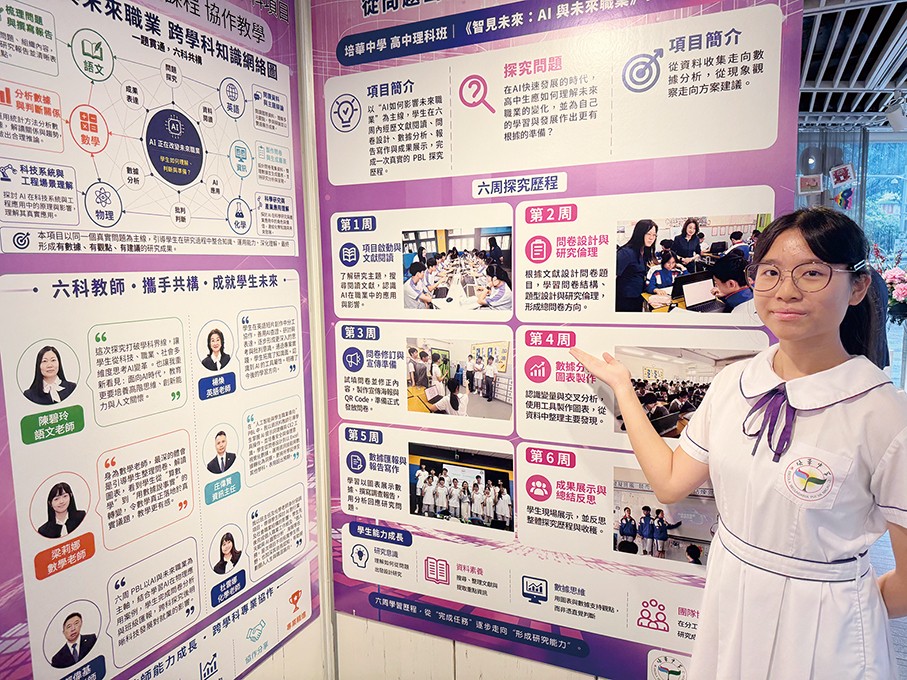
Form 4 student Chu Weng Cheng participated in the “AI and Future Careers” project, where she learnt how to verify AI-generated content, organise data, and work collaboratively with others, strengthening both her digital literacy and teamwork skills. This experience confirmed her ambition to pursue a career in AI. She expressed appreciation for the school’s diverse interdisciplinary projects, noting that they had broadened her horizons and enriched her learning experience.
* STEAM is an educational framework that integrates five core disciplines to encourage critical thinking, creativity, and interdisciplinary problem-solving: Science, Technology, Engineering, Arts, and Mathematics. An expansion of the traditional STEM model, STEAM adds the Arts – encompassing humanities, visual arts, design, music, and language arts – to foster innovation, creative design thinking, and communication alongside technical skills. – Gemini
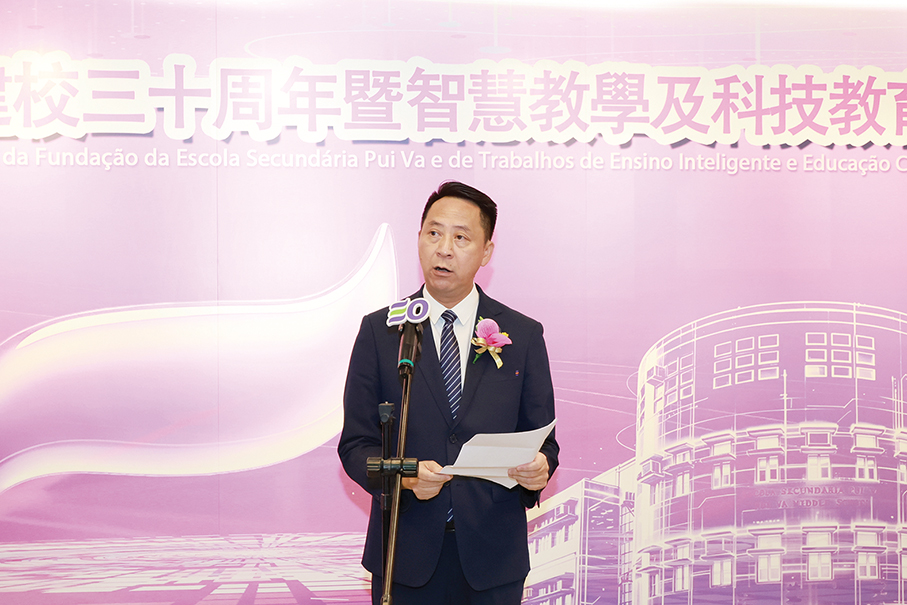
Pui Va Middle School Principal Lei Chao Lam addresses an opening ceremony on July 17 at the Centre of Educational Resources’ Exhibition Gallery opposite S. Francisco Garden. – Photos: Pui Va Middle School