

The 5th Fujian–Macao Cooperation Conference was held in the provincial capital of Fuzhou yesterday morning, the third day of Chief Executive Sam Hou Fai’s four-day working visit to the province. Sam, alongside Communist Party of China (CPC) Fujian Provincial Committee Secretary Zhou Zuyi and Fujian Governor Zhao Long, led their respective government delegations. Both sides agreed that Fujian–Macau cooperation is grounded in deep roots, rich achievements, and broad prospects. They stated that the two regions will move in tandem to open a new chapter featuring complementary strengths and shared development, according to a statement released by the Macao Government Information Bureau (GCS) yesterday.
During the conference, Sam noted that Fujian and Macau share deep historical ties, common cultural roots, and close people-to-people bonds. Since the establishment of the Fujian–Macao Cooperation Conference mechanism in 2016, four prior meetings have advanced collaboration into an institutionalised and regular phase. Under the central authorities’ guidance, Fujian–Macau cooperation has yielded fruitful results, Sam added.
Jointly supporting Mazu cultural activities
According to the statement, Sam highlighted that this conference marks the mechanism entering its second decade. Standing at a new starting point, both regions must consolidate existing achievements while seizing new opportunities. Across trade and investment, modern finance, innovation and technology, culture and education, and healthcare, Sam suggested promoting more practical cooperative projects, jointly supporting Mazu* cultural activities, and creating a new outlook for coordinated development.
Sam also gave a presentation on the planning and development opportunities for Macau and the Guangdong–Macao In-Depth Cooperation Zone in Hengqin during Macau’s 3rd Five-Year Plan (2026–2030). He noted expectations for Fujian and Macau to join forces for global expansion, leveraging Fujian as the core area of the 21st Century Maritime Silk Road, Macau’s role as a trade service platform between China and Portuguese-speaking countries, and Hengqin’s strategic “Macao + Hengqin” positioning.
BRI and GBA synergy
This synergy aims to connect the Belt and Road Initiative (BRI) with the development of the Guangdong–Hong Kong–Macao Greater Bay Area (GBA), supporting the nation’s high-level opening-up, Sam said.
According to the statement, Zhou noted that President Xi Jinping attaches great importance to Fujian–Macau exchanges, having issued key instructions on promoting mutually beneficial cooperation among the Chinese mainland, Hong Kong, and Macau.
Zhou also said that Fujian and Macau share linked cultural ties, deep historical connections, and close economic cooperation alongside frequent people-to-people exchanges. As this year marks the beginning of the nation’s 15th Five-Year Plan (2026–2030), Fujian remains committed to building a new provincial model characterised by dynamic mechanisms, superior industries, prosperous citizens, and a sustainable environment, Zhou underlined.
Zhou expressed hope that both sides would use the conference to build closer ties and write a new chapter of win-win development. Following the conference, both delegations signed several bilateral agreements across multiple sectors.
In addition to the conference, Sam met with Zhou and Zhao together yesterday morning, according to a separate GCS statement.
Sam expressed gratitude to Fujian Province for its long-standing support of Macau’s development. He noted that the Macau government will align its upcoming 3rd Five-Year Plan with the nation’s 15th Five-Year Plan, opening new opportunities for regional collaboration.
Sam pledged that Macau will advance its economic diversification and Hengqin’s high-quality development, adding that he expects more Fujian enterprises and individuals to share in these opportunities.
Zhou expressed gratitude to the Macau government for its care and support of the Fujian community in Macau. Highlighting the province’s development, Zhou noted that Fujian’s total economic output exceeded 6.0 trillion yuan last year, ranking eighth nationally. He also underscored Fujian’s status as a historic revolutionary site – having hosted the Party’s two Gutian Conferences – and its position as the nation’s leader in forest coverage rate for 47 consecutive years.
Furthermore, Zhou noted that Fujian is a frontier for the nation’s reform and opening up, with Xiamen City serving as a key strategic platform, and highlighted the province’s strong ties with overseas Chinese communities.
‘3820’ strategy
Yesterday afternoon, Sam visited the 30th Anniversary Achievement Exhibition for the “3820”** strategy project – Fuzhou’s 20-Year Economic and Social Development Strategic Vision – formulated under Xi’s leadership during his tenure as CPC Fuzhou Municipal Committee secretary in the 1990s.
The visit aimed to review the city’s development planning and explore practical mainland practices that Macau can incorporate into its own development philosophy, the statement said.
Afterwards, Sam and his delegation visited Guling (“Drum Mountain”) to review the strategic deployment of local eco-tourism. In the evening, Sam visited the Sanfang Qixiang (“Three Lanes and Seven Alleys”) Historic and Cultural Block to study successful urban renewal and historical preservation cases that Macau could reference.
Sam and his delegation, including Secretary for Economy and Finance Dora Ng Wai Han, are scheduled to return to Macau today.
* Mazu (also known as A-Ma or Tin Hau) was originally a 10th-century historical figure named Lin Moniang from Meizhou Island in Fujian. Following her death, she was deified as a sea goddess and patron protector of seafarers, fishermen, and maritime traders. Mazu is formally canonised within the Taoist pantheon as the Queen of Heaven (Tin Hau) and is simultaneously revered in Chinese Buddhism. Mazu is foundational to Macau’s culture and identity. The A-Ma Temple—built in 1488 before the arrival of the Portuguese—is dedicated to her. Legend has it that the name “Macau” derives from A-Ma-Gok (“Pavilion of Mazu”). – Gemini, MPD
** The “3820” Strategic Scheme (3820战略工程) is a long-term urban, economic, and social development blueprint formulated in 1992 for Fuzhou, the provincial capital of Fujian. Initiated under the leadership of Xi Jinping during his tenure as Secretary of the CPC Fuzhou Municipal Committee (1990–1996), it established a structured, phased master plan designed to transform Fuzhou into a modernized international metropolis. The numbers stand for the 3-year, 8-year, and 20-year goals for economic and social modernisation. – Gemini
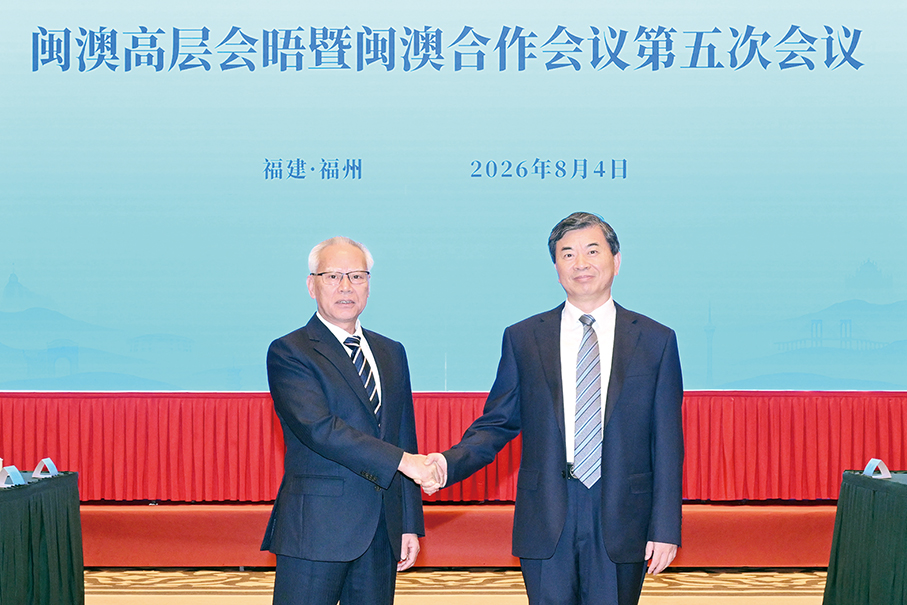
Chief Executive Sam Hou Fai (left) shakes hands with Communist Party of China (CPC) Fujian Provincial Committee Secretary Zhou Zuyi on the sidelines of yesterday’s 5th Fujian-Macao Cooperation Conference in Fuzhou. – Photo: GCS
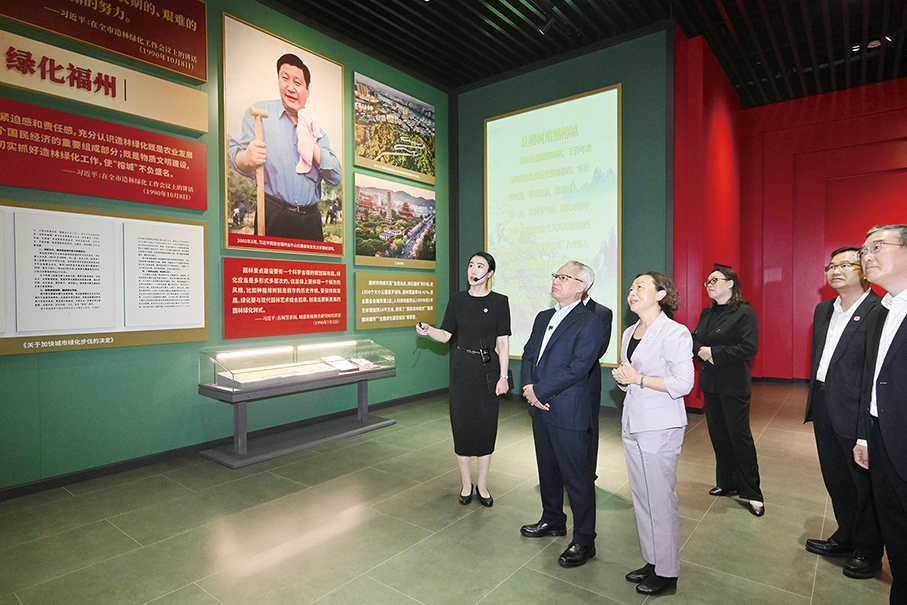
Chief Executive Sam Hou Fai (front, second from left) yesterday visits the 30th Anniversary Achievement Exhibition for the “3820” strategy project – Fuzhou’s 20-Year Economic and Social Development Strategic Vision. – Photo: GCS