

The Macau government announced yesterday that from today Macau residents returning from the Chinese mainland to Macau can choose to present their Home Return Permits when using e-channels at the three Macau-mainland joint checkpoints – the Macau-Zhuhai checkpoint of the Hong Kong-Zhuhai-Macao Bridge (HZMB), the Hengqin checkpoint, and the Qingmao checkpoint.
Nevertheless, they can choose to continue presenting their Macau ID cards (BIR).
The new measure to be implemented at the three checkpoints from today was announced in a joint statement by the Public Security Police Force (PSP) and the Macao Public Security Forces Affairs Bureau (DSFSM) yesterday.
Previously, Macau residents returning from the mainland to Macau were required to present their Macau ID cards when using e-channels at the three joint checkpoints.
Under the new measure, which starts today, Macau residents, when either travelling to the mainland or returning to Macau, can present their Home Return Permits when using e-channels at the three checkpoints.
A Home Return Permit is a card-sized travel document for Hong Kong residents or Macau residents to travel to and stay in the mainland. The document, issued by the Chinese mainland authorities, is officially known as the Mainland Travel Permit for Hong Kong and Macao Residents.
Three of Macau’s land border checkpoints with Zhuhai are Macau-mainland joint checkpoints, where the “joint inspection and one-time release” system is operating, namely the HZMB Macau-Zhuhai checkpoint, the Hengqin checkpoint, and the Qingmao checkpoint.
While the Hengqin checkpoint and the Qingmao checkpoint operate 24/7, the HZMB Macau-Zhuhai checkpoint opens between 8:00 a.m. and 10:00 p.m. Qingmao is a land border checkpoint for pedestrians only.
The “joint inspection and one-time release” model is a joint Macau Special Administrative Region (MSAR)-Chinese mainland immigration clearance system adopted at Macau-mainland joint checkpoints where border crossers are required to pass border controls only once when completing their departure and arrival formalities.
Before today, Macau residents using the three joint checkpoints’ e-channels were required to present different documents depending on the direction of their travel. When travelling from Macau to the mainland, they had to present their Home Return Permits. When returning to Macau from the mainland, they were required to present their Macau ID cards.
Yesterday’s PSP-DSFSM joint statement said that from today Macau residents can pass through the three joint checkpoints’ e-channels by presenting their Home Return Permits in either direction: travelling to the mainland or returning to Macau.
Consequently, Macau residents travelling to the mainland are, as previously, required to present their Home Return Permits. Conversely, Macau residents returning to Macau can now choose to present either their Macau ID cards (as previously) or their Home Return Permits (under the new measure).
The new measure also applies to the Hengqin joint checkpoint’s vehicle inspection channels, where the “joint inspection and one-time release” system is operating.
According to the statement, the new measure also applies to Hong Kong permanent residents. Specifically, when travelling from Macau to the mainland, they are now, as previously, required to present their Home Return Permits. Conversely, when travelling from the mainland to Macau, they can now choose to present either their Hong Kong ID cards (as previously) or their Home Return Permits (under the new measure).
The new measure also applies to non-Chinese nationals holding a Home Return Permit equivalent. Their version of this travel document is officially known as the Mainland Travel Permit for Hong Kong and Macao Residents (Non-Chinese Citizens).
Since earlier this year, eligible border crossers have been able to register to use a new function enabling them to use the three joint checkpoints’ e-channels without having to present their travel documents. Under this function, they do not have to have their travel documents scanned. Instead, they are only required to pass fingerprint scans and facial recognition.
Speaking to the Post over the phone yesterday, a PSP spokesperson noted that the new measure commencing today effectively benefits those who choose to continue presenting their travel documents instead of using the document-free function.
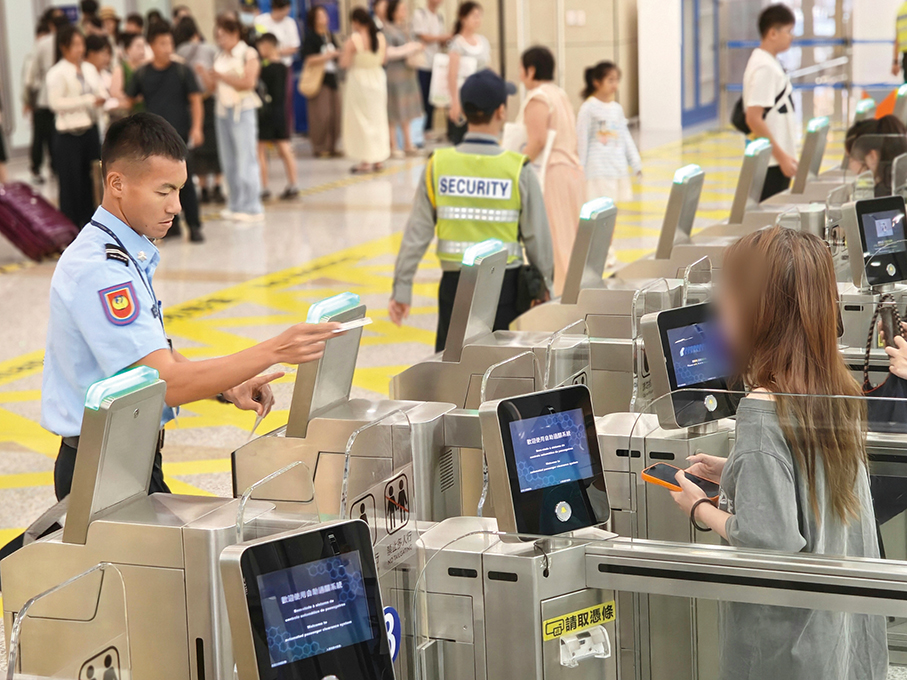
This undated handout photo released yesterday shows border crossers using e-channels at the Qingmao joint checkpoint. – Photo: PSP/DSFSM