

The local government yesterday announced and published the final version of Macau’s 3rd Five-Year Plan.
Addressing a one-hour press conference yesterday afternoon, Chief Executive Sam Hou Fai stressed the government’s commitment to advancing the implementation of the plan in four major aspects: promoting Macau’s appropriate economic diversification with its four future large-scale projects as key drivers, advancing Hengqin’s development, accelerating Macau’s urban renewal, and better integrating Macau’s development into the nation’s development.
The chief executive also described the commencement of the implementation of the 3rd Five-Year Plan as “a major event” this year for the local government and Macau’s civil society as well. For the next step, he said, the government will draft details aiming to ensure that all major tasks and targets listed by the 3rd Five-Year Plan will be implemented as scheduled.
The government held a 40-day public consultation between May 20 and June 28 on its drafting of Macau’s 3rd Five-Year Plan. Afterwards, the government assessed the opinions gathered during the consultation period and incorporated them into the plan’s final version, which was published yesterday.
Yesterday’s press conference was held at Government Headquarters. Chaired by Sam, it was also attended by his five policy secretaries and Policy Research and Regional Development Bureau (DSEPDR) Director Cheong Chok Man. The bureau is the public entity tasked with the drafting of Macau’s 3rd Five-Year Plan.
The plan’s final version, available in Chinese and Portuguese, can be downloaded from the bureau’s website on the plan (https://www.dsepdr.gov.mo/zh-hant/event/plan3/plan3).
The Macao Special Administrative Region’s (MSAR) 3rd Five-Year Plan, officially known as the 3rd Five-Year Plan for Economic and Social Development, covers the period between 2026 and 2030. The Macau government has underlined its commitment to aligning Macau’s third five-year socioeconomic development plan with the nation’s 15th Five-Year Plan (2026-2030), the full version of which was published by the Central People’s Government in March this year.
During the press conference, Sam said that the 3rd Five-Year Plan is a blueprint that reflects scientific rigour, has a forward-looking vision, and is practical in terms of feasibility, underlining that the plan aims to put into practice the spirit of President Xi Jinping’s various important speeches and instructions concerning Macau’s development.
3 key lists
For the next step, Sam said, the government will draft three key lists aiming to ensure that all major tasks and targets listed by the 3rd Five-Year Plan will be implemented as scheduled: a list of key projects, a list of key tasks with clearly defined and assigned responsibilities, and a list of major reform initiatives.
Strength of executive-led governance
Sam said that the 3rd Five-Year Plan also highlights the strengths of Macau’s executive-led governance system. Throughout the plan’s drafting process, there was close coordination and efficient collaboration among all respective public entities, while the legislative and judicial organs also offered their respective feedback to the government, demonstrating Macau’s institutional advantage of distinct yet coordinated roles among the executive, legislative, and judicial organs, he said.
Sam also said that the 3rd Five-Year Plan is a strategic document that underscores Macau’s commitment to integrating itself into and making greater contributions to the nation’s overall development. The nation’s 15th Five-Year Plan sets new requirements and provides fresh development opportunities for Macau, he said, pledging that the Macau government will ensure the implementation of the measures outlined by the nation’s 15th Five-Year Plan concerning Macau, while aligning with the respective development plans of Guangdong Province and Hong Kong.
The 3rd Five-Year Plan represents a significant innovative step in deepening Macau’s implementation of the “One Country, Two Systems” principle and its alignment with the nation’s overall development, Sam said.
Broad public consensus
Sam also said that the final version of the 3rd Five-Year Plan is a product of democratic consultation and broad public consensus. During the 40-day public consultation, residents from various segments of civil society offered constructive opinions, which were extensively incorporated into the plan’s final version, he said.
4 major implementation aspects
For the implementation of the 3rd Five-Year Plan, Sam said, the government will place strong emphasis on four major aspects.
The first is to advance Macau’s appropriate economic diversification with its four future large-scale projects and a government guidance fund as key drivers. Sam said that the government will strengthen policy support and capital injection, and leverage market forces and enterprise-based initiatives, aiming for the value added of all non-gaming sectors to account for around 60 percent of Macau’s gross domestic product (GDP) in 2030 – an increase from 56.7 percent in 2024.
The second is to deepen Macau-Hengqin integration and advance Hengqin’s high-quality development, Sam said, pledging Macau’s commitment to strengthening the alignment of rules and mechanisms between Macau and Hengqin and enhancing the infrastructure connectivity between the two places. He also underlined his government’s efforts to enable Hengqin’s development to deliver tangible results to Macau’s appropriate economic diversification.
The third is to accelerate Macau’s urban renewal, Sam said, underlining that the government will adopt innovative thinking and bold actions to speed up urban renewal. The government will propose improvements to the legal system for urban renewal, facilitate better coordination of funding, resources, and policy support for urban renewal, and establish a sustainable urban renewal mechanism.
Sam said that the government will advance the conservation-led revitalisation of the area around the UNESCO World Heritage-listed Ruins of St. Paul’s landmark, while accelerating the redevelopment of dilapidated buildings in districts such as Iao Hon.
The fourth is to better integrate Macau’s development into the nation’s development. Sam said that Macau will leverage its unique advantages brought about by the backing of the motherland and its connection to the world, underlining its extensive participation in the development of the Guangdong-Hong Kong-Macao Greater Bay Area (GBA) and commitment to strengthening cooperation with Hong Kong.
Sam also reaffirmed Macau’s efforts to expand the functions and scope of its service platform role serving China and Portuguese- and Spanish-speaking countries.

Chief Executive Sam Hou Fai (centre) addresses yesterday’s press conference about Macau’s 3rd Five-Year Plan at Government Headquarters as other officials look on, comprising (from left to right) Secretary for Transport and Public Works Raymond Tam Vai Man, Secretary for Security Chan Tsz King, Secretary for Administration and Justice Wong Sio Chak, Secretary for Economy and Finance Dora Ng Wai Han, Secretary for Social Affairs and Culture Wallis O Lam, and Policy Research and Regional Development Bureau (DSEPDR) Director Cheong Chok Man. – Photo: Tony Wong
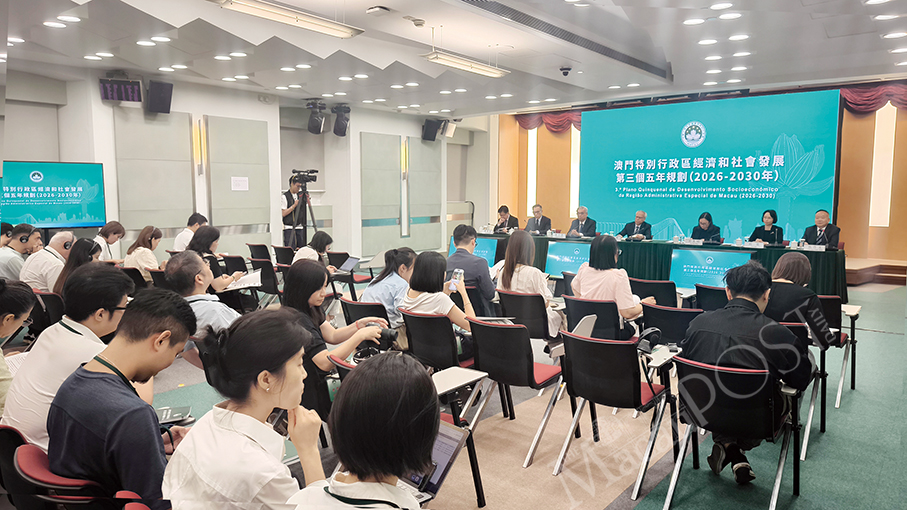
Media workers attend yesterday’s press conference at Government Headquarters on Avenida da Praia Grande in Nam Van. – Photo: Tony Wong