

Organised by Macau Temple Civilisation, the first “2026 World Na Tcha Folk Belief Culture Festival” will take place from September 15 to 18.
The group held a press conference yesterday at the Macao Taoist Association headquarters on Avenida do Almirante Lacerda (提督馬路).
According to a statement released by the group yesterday, the festival – funded by the Cultural Development Fund and co-organised by the city’s two Na Tcha Temple associations, based near the Ruins of St Paul’s and Calçada das Verdades respectively – plans to host around 200 visiting guests from Fujian, Sichuan, Zhejiang, Hong Kong, and China’s Taiwan region, as well as Malaysia, Singapore, and Thailand.
The festival aims to promote fine traditional Chinese culture while fostering the preservation, transmission, and exchange of Na Tcha beliefs and customs, the statement said. It added that, following its inscription on the National List of Intangible Cultural Heritage in 2014, Macao’s Na Tcha folk beliefs will be highlighted through exhibitions, seminars, parades, and blessing ceremonies to showcase the tradition’s historical evolution and cultural depth.
An exhibition and the “Na Tcha Folk Beliefs Seminar” will be held at Barra Kitchen next Tuesday, according to the statement. Featured speakers include Lam Fat Iam, president of the Oral History Association of Macao, representatives from the Na Tcha ancestral shrine in Sichuan, scholars from Taiwan region, and temple delegates from several foreign countries.
The statement also noted that a joint parade will depart at 11:00 a.m. next Wednesday from the Ruins of St Paul and proceed to Largo do Senado. A grand blessing ceremony will follow at Barra Kitchen at 5:00 p.m.
The organisers hope the festival will enhance cross-regional cultural exchange and deepen public appreciation for the continuity and development of this intangible cultural heritage within the local Macau community, the statement said.
According to DeepSeek, Nezha (known in Cantonese as Na Tcha) is one of Chinese mythology’s most beloved and rebellious deities, a figure whose story blends Daoist, Buddhist, and Confucian traditions. He is often depicted as a powerful, childlike god who fights evil and is a patron of children.
Na Tcha’s origins lie in Buddhism, where he was the son of a Heavenly King and a fierce guardian of the Dharma (Natural Law). His name is derived from the Sanskrit Nalakubala. Over centuries in China, his story was adapted and absorbed into the Daoist and folk pantheon. The pivotal transformation happened in the novel (封神演义) (The Investiture of the Gods), which established his iconic Chinese identity.
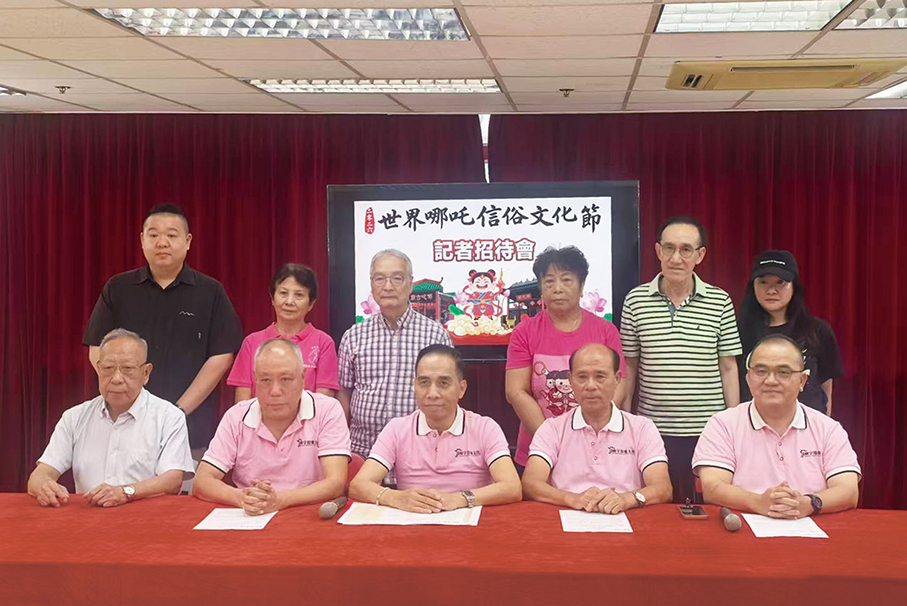
Macau Temple Civilisation Vice-President Fong Kin Fu (front row, centre), Chairman Ip Tat (front row, second from right) and other representatives pose during yesterday press conference at the headquarters of the Macao Taoist Association on Avenida do Almirante Lacerda about next week’s Na Tcha culture-fest. – Photo courtesy of Macau Temple Civilisation