

Chief Executive Sam Hou Fai announced during a meeting on Monday that a detailed work plan for Chi Lam Vai’s revitalisation has been formulated.
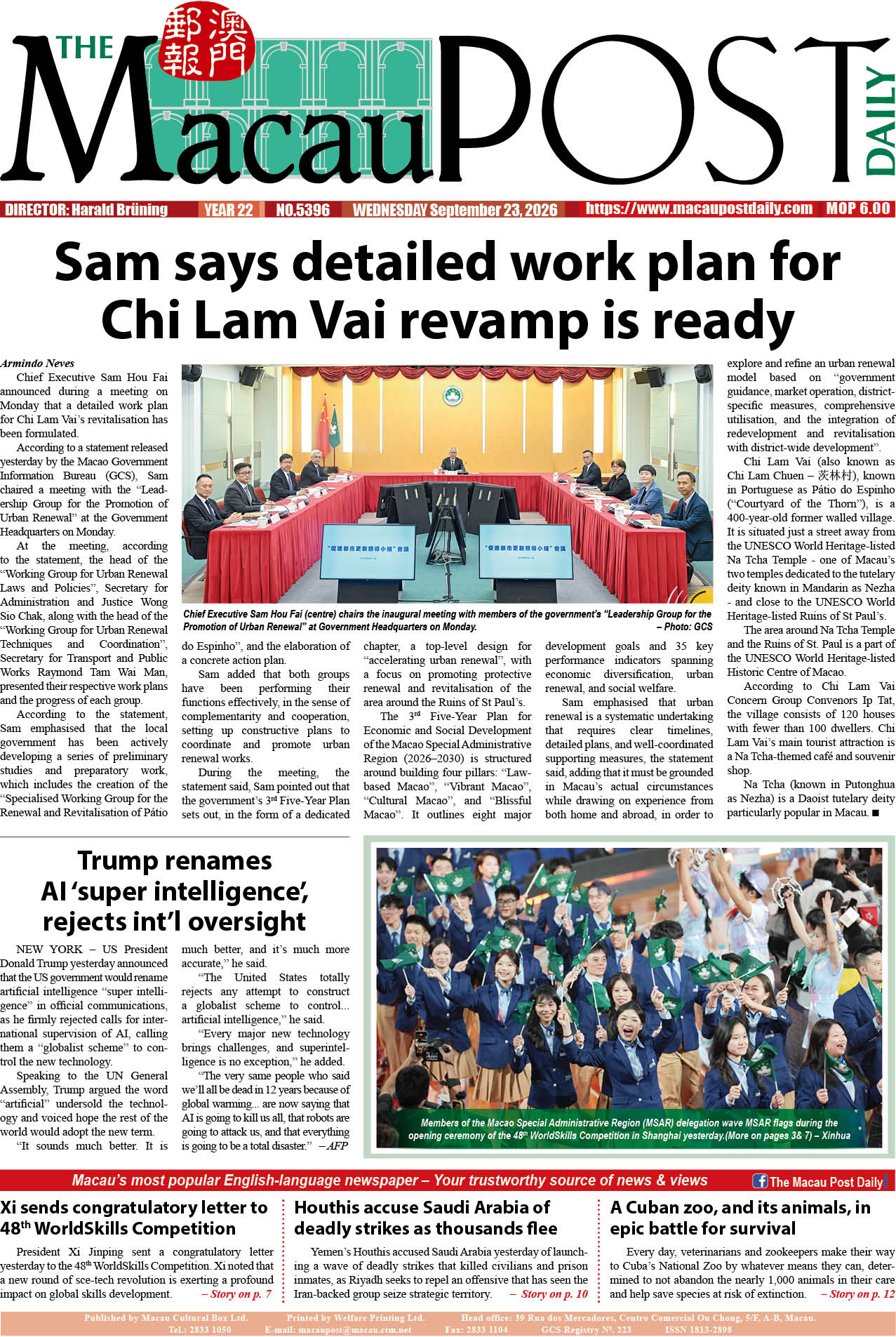
According to a statement released yesterday by the Macao Government Information Bureau (GCS), Sam chaired a meeting with the “Leadership Group for the Promotion of Urban Renewal” at the Government Headquarters on Monday.
At the meeting, according to the statement, the head of the “Working Group for Urban Renewal Laws and Policies”, Secretary for Administration and Justice Wong Sio Chak, along with the head of the “Working Group for Urban Renewal Techniques and Coordination”, Secretary for Transport and Public Works Raymond Tam Wai Man, presented their respective work plans and the progress of each group.
According to the statement, Sam emphasised that the local government has been actively developing a series of preliminary studies and preparatory work, which includes the creation of the “Specialised Working Group for the Renewal and Revitalisation of Pátio do Espinho”, and the elaboration of a concrete action plan.
Sam added that both groups have been performing their functions effectively, in the sense of complementarity and cooperation, setting up constructive plans to coordinate and promote urban renewal works.
During the meeting, the statement said, Sam pointed out that the government’s 3rd Five-Year Plan sets out, in the form of a dedicated chapter, a top-level design for “accelerating urban renewal”, with a focus on promoting protective renewal and revitalisation of the area around the Ruins of St Paul’s.
The 3rd Five-Year Plan for Economic and Social Development of the Macao Special Administrative Region (2026–2030) is structured around building four pillars: “Law-based Macao”, “Vibrant Macao”, “Cultural Macao”, and “Blissful Macao”. It outlines eight major development goals and 35 key performance indicators spanning economic diversification, urban renewal, and social welfare.
Sam emphasised that urban renewal is a systematic undertaking that requires clear timelines, detailed plans, and well-coordinated supporting measures, the statement said, adding that it must be grounded in Macau’s actual circumstances while drawing on experience from both home and abroad, in order to explore and refine an urban renewal model based on “government guidance, market operation, district-specific measures, comprehensive utilisation, and the integration of redevelopment and revitalisation with district-wide development”.
Chi Lam Vai (also known as Chi Lam Chuen – 늙주닷), known in Portuguese as Pátio do Espinho (“Courtyard of the Thorn”), is a 400-year-old former walled village. It is situated just a street away from the UNESCO World Heritage-listed Na Tcha Temple - one of Macau’s two temples dedicated to the tutelary deity known in Mandarin as Nezha - and close to the UNESCO World Heritage-listed Ruins of St Paul’s.
The area around Na Tcha Temple and the St Paul’s Ruins is a part of the UNESCO World Heritage-listed Historic Centre of Macao.
According to Chi Lam Vai Concern Group Convenors Ip Tat, the village consists of 120 houses with fewer than 100 dwellers. Chi Lam Vai’s main tourist attraction is a Na Tcha-themed café and souvenir shop.
Na Tcha (known in Putonghua as Nezha) is a Daoist tutelary deity particularly popular in Macau.
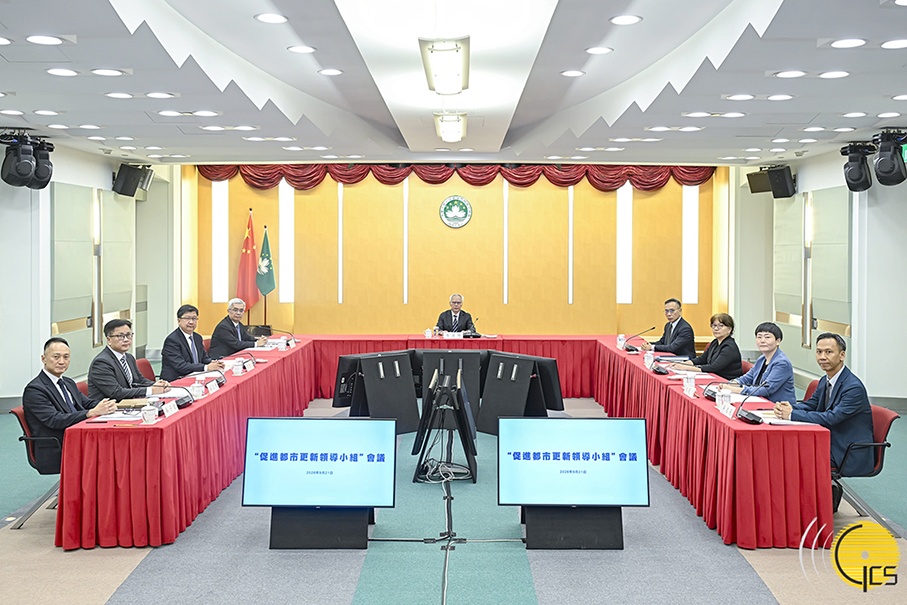
Chief Executive Sam Hou Fai (centre) chairs the inaugural meeting with members of the government’s “Leadership Group for the Promotion of Urban Renewal” at Government Headquarters on Monday. – Photo: GCS