


Giacomo Puccini’s (1858-1924) opera “Turandot”* will return to Macau with a new production directed by Hong Kong star Fang Shilong, known professionally as Jackie Chan, combining Italian opera with Chinese martial arts and modern visual effects to mark the centenary of the opera’s premiere in 1926.
At a meet-and-greet with the production team at the Macao Cultural Centre (CCM) in Nape yesterday, the creators discussed how the centenary production introduces Chinese martial arts into the dramatic language of Puccini’s final opera.
According to the CCM website, Jackie Chan makes his operatic directorial debut with the production, which pairs each principal character with a combative alter ego to express unspoken thoughts and emotions through movement. Modern multimedia effects and water-themed visuals further shape the staging.
Producer and Artistic Director Tian Hui said the production sought to connect the classic opera with contemporary audiences while incorporating Chinese cultural elements. She highlighted the use of martial arts not merely as action choreography, but as a means of adding depth to the characters.
Conductor Carlo Montanaro, who has conducted the opera more than 120 times, described the local production as particularly special because of Jackie Chan’s involvement and its martial arts choreography. “In my business, we are lucky because we speak an international language, which is music,” Montanaro said, adding that each interpretation brought something new to the opera.
The production features soprano Ewa Płonka as Princess Turandot and tenor Marco Berti as Calaf, accompanied by the Nuova Orchestra Scarlatti and Coro dell’Opera di Parma, according to the website.
Organised by the Cultural Affairs Bureau as part of the 38th Macao International Music Festival (MIMF), Turandot will be staged at the CCM’s Grand Auditorium this coming weekend at 7:30 p.m. on both days. The opera will be performed in Italian with Chinese and English subtitles.
** Turandot is Giacomo Puccini’s final opera, left unfinished at his death in 1924 and completed by Franco Alfano. Set in a mythical, legendary China, it tells the story of a ruthless, icy princess who challenges her suitors with three riddles - executing any prince who fails to answer them correctly. The name Turandot derives from the Persian name Tūrāndokht, composed of two parts: Tūrān: A historical Persian region encompassing lands north of the Oxus River (modern-day Central Asia/Turkestan). Dokht: A Persian word meaning “daughter” or “girl”. Literal Meaning: “Daughter of Turan” or “Turanian Princess.” - Gemini
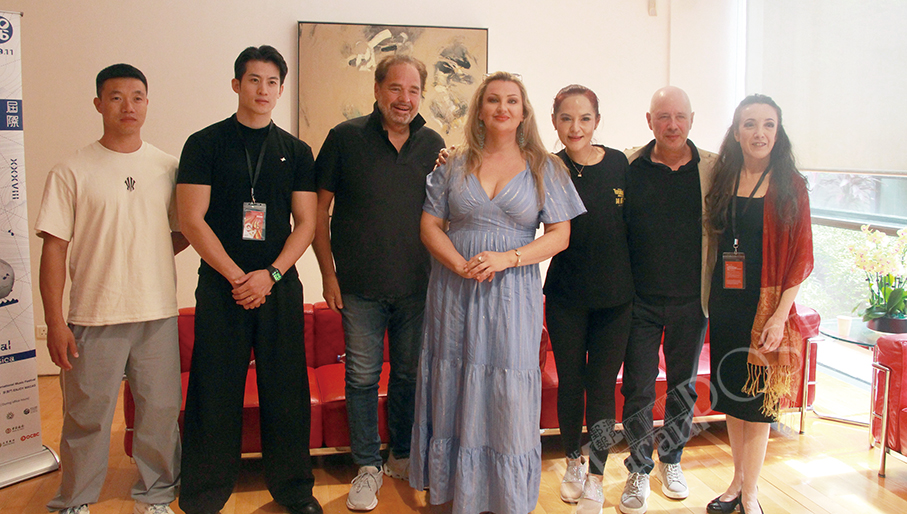
Members of the Turandot production team (from left to right) Martial Arts Choreographers Zhao Zan and Zhang Feng, Marco Berti (tenor, in the role of Calaf), Ewa Płonka (soprano, in the role of Turandot), Producer and Artistic Director Tian Hui, Conductor Carlo Montanaro , and Associate Director Luisa Baldinetti – pose for a group photo during yesterday’s meet-and-greet session at the CCM in Nape. – Photo: Khalel Vallo

This poster downloaded from the Macao Cultural Centre (CCM) website yesterday promotes this weekend’s “Turandot” performance.