

Chief Executive Sam Hou Fai yesterday pledged the local government’s commitment to ensuring the stable, healthy, and orderly development of Macau’s gaming and tourism industry, enabling Macau to buy “breathing room” for its ongoing efforts to diversify its economic structure.
Sam also reaffirmed that the government believed that its forecast for this year’s gross gaming revenue (GGR) of 236 billion patacas could be met.
Sam made the remarks during a Q&A session in the legislature’s hemicycle yesterday afternoon. The chief executive attended the four-hour session – which was held a day after he delivered his 1.5-hour 2027 Policy Address on Monday – to answer questions from 32 lawmakers in the 33-member Legislative Assembly (AL) chaired by André Cheong Weng Chon.
As is customary, the speaker of the legislature refrains from actively taking part in his peers’ Q&A session, merely overseeing it.
Sam was asked by several legislators yesterday about Macau’s downward trend in its economic performance, its year-on-year declines in monthly GGR, and the sustainability of its public finances in meeting the government’s large annual expenditure.
When drafting its 2026 budget bill late last year, the local government expected Macau’s GGR to reach 236 billion patacas (a monthly average of 19.67 billion patacas) in 2026.
Macau’s monthly GGR saw a year-on-year decrease for five consecutive months: 12.1 percent in June, 8.4 percent in July, 1.2 percent in August, 1.2 percent in September, and 10.0 percent in October. In the first 10 months of this year, GGR rose by 1.6 percent year-on-year to 208.796 billion patacas – representing a monthly average of 20.88 billion patacas.
Since January, accumulated GGR growth has fallen from this year’s high of 24.0 percent year-on-year to its lowest rate last month.
During yesterday’s Q&A session, Sam said that despite a year-on-year decrease in monthly GGR for five consecutive months between June and October, GGR in the first 10 months of this year amounted to 208.8 billion patacas, leaving just 27.2 billion patacas to be generated to meet the predicted figure. Consequently, Sam said, the government believed that its forecast for this year’s GGR of 236 billion patacas could be met. In his 2027 Policy Address presented on Monday, Sam said that the government would seek to maintain growth in Macau’s gross domestic product (GDP) next year amid downward pressure.
Citing official statistics, Sam noted during yesterday’s Q&A session that Macau’s GDP grew 7.1 percent year-on-year in the first quarter of this year, 0.3 percent in the second quarter, and 0.1 percent in the third quarter, with economic output rising 2.9 percent year-on-year in the first three quarters.
Linkage between GDP and GGR downward trends
Sam acknowledged that the large downward trend in year-on-year quarterly GDP growth was consistent with the downward trend in monthly GGR. Sam also said that Macau’s GDP performance in the third quarter was better than the government had expected, as it had initially projected negative year-on-year growth. He said that despite negative year-on-year growth of 4.7 percent in exports of gaming services in the third quarter, Macau’s GDP managed to achieve positive year-on-year growth of 0.1 percent in the quarter thanks to 6.8 percent growth in exports of other tourism services.
Sam underlined that the year-on-year decrease in monthly GGR over the past few months was due to two major reasons: changes in the external economic situation and changes in visitors’ consumption attitudes and patterns.
Sam said that the ongoing adjustments in the gaming industry have nothing to do with the implementation of the revised gaming law, including the official ban on so-called “satellite casinos” operated by third-party enterprises – informally known as junkets – in collaboration with gaming concessionaires.
Sam noted that following the government’s announcement in June last year regarding the closure of the city’s then 11 satellite casinos, the matter was handled step-by-step with minimal impact on the gaming industry.
The last satellite casino closed for good at the end of December. Sam said that following the closure of the satellite casinos, the gaming sector continued to “maintain a stable and healthy development” in the first five months of this year by recording positive year-on-year GGR growth during the period.
‘1+4’ offers ‘promising prospects’
Sam said that the current challenges Macau’s economy is facing highlighted the need for the government to advance appropriate economic diversification in compliance with its “1+4” model: consolidating and diversifying the development of the city’s tourism and leisure industry, i.e., the “1” element, while putting special emphasis on promoting the development of four new key industries, i.e., the additional “4” elements, namely (+1) big health mainly driven by traditional Chinese medicine (TCM), (+2) modern finance, (+3) high-tech, and (+4) MICE and commerce as well as culture and sports.
Sam underlined that the “1+4” development initiative will give Macau promising prospects for its sustainable economic development in the long term.
In terms of tourism, Sam said, the Macau government plans to launch a new promotional model to attract more foreign visitors, according to which it will use Portugal as a hub to radiate northwards to France, expand eastwards to Spain, and promote to other European markets such as Italy.
Sam noted that despite a year-on-year increase of just 3.4 percent in the number of foreign visitors to Macau during the first three quarters of this year, the number of visitor arrivals from European countries rose over 30 percent year-on-year during the period – which was “very good news”, he said. Regarding the big health industry, Sam noted that Macau already has a solid foundation, featuring several state key laboratories.
Scientific research achievements
Thanks to collaboration initiatives with Hengqin, the University of Macau (UM), and the Macau University of Science and Technology (MUST), various scientific research achievements have been translated into commercialised traditional Chinese medicine (TCM) products. Macau will continue to deepen the “Macao Registration + Hengqin Production” model for TCM products, he said.
For modern finance, Sam said, numerous new fund companies have been approved after the Investment Funds Law took effect early this year, bringing the current total number to 11, with another 20 awaiting approval, while the total scale of Macau’s bond market stands at 1.1 trillion patacas.
As for high-tech, Sam said, over 10 enterprises running their offices at the Macao International Technology Industry Centre are operating in synergy with Hengqin. The Macau government will also collaborate with the Beijing-based ZGC Group to advance the construction and development of the future Macao Science and Technology Research and Development Industrial Park, he said.
Sam underlined the need for Macau to leverage the stable, healthy, and orderly development of its gaming and tourism industry to gradually advance appropriate economic diversification and seize development opportunities in Hengqin.
Sam called for a study on the feasibility of broadening Macau’s tax base to enhance and resilience and sustainability of its public finances, with the aim of better safeguarding residents’ social welfare.
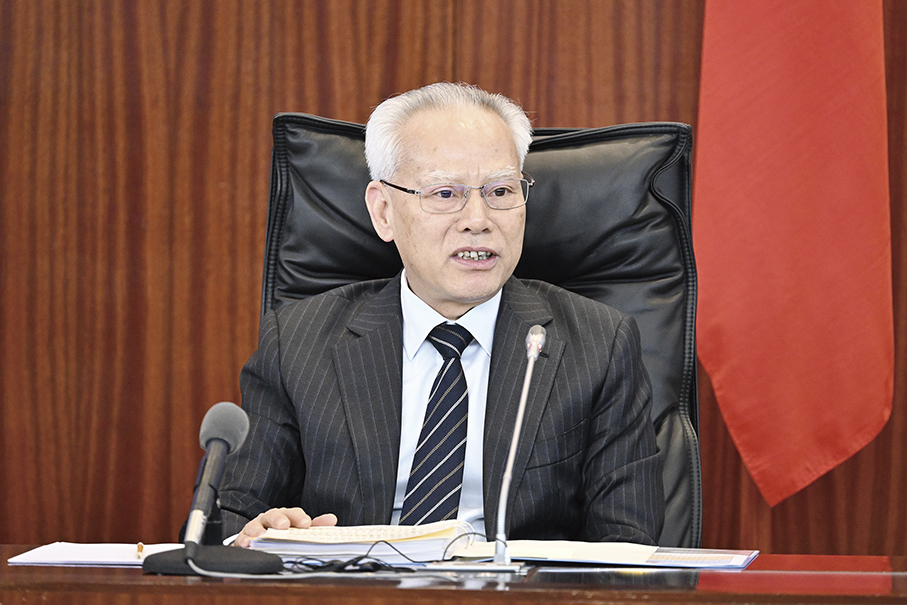
Chief Executive Sam Hou Fai answers questions from lawmakers during yesterday’s Q&A session about his 2027 Policy Address in the Legislative Assembly’s (AL) hemicycle. – Photo: GCS
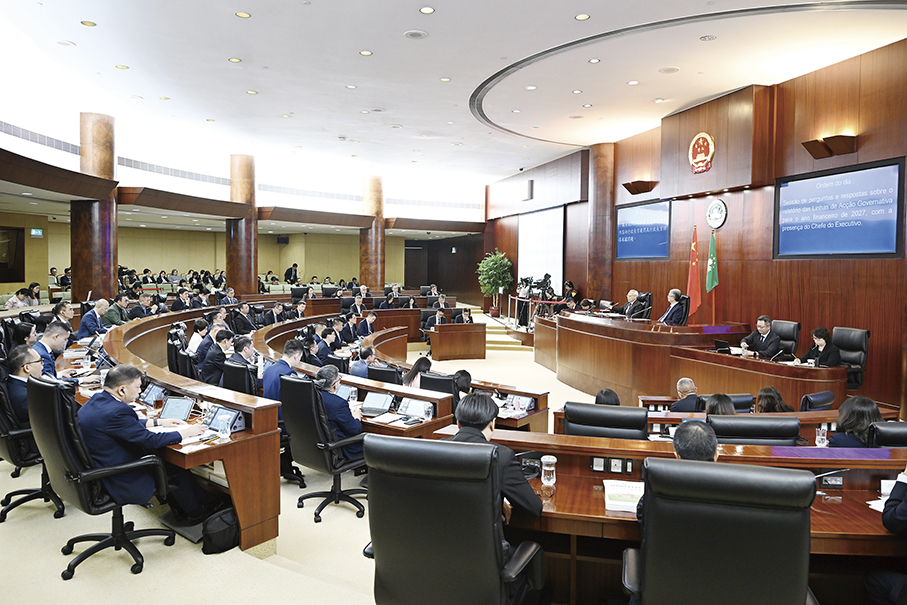
Legislators attend yesterday’s Q&A session in the legislature’s hemicycle. – Photo: GCS