


To align with the Macau government’s childbearing support policies and address infertility challenges faced by some local families, the Macao Union Hospital began accepting local infertile couples referred by the Health Bureau (SSM) for evaluation services in February 2025. As the hospital’s operations have continued to expand and its technical achievements have grown increasingly prominent, it has served numerous local families struggling with infertility. Through various assisted reproductive technologies (ART) – including ovulation induction medication, hysteroscopic and laparoscopic surgeries, artificial insemination, and in vitro fertilisation (IVF) – the hospital has welcomed numerous healthy newborns, marking the increasing maturity of Macau’s public assisted reproductive healthcare services, the hospital said in a statement yesterday.
The large-scale healthcare complex in south Cotai is officially known as Islands Healthcare Complex – Macao Medical Centre of Peking Union Medical College Hospital (CMM-PUMCH). It is jointly operated by the internationally renowned Peking Union Medical College Hospital (PUMCH) in Beijing and the Macau government, thanks to the Central People’s Government’s support.
“Islands” is the official term referring to Taipa, Coloane and Cotai.
For short, the large-scale public healthcare facility is officially known as Macao Union Medical Centre or Macao Union Hospital.
Yesterday’s statement said that since launching the ART services, the hospital has completed evaluations and screenings for over 500 infertile couples. Clinical data from the patient cohort indicates an average duration of infertility of 4.5 years, with the longest reaching 15 years. The average age is 36 for female patients and 39 for male patients, placing them in an advanced maternal/paternal age group where conceiving is relatively more difficult.
The statement said that the primary causes of infertility are concentrated in endometriosis, accounting for 40 percent, followed by ovulatory dysfunction at 30 percent. Tubal factor infertility accounts for 20 percent, while other unexplained infertility makes up the remaining 10 percent.
Notably, 45 percent of the cases also involve varying degrees of male factor issues, such as low sperm count, poor motility, and abnormal morphology, as well as male sexual dysfunction.
The statement said that the hospital has gradually introduced a range of assisted reproductive technologies. In July 2025, it began offering intrauterine insemination (IUI) services. As of October this year, 133 clinical cases have been completed, achieving a clinical pregnancy rate of 10 per cent. The first patient to conceive via IUI gave birth to a healthy baby in July 2026.
Simultaneously, advanced assisted reproductive technologies have been implemented with tangible results. In October 2025, the hospital launched in vitro fertilisation (IVF) and intracytoplasmic sperm injection (ICSI) procedures, addressing a major gap in local public assisted reproductive healthcare. To date, over 200 oocyte (egg) retrieval procedures have been performed. Stratified by age, the clinical pregnancy rates are 13.6 per cent for patients aged 40 and above, 30.2 per cent for those aged 35 to 39, and 56.3 per cent for those under 35, yielding an overall clinical pregnancy rate of 27.5 per cent.
Furthermore, the statement said, the hospital has cryopreserved over 100 embryos, enabling ongoing medical services such as subsequent frozen embryo transfers and future family planning. Following the successful IUI delivery, the hospital’s first ICSI test-tube baby was safely born in September 2026, signifying that all categories of the hospital’s assisted reproductive technologies have reached mature clinical application capabilities.
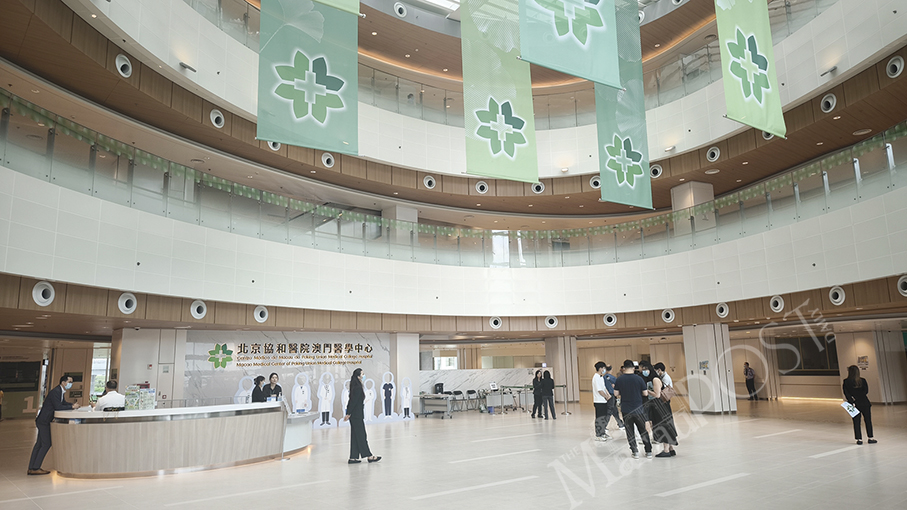
This file photo taken earlier this year shows the main lobby of the Macao Union Hospital in south Cotai. – Photo: Tony Wong